


What Is Payment Reporting?
Payment Reporting refers to the organized recording of financial transactions that occur periodically. When monitored, payment activities provide entities with the right financial figures and insights, thereby helping them make appropriate decisions as and when required.
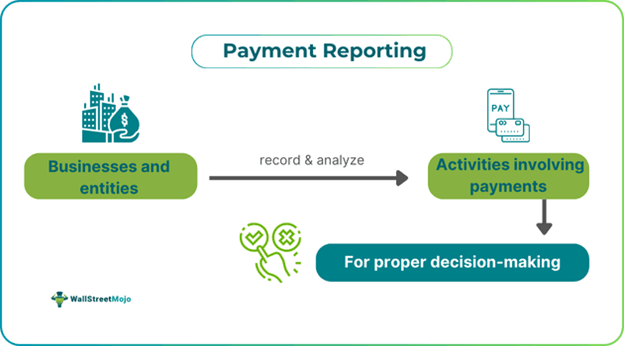
Payment reporting takes various forms, including treasury reporting, financial statement preparation, cash forecasting and reporting, performance and operational reporting, etc. It is quite common for businesses, entities, government agencies, etc., to carry out this activity at regular intervals.
Key Takeaways
- Payment reporting refers to the systematic recording of financial data to track expenses, cash inflows, and cash outflows.
- The reports summarize business financial transactions and include payment of fees, fulfilment of contractual obligations, exchange of goods and services, etc. They serve as a record of all payments made and received. It hence assists in cash flow management..
- The reporting process may involve capturing transaction details and verifying authorization and transfer of funds between banks.
- The process is important as it serves as proof, detects fraud, manages cash flow, and ensures tax compliance. It also aids in financial forecasting and decision-making.
Payment Reporting Explained
The payment reporting process involves the systematic recording of financial transactions, enabling easy analysis through tracking sales, purchases, refunds, fees, and other payment-related activities. The reports generated are summaries of financial transactions made by companies and may also serve as proof for contracts and similar transactions. Moreover, they ensure financial compliance, efficiency, and profitability for a business.
All payments made and received, including sale refunds, are included in it, along with the rent payment received, taxable payment applicable, and supplier payment details. These records are used to track cash inflows and outflows and help maintain proper cash flow management. Details such as names, bank accounts, dates, and the kind of transactions involved are all recorded while reporting payments.
The payments made are checked for authorization and are either approved or declined based on their relevance. The approved or declined status is then sent to the merchant and then passed on to the banks. The next step involves the absolute transfer of funds between the issuing and acquiring banks. The reports are generated based on the details of the transactions.
The process ensures that companies and businesses keep track of exchanges. This helps prepare the company’s financial statements and maintain financial integrity. It makes them transparent and earns them customer trust. The data is further analyzed, which helps make better decisions through performance monitoring. It enables proper resource allocation and credit management, thereby encouraging the planning of business growth.
Requirements
Given below are some of the requirements to consider while reporting payment as per the government:
- Form 1099-K is to be used for reporting payments of goods and services made in a year from credit, stored value (gift cards), or debit cards. It is applicable to purchases made through payment apps and online marketplaces if the total exceeds $20,000 from more than 200 transactions.
- The government mandates reporting of payments that exceed $10,000 in a transaction or a series of transactions. This shall be reported in Form 8300 within 15 days of such transactions.
- Some provisions require international taxpayers to report certain details, such as income paid to a foreign intermediary or an entity that collects payments on behalf of a US person and is subjected to reporting as per Form 1099.
Examples
Let us look at some of the examples to explain the concept better.
Example #1
Suppose Dan, the owner of a clothing store, has just started the business and purchased a book to record all the transactions he made in the name of the business. This would include the rent he pays to the landlord for his shop, the raw materials he purchases, the credit he gives to his customers, etc. All of these entries are payment records, summarizing the transactions in the report and thereby helping Dan track the payments and have an idea of his expenses every month, ensuring wiser decision-making.
Example #2
In October 2024, the Australian Federal Government came up with the Cyber Security Bill 2024, which made reporting ransomware payments mandatory. While reporting these payments, entities must include details of the incidents that occurred, the extortion demanded, and the final ransomware payment made. According to the regulation, if an organization doesn’t prepare this report, they will have to pay heavy penalties.
This shows how payment reporting forms part of cybersecurity. It thereby brings to light the ransomware payment activities, which, in turn, expose ransomware threats and help take necessary measures accordingly.
Importance
Below are some of the points that highlight the importance of reporting payments:
- It helps in understanding the payment sources and gives a comprehensive view of a business’s financial health.
- The reporting of payments helps in recording financial transactions accurately.
- It helps identify and check if the transactions are authentic and helps detect fraud.
- The process helps in cash flow management as it allows the detection of patterns in cash inflows and outflows.
- It helps maintain cash flow through constant monitoring and covers everything, including rent payment, taxable payment, and supplier payment reporting.
- It helps in planning future expenses and sometimes even investments.
- It helps in filing tax returns and ensures compliance with the land’s tax laws.
- Payment reporting saves time, trouble, and legal issues.
- Data helps in financial planning, and forecasting can be done through performance analysis (of different departments and units).
- It could also give insights into customer behavior and help make informed decisions based on the report’s insights.
Frequently Asked Questions (FAQs)
Frequently Asked Questions
How do you get payment reporting done?
There are software products available online that help users obtain detailed reports at their discretion. These reports summarize payments and refunds made or received. The options differ from one product to another.
What is the balance of payment reporting?
Balance-of-payment reporting (BoP) is an electronic message system that banks or other authorized dealers often use to report cross-border transactions. It is, in short, a way of monitoring international monetary transactions for a specific period.
What is payment reporting for creditors?
In the process, the creditors report the details of payments and debt information to credit reporting companies. These agencies then put together the reports they gather so that other creditors can decide to lend funds to the company. These agencies give ratings that help the public decide the business’s payment capacity.