


What Is Planned Giving?
Planned giving, legacy giving, or gift planning refers to a donor’s commitment to charitable contributions to nonprofit organizations in the form of planned gifts during their lifetime or after their death. It is a critical element in financial or estate planning by a philanthropic person.
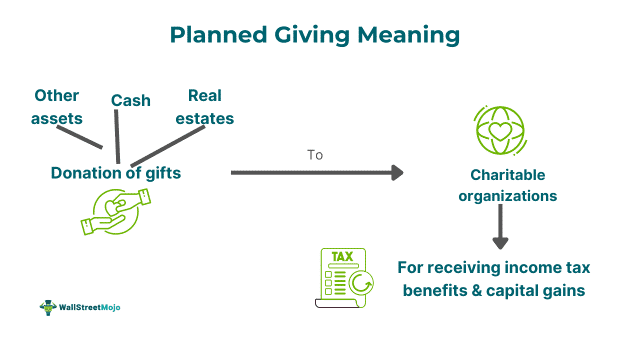
People can contribute to noble causes by leaving a legacy or planned gifts for charity as a gesture of gratitude towards society or communities without compromising their financial needs and obligations during their lifetime. Thus, gift planning serves as a philanthropic step that helps such individuals achieve inner peace and various federal and state tax exemptions and benefits.
Key Takeaways
- Planned giving is a way of pledging legacies such as cash, assets, property, retirement proceeds, life insurance policy, and other valuables to the charity when they are alive or after their demise (through a trust).
- These donations provide tax benefits to the donors through estate, financial, and tax planning, such as estate tax exemption, saving capital gains tax, and deductions in income tax.
- Some of the prominent types of legacy giving include bequest, charitable gift annuity, charitable lead trust, charitable remainder trust, life insurance policy, financial service product, and retirement plan beneficiary designation.
Planned Giving Explained
Planned giving is the donation of planned gifts like cash, real estate, other assets, life insurance policy, retirement assets, etc., to charitable organizations during a donor’s lifetime or after their death. They are critical components of estate, financial, and tax planning. The most common and the easiest way to transfer legacy to a charity is through a living trust or will, i.e., bequest. The charitable organizations have planned giving programs and strategies to successfully secure funding from donors for their long-term existence and operations.
Nonprofit organizations can work for the welfare of society, like for poor, distressed, and underprivileged communities. Some of these charities facilitate the rehabilitation of the victims of mishaps, disasters, or calamities. Others may work to preserve the environment, animals, nature, and ecology. The planned gifts can be a great help to these organizations in achieving their goals and ensuring their financial flexibility and strength.
Moreover, it allows donors to have a tax break while waiving off estate taxes, capital gains taxes, and income taxes in some instances.
Types
The individuals can choose to transfer their legacy to the not-for-profit organization through the following different kinds of planned giving programs:
- Charitable Gift Annuities: Donors choose to transfer property or cash to a charitable organization to receive a partial tax deduction and generate a regular annual income over their lifetime.
- Bequest Contributions: This is a charity gifting process in which individuals mention the names of the respective qualified charitable organizations in their living trust or will. While the donor can hold and use the committed asset throughout their lifetime, they can claim a total deduction of such a charity from their estate tax liability.
- Life Insurance Policies: A donor can even gift their life insurance policy to a nonprofit community. However, the individual has to pay annual or periodic premiums for the life cover; they can enjoy the tax benefits throughout their lifetime.
- Financial Service Products: One can even transfer their stocks, certificates of deposits, or other investments to their preferred charity.
- Retirement Plan Beneficiary Designation: The donors can name the charities as partial or full beneficiaries in their 401(k) retirement plan, individual retirement account (IRA), or other retirement assets. Thus, the designated charity will not be subject to income or estate tax.
- Charitable Lead Trusts: In this arrangement, the donor and their financial or legal advisor pick the assets for financing a charitable lead trust, which will pay a fixed annual amount to the respective charity up to a specific tenure. However, after the completion of the charity’s payout term, whatever is left with the trust goes to the designated beneficiaries.
- Charitable Remainder Trusts: The donor transfers the assets to a qualified trust that provides income to the beneficiaries up to a certain period. After this, the remaining trust assets are given to qualified charitable organizations. Hence, it helps the donor claim deductions for charitable income tax and waive capital gains tax.
Strategies
Nonprofit organizations should have a proper planned giving program in place that includes a well-structured process and strategies to raise funds and receive planned gifts from the donors for its uninterrupted functioning and sustainability in the long run. An effective legacy giving involves the following strategies:
- Charitable organizations should outline their policies on legacy giving precisely and clearly to establish a clear path for themselves and their donors.
- NPOs need to educate donors properly about the benefits of donations, such as estate, income, or capital gains tax exemptions and relief, and the difference that their contribution can make to the lives of others.
- These organizations and donors should collaborate with legal and financial experts to ensure efficient estate and financial and tax planning before and after the transfer of legacy.
- The NPOs need to frequently review, monitor, and update their planned giving strategies to ensure that they remain efficient and relevant to the changing scenario.
Examples
As people are becoming more aware of nature, the environment, communities, animals, etc., they have developed an inner responsibility to contribute towards the betterment of society. Let us understand the significance of such legacy giving through the following examples:
Example #1
Suppose Mrs. Edison is a Managing Director of XYZ Pvt. Ltd. Also, she is compassionate and benevolent towards the animals, which is why she has long been associated with ABC Animal Welfare Group, where she contributes 5% of her annual earnings every year. She is a widow and has two children who are well-settled in different states.
Also, she owns a lavish house in Manchester, where she is living now. Mrs. Edison be requested her house to ABC Animal Welfare Group through a living trust. She continues to live in her house while claiming estate tax deduction to the full extent over it. However, she died at the age of 78, after which the possession of her house worth $1.2 million was transferred to ABC Animal Welfare Group.
Example #2
On July 15, 2022, Bill Gates committed a $20 billion contribution to the Bill & Melinda Gates Foundation, with the goal of giving away nearly all of his $113 billion wealth. Notably, since 1994, Gates and his ex-wife have together contributed more than $50 billion to this foundation.
Apparently, the Bill & Melinda Gates Foundation plans to raise its annual spending from $6 billion to $9 billion by 2026. Meanwhile, Gates’ assets comprise a 1% stake in Microsoft worth $19 billion, a lakeside home worth $80 million, and an art collection valuing $130 million. One of the critical contributions of this foundation includes $4 billion to the Vaccine Alliance, Gavi, which has vaccinated 1.2 billion people for coronavirus and saved 15 million lives.
Best Practices
Various tactics can help the nonprofit firms to secure funding successfully from the prospects, as discussed below:
- Organizations can find potential prospects in their existing contacts, including current donors, committee members, staff, and others, since these people are most likely to convert into donors.
- Be polite and highlight the potential benefits of the planned gift commitments for the donors and the community that will be helped with these funds.
- Run effective branding through planned giving brochures and other advertisements to ensure that the audience gets the right message.
- The donors can be informed of the blended gifts, which have income and tax benefits, to help them make decisions.
- The NPOs should equally value their large and small donors to establish long-term relations with them.
Benefits
The legacy is not only a strategic move to save taxes but also fulfills the magnanimous objectives in life. Given below are its prominent advantages:
- Long-Term Financial Support: Donations made through legacy giving can be a significant financial help to not-for-profit organizations (NPOs), which can invest that money in the intended cause in the long run, like building a school or expanding shelters for orphans and older adults.
- Donors Establish Legacy: Such planned giving for nonprofits facilitates donors’ representation of their values over time so that their descendants learn from them.
- Estate Tax Exemption: Individuals can plan to donate their legacy to qualified charitable organizations to be exempt from estate tax liability.
- Saves Capital Gains Tax: The transfer of real estate under gift planning can help the donors avoid any capital gains tax liable on such a property.
- Sets an Example of Philanthropic Gesture: When few people come forward to financially aid organizations working for a certain social cause, they can encourage and motivate others to be generous and charitable.
- Brings Inner Satisfaction and Peace: The act of giving to the desired cause or a preferred NPO brings joy and peace of mind since it helps the donor show gratitude and thankfulness towards society.
- Revocable Decisions: The donors have the freedom to withdraw from the charitable gifting decision at any time. They can also revise the beneficiaries’ names on such a will.
- Right to Use Property Until Death: The donors need to pledge the transfer of legacy on paper so that they can freely use their property or assets over their lifetime. Thus, they can fulfill their financial commitments and responsibilities while realizing their humanitarian goals.
Frequently Asked Questions (FAQs)
What does a planned giving officer do?
The planned giving officers are responsible for fundraising, approaching the prospects, and collecting monetary donations, gifts, and assets from the donors on behalf of a charitable organization.
What makes a good planned giving prospect?
Given below are some of the most promising prospects of planned giving for nonprofits:
- The NPO’s present or former board members, committee members, or volunteers;
- Frequent, regular, long-term donors or contributors, whether associated with the charitable organization at present or in the past;
- Other current or previous members, alums, patrons, clients, staff, family members, or patients; and
- People who have a record of past charity capable of planned gifting, individuals planning retirement, people in their 50s, and individuals or couples who aren’t blessed with children.
When is the planned giving month?
August is observed as a make-a-will month for planned giving across the United States.
What is the difference between planned giving and major gifts?
Legacy giving requires the charitable organization to wait a long time to receive possession of the assets or legacy provided by the charity. On the contrary, major gifts are the most significant donations received by NPOs from a single donor during a particular fiscal year.