


What Is Reference Point?
A reference point refers to a standard or benchmark used by investors to analyze and compare the performance, i.e., the risk and return profile of other similar stocks or assets. It can be government bonds, market indices, or other financial assets that serve as a base for investment and financial decision-making.
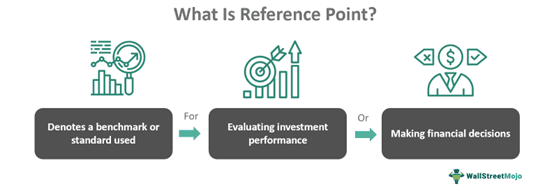
Further, it helps in setting clear investment goals, measuring the performance of investment portfolios, and devising effective investment strategies. Any security providing higher returns than that of its reference point is ideal for investment. At the same time, if it provides a comparatively lower return, then it is deemed to be unattractive for investing.
Key Takeaways
- A reference point is a fundamental concept in finance and investing, representing a benchmark or standard used by investors to assess and compare the performance and risk profile of various investments.
- These standards are often considered by investors, financial advisors, and analysts for goal setting, decision-making, portfolio diversification, and long-term strategy formulation.
- Some of the standard reference points in investment are the S&P 500 benchmark index, Russell 2000, Russell 1000, and the Dow Jones Industrial index.
- However, while emphasizing such benchmarks, the investors may overlook the fundamental aspects such as financial reports, potential projects, and growth opportunities.
Reference Point Explained
Reference points as investment benchmarks can take various forms, such as market indices like the S&P 500, government bonds, or similar financial instruments. Investors rely on such asset price movements to evaluate the returns on their investments, enabling them to make well-informed decisions based on the relative performance compared to these established standards. As it provides room for comparing different assets’ performance and potential loss or gain, it helps in planning the diversification strategies while spreading risk across different securities and sectors.
By comparing the performance of an investment to a relevant benchmark, investors can gauge the level of risk they are taking. Similarly, if an investment outperforms the target, it indicates good performance. Conversely, if it underperforms, it raises questions about the investment strategy. Thus, this concept is inevitable in behavioral finance, exploring how psychological factors influence financial behaviors and market dynamics.
People often compare their present financial status or investment returns to this target, shaping their risk tolerance, investment choices, and responses to financial gains or losses. Furthermore, these benchmarks help in goal setting. Investors often set their targets based on the performance of specific indices or benchmarks.
However, centering decisions around it may divert investors from considering an asset’s fundamental aspects, such as evaluating a company’s financial stability, management effectiveness, and growth potential. Hence, such considerations or herd behavior by mass investors may lead to market bubbles or crashes. Different individuals possess distinct reference points based on their experiences, resulting in varying outcomes under similar market circumstances. Also, these standards do not necessarily offer insights into future market movements.
Factors
Understanding the reference points is essential for investors and analysts, allowing them to navigate financial markets with informed decisions and strategies. Various dynamic factors influence these crucial benchmarks in finance:
- Market Conditions: Reference points fluctuate with the economic cycles and conditions. During inflation, the benchmarks elevate, mirroring investor optimism, while depression and recession lead to lower performance standards due to higher uncertainty.
- Investor Sentiment: When the majority of investors show confidence in the market, the stock prices tend to rise, setting higher benchmarks. Conversely, negative sentiment reduces reference points due to heightened risk aversion.
- Macroeconomic Conditions: When the key economic metrics such as GDP growth, inflation rates, interest rates, and employment figures are positive, the reference points are high, signaling a robust economy, and vice-versa.
- Psychological Factors: Behavioral biases like fear and greed impact it. Emotional reactions lead to market overreactions or under valuations, directly shaping these benchmarks.
- News and Events: Significant events and announcements rapidly alter reference points. Positive news raises them, while adverse events lead to downward shifts as investors reassess their perceptions and expectations.
- Global Events: Extraordinary events such as pandemics create market uncertainties, significantly impacting it as investors assess and revise risk acceptance based on global economic landscapes.
- Historical Performance: Investors analyze historical data, influencing current benchmarks based on prior market behaviors.
Examples
Here are a few hypothetical and real-world examples to help ONE understand the concept better.
Example #1
Suppose an investor named Emily is considering investing in Company XYZ’s stock. She typically uses the S&P 500 index as her reference point to gauge the performance of her investments. If Company XYZ’s stock consistently outperforms the S&P 500 index over a certain period, Emily may view it as a favorable investment opportunity. On the other hand, if Company XYZ’s stock consistently underperforms the S&P 500 index, Emily may question the investment’s potential and opt for other opportunities.
In this example, the S&P 500 index serves as Emily’s reference point, guiding her investment decisions by providing a benchmark for comparison. It helps her assess the relative performance and risk associated with investing in Company XYZ’s stock, ultimately influencing her investment strategy.
Example #2
Imagine a bond investor named Alex who primarily invests in government bonds. His reference point for assessing bond investments is the yield on 10-year U.S. Treasury bonds. Whenever Alex considers investing in corporate bonds or municipal bonds, he compares their yields to the yield on 10-year Treasury bonds.
If the yield on corporate or municipal bonds is higher than that of 10-year Treasury bonds, Alex may perceive them as attractive investment opportunities, potentially offering higher returns. Conversely, if the yield on these bonds is lower than that of Treasury bonds, Alex may view them as less favorable investments due to their comparatively lower returns.
In this example, the yield on 10-year Treasury bonds acts as Alex’s reference point, guiding his investment decisions in the bond market by providing a benchmark for evaluating the attractiveness of different bond offerings.
Frequently Asked Questions (FAQs)
Frequently Asked Questions
Which is an ideal reference point?
The ideal reference point in finance varies depending on individual investment goals and preferences. Typical points include market indices such as the S&P 500 or benchmarks specific to an investor’s asset class. Ultimately, it should accurately reflect the performance and risk profile of the investments being considered, aiding investors in making informed decisions and achieving their financial objectives.
Why is a reference point important?
It is crucial in finance as it provides a standard for evaluating investment performance and assessing risk. It offers investors a benchmark against which they can measure the success of their investment strategies and portfolio allocations. By comparing investment returns to a reference point, investors gain insight into their relative performance within the broader market, enabling them to make informed decisions, set realistic goals, and manage their portfolios effectively.
Can reference points vary for different investors?
Yes, it can vary based on individual investor preferences, investment objectives, and risk tolerance. While some investors may prioritize market indices, others may focus on industry-specific benchmarks or customized performance metrics tailored to their investment strategies.