


What Is A Stochastic Differential Equation (SDE)?
A stochastic differential equation(SDE) is an equation that uses random numbers as coefficients associated with independent or multiple independent variables. Typically, a differential equation links one or more unknown functions to its derivatives. However, a stochastic process is used for sequencing random variables.
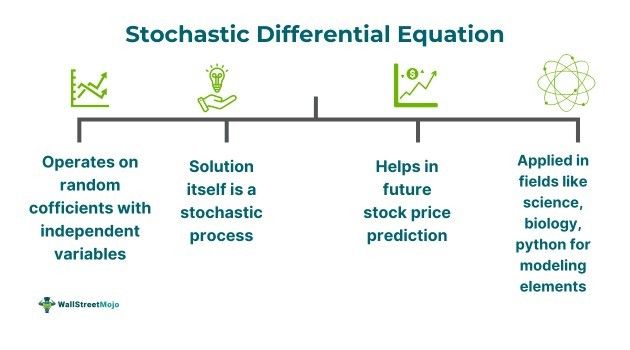
The concept revolves around the given coefficients, and the solution must be determined. The equations are mostly related to continuous processes and dynamic systems. The solution of an SDE is the introduction of a stochastic process. It differs from random and ordinary differential equations regarding applications, elements and random variables.
Key Takeaways
- A stochastic differential equation has random functions associating multiple derivatives to its independent variables.
- Though first sighted in the work of Einstein, Louis Bachelier, Kiyoso Ito and Stratonovich are given key credits for their work in developing the equation.
- The equation is used in biology and science and as a tool in finance to study and analyze stock price modeling.
- The stochastic process helps deal with uncertainties while entering data and using the already present inherent randomness.
Stochastic Differential Equation Explained.
A stochastic differential equation (SDE) refers to a differential equation that is rich in a stochastic process with random functions and random coefficients of one or more independent variables. These equations were first developed in the Brownian motion theory in the work and study of Albert Einstein and Smoulchowski.
However, Louis Bachelier, a French mathematician, is regarded as the first person to model the Brownian motion in 1900. He expressed the early examples of SDEs that led to the Bachelier model’s development. Later, in the 1940s, the Japanese mathematician Kiyosi Ito came forward with the concept of stochastic integral and nonlinear SDEs. Early there were only linear stochastic differential equations. Stratonovich, a Russian physicist, also contributed to proposing an approach that led to calculus.
For investment and asset studies, the stochastic differential equation in finance helps predict future stock prices by assuming a stochastic process helping traders and investors to make the right decision. The SDEs are related to systems that evolve continuously in time. If they are autonomous, the future values depend only on the present state. In contrast, they can be exogenous in the case of non-autonomous systems. Nonlinear differential equations are more difficult and sometimes impossible to solve than linear ones. However, a long approach is first to minimize the difficulty by linearizing the differential equation.
Examples
Below are two real-world examples explaining the applications of stochastic differential equations in different fields –
Example #1
In the Journal of Computational Finance, a paper was submitted expanding on using SDEs to study pricing barrier options. The method applied forward and backward stochastic differential equations and deep learning pathwise to monitor boundary conditions and barrier branches. The approach also applies to handling nonuniform problems with time variation and multiple boundaries.
Barrier instruments transform into another instrument once satisfied; the paper presented a more direct approach to solving final value problems. The hedging profit and loss achieved with this method is more robust, definitive and optimized than traditional time hedging approaches.
Example #2
Another submitted paper uses stochastic differential equations to model health-related quality of life. The theory defines compression of morbidity in terms of the illness-death model. The HRQoL varies between 0 to 1, defining death and perfect health. A missing HRDoL introduces a paradoxical situation.
However, the illness-death model is not considered capable enough. Hence, the HRDoL is considered because, with IDM, only one health disease can be catered to, only expressing its presence or absence. The paradox is seen as medical progress as diseases with chronic treatments can be dealt with with fewer adverse effects.
Applications
The applications of stochastic differential equations are –
- The equation is used as a modeling tool in quantum field theory.
- A stochastic differential equation is used in probability theory for constructing random variable sequences and signal processing.
- It is used in finance to develop investing models based on taking stock prices into account.
- Applied as tools to determine systems with external noise.
- The equation is known for its application in economics, biology, telecommunication and finance mathematics.
Stochastic vs Random Differential Equations
Here are the differences between the two:
- A new integral is defined for stochastic differential equations, but classical calculus can be used for theorem determination for random differential equations.
- There is no difference between SDE solutions and the Ito theory, but the results of RDEs differ from the Ito theory.
- Both SDEs and RDEs are based on separate theories independent of each other. The random differential equation can be defined as ODEs pathwise with its uniqueness and existence.
Stochastic vs Ordinary Differential Equations
Here are the differences between the two:
- Stochastic differential equations are deterministic, whereas ordinary differential equations are used to term dynamics in continuous time and path.
- SDEs have a random element, but ODEs do not have a random element.
- Both have different calculus; stochastic calculus offers a derivative of a random component in Brownian motion, which is impossible in ordinary calculus.
Frequently Asked Questions (FAQs)
Frequently Asked Questions
What is a stochastic differential equation in financial modeling?
The stochastic differential equation belongs to the Brownian model that is also used to predict future stock prices. It is devised as a mathematical model in which it is assumed that the return yielded by a stock follows a stochastic process; hence, it can be termed a function, and stock prices can be modeled taking account of volatility and expected return.
What are the benefits of stochastic differential equations?
The benefits of stochastic differential equations are – – The equation is data-driven, so the predictions stay close to the data. – If the parameters used in SDE are incorrect, there is a high probability of getting the right results. – Helps in eliminating the issue of local minima in the objective function.
What are the four types of stochastic processes?
There are mainly four types of stochastic processes – – Non-stationary – random variables with dynamical statistical properties – Stationary – constant statistical properties with time associated with random variables. – Discrete-time – In this type, the random variables construct a sequence in which individual variables comprise a limited set of values. – Continuous time – the sequence of random variables that get values that remain in a continuous range.