


Part of our Types of Taxes guide
Pigouvian Tax Definition
A Pigouvian tax is a tax imposed by the government on economic activities, creating an adverse effect on society. Private individuals or businesses may perform such activities. This tax aims to induce the producers of negative externalities to decrease production to a level ideal for society.
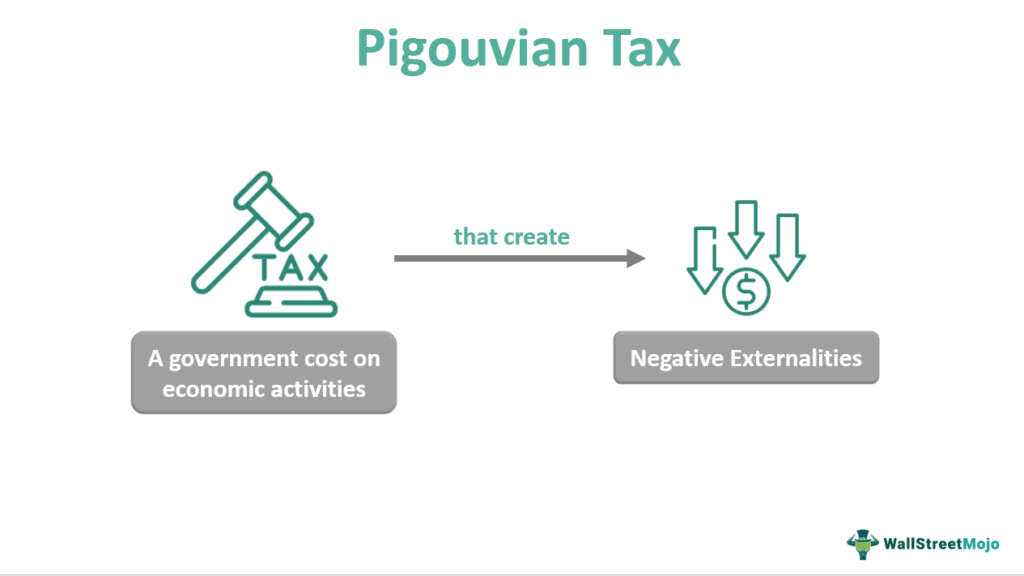
A product’s final cost does not include the cost arising from socially harmful effects, leading to market inefficiency. According to economist Arthur C. Pigou, correcting the adverse impact is possible by imposing taxes equivalent to externalized costs. The taxes would equal the adverse side effects, reducing external costs.
Key Takeaways
- Pigouvian tax is a tax levied on market transactions that generate negative externalities. Its primary aim is to resist economic inefficiencies by redistributing the cost to the entity producing the externality.
- Tax levied on plastic bags, noise taxes, and carbon taxes are a few examples of Pigouvian tax.
- It has a few disadvantages, but the Pigouvian tax’s advantages outweigh them. For example, it generates revenue for the government and fosters economic efficiency.
- The tax is named after economist Arthur C. Pigou, who developed the concept of correcting negative externalities through taxation.
Pigouvian Tax Explained
Pigouvian tax meaning refers to a tax placed by the government on goods generating socially harmful externalities. Externalities are activities that create an adverse effect in society but do not impact the individual or organization carrying out the activity. Environmental pollution and the sale of tobacco are two examples of negative externalities.
Under free market conditions, the market reaches equilibrium where private marginal cost or PMC equals private marginal benefit or PMB. Also, social marginal cost (SMC) exceeds private marginal cost because producers do not bear the full external costs of their activities. Consequently, free-market equilibrium yields an output level exceeding the socially efficient quantity.
Ideally, a government levies the Pigouvian tax at an amount equal to the costs related to the negative externality. The tax increases the producer’s cost of production, shifting the supply curve upward and reducing the quantity supplied. As a result, market output falls toward the socially efficient level, while the price paid by consumers generally rises and the net price received by producers falls. The market reaches the socially efficient outcome when social marginal cost equals social marginal benefit or SMB.
How To Calculate?
One can find it extremely challenging to calculate Pigouvian tax accurately. This is because the computation will not work the same in different situations. Theoretically, the tax amount must equal the net cost of the negative externality it tries to correct. As a result, the tax amount must equal the difference between the MPC or marginal private cost and the social cost at a certain production level.
Example
Suppose company GoodCrops, a pesticide manufacturer, poisoned the groundwater for seven years since its inception. In addition, the company emitted 150,000 gallons of waste during that timeframe. Because of this, the town nearest the organization’s manufacturing unit spent roughly $1.5 million cleaning up the groundwater.
The town levied a fine worth $1.5 million for the company’s past actions. Moreover, the town announced that it would impose a $20 Pigouvian tax per gallon of waste to cover the cost of the negative externality in the future.
Graph
Let us look at this Pigouvian tax graph to know how the concept works.
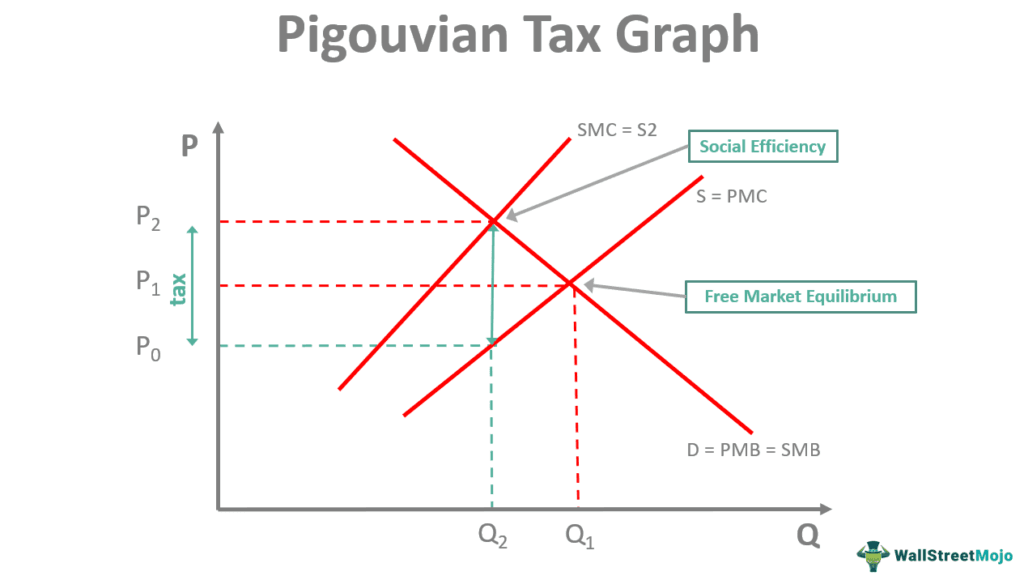
One can go through these points to understand the graph.
- Under free-market conditions, equilibrium occurs at Q1, where PMC equals PMB. However, this output exceeds the socially efficient level because producers do not bear the full external cost of production.
- At Q1, output exceeds the socially efficient level because producers do not account for the external costs of production. As a result, SMC is higher than SMB.
- A Pigouvian tax equal to the marginal external cost shifts the effective supply curve from PMC to SMC, reducing output from Q1 to Q2. At Q2, SMC equals SMB, achieving the socially efficient production level. The burden of the tax is shared between producers and consumers depending on the relative elasticities of supply and demand.
Advantages & Disadvantages
Let us look at the benefits and limitations of this tax.
#1 – Advantages
- Discourages Socially Harmful Activities: The imposition of this tax by the government effectively discourages economic activities leading to adverse side effects for society. For instance, introducing carbon taxes can put an organization producing high amounts of emission gases under tremendous pressure. As a result, the organization operates differently to produce lower amounts of emission gasses.
- A Source Of Revenue For The Government: Pigouvian tax is an additional source of revenue for a government. It can use the extra funds to challenge the externalities further.
- Encourages Market Efficiency: Another key advantage of the Pigouvian tax is that it fosters economic efficiency by including the extra costs imposed by the negative externalities.
#2 – Disadvantages
- Political Resistance to Implementation: Implementing a Pigouvian tax can face political resistance because affected industries, consumers, or political groups may oppose higher taxes. While this does not reduce the economic effectiveness of the tax, it can make implementation more challenging.
- Difficult To Measure: Ideally, the tax should equal the marginal external cost created by the negative externality. However, accurately estimating these costs is often difficult because environmental and social damages may vary across time, locations, and affected populations. This makes it challenging to determine the optimal tax rate.
- Another limitation is that Pigouvian taxes may have regressive effects if lower-income households spend a larger share of their income on the taxed goods or services. That said, governments can reduce this impact through targeted rebates, tax credits, or public spending financed by the tax revenue.
.
Sin Tax vs Pigouvian Tax
There are some similarities between the sin tax and the Pigouvian tax, which often leads to confusion among individuals new to finance. However, knowing their critical differences is key to understanding the two concepts. So, this table highlights the distinct characteristics.
| Sin Tax | Pigouvian Tax |
| Governments levy this tax primarily to discourage the consumption of goods considered harmful to individuals or society, such as tobacco or alcohol. | Governments levy this tax to correct negative externalities by making producers or consumers bear the social cost of their activities. |
| Primarily aims to reduce the consumption of goods considered harmful or socially undesirable. | Primarily aims to make market participants internalize the external costs of their activities and achieve a socially efficient outcome. |
Frequently Asked Questions (FAQs)
Frequently Asked Questions
Does Pigouvian tax cause deadweight loss?
A properly calibrated Pigouvian tax does not create additional deadweight loss. Instead, it reduces or eliminates the deadweight loss caused by a negative externality by aligning private costs with social costs.
What is the intent of a Pigouvian tax?
The purpose of levying such a tax is to tax the entity producing a service or a product that generates negative externalities or harmful side effects, such as environmental pollution, traffic congestion, etc., on society. According to economists, society and not the producer bears these externalities’ costs.
How do Pigouvian taxes internalize externalities?
It is possible to internalize negative externalities by levying a tax on purchasing every unit of the product the producer offers. Also, individuals must note that that tax rate must be set equal to the MEC or Marginal External Cost at the socially optimum level.
What is a Pigouvian tax on cigarettes supposed to accomplish?
The tax amount levied by the government on cigarettes will be equal to the cost borne by society to treat lung cancer.
Recommended Articles
This has been a guide to Pigouvian Tax and its definition. We explain its example, graph, calculation, advantages & disadvantages, & comparison with sin tax. You can learn more about financing from the following articles –