


Part of our International Trade guide
What Is Export-Oriented Growth?
Export-oriented growth refers to an economic paradigm whereby a nation is reliant upon international trade for its economic development. Thus, the export of goods and services serves as a significant factor behind job creation, rising real gross domestic product, and surging per capita income in the country.
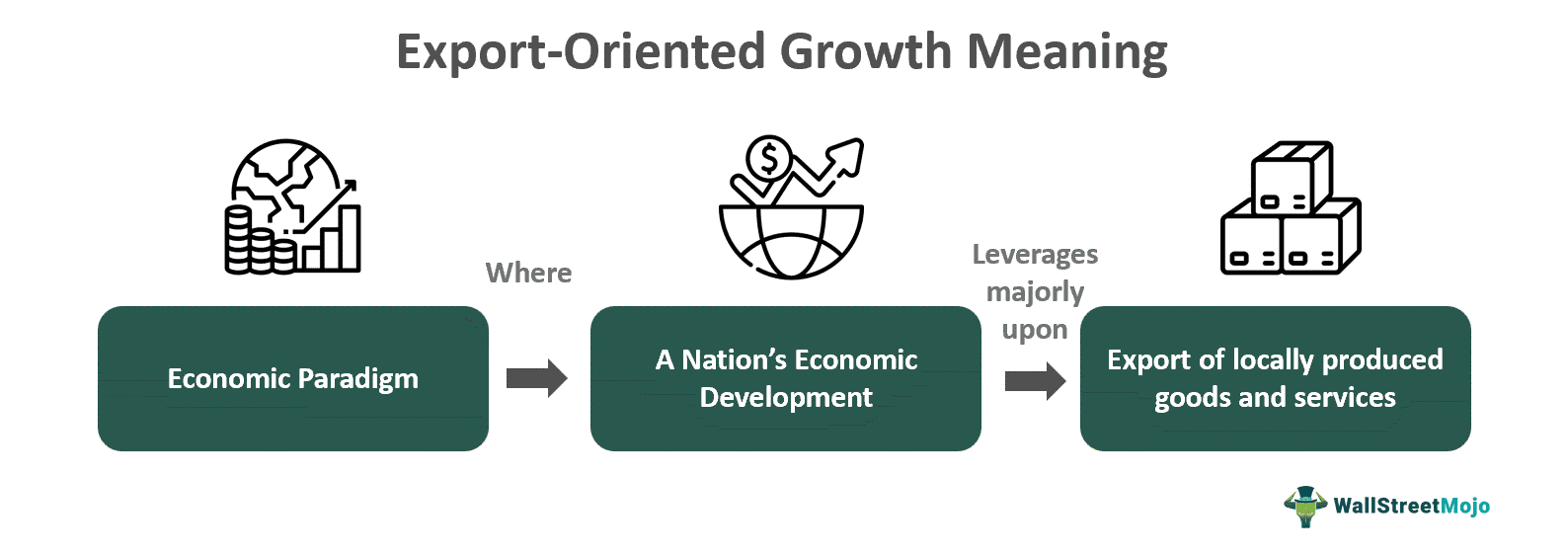
The nations, especially the developing countries, adopt an export-led growth strategy to increase local output by increasing their export activities. Thus, it brings in business for the local industries, helping them expand their operations in the international market. Moreover, it has an accelerator effect on the economy, which parallels growth through higher capital investment spending and employment prospects.
Key Takeaways
- Export-oriented growth refers to an economic development model whereby a country opens up to international trade interaction by strengthening
- the export of goods and services to boost the economy by increasing the nation’s GDP, capital investment spending, per capita income, and job prospects.
- This strategy leads to rapid growth of the country, industries, society, and overall economy.
- The export country’s economic development relies upon the economic cycles of the importing nations, increasing the potential risk.
- It contradicts the import substitution strategy, which focuses on limiting imports and promoting local consumption.
Export-Oriented Growth Explained
Export-oriented growth is an economic strategy implemented by nations to leverage their economic development, mainly in the supply of domestically manufactured goods and services to foreign markets. Developing economies often resort to such a strategy for the rapid growth of the country, industries, society, and overall economy. It is one of the best ways to increase the demand for local goods and services by creating a broad international market for these commodities. The industries that focus on export trade can learn new technologies and innovative methods from such global interaction. Notably, the government eases trade policies like tariffs and export duties to encourage the supply of goods and services in the international market.
This economic paradigm found its origin in the four Asian countries, also known as the Asian Tigers, from 1970 to 1985. These nations included Hong Kong, Singapore, South Korea, and Taiwan. The initial adoption of this strategy was to boost the economies, especially in the manufacturing and automobile sectors, since, at that time, the export of such goods was highly competitive in the international market due to undervalued exchange rates. Thus, there was a greater need for global technological integration. Later on, many other developing and developed economies adopted this method of economic development, including Germany, China, Vietnam, and Japan.
Examples
Let us now have a close look at some of the export-led growth examples:
Example #1
Suppose a developing nation ‘A’ opened up the doors for foreign automobile companies in country ‘B’ to invest in setting up manufacturing units within the country ‘A.’ It even reduced the various trade barriers on the export of auto parts within the nation. Thus, within the next five years, nation A’s GDP surged by 1.5% per annum. Moreover, the automobile sector provided business to the various auxiliary trade businesses like logistics and insurance companies in country A, thus tremendously increasing job opportunities, per capita income, and capital investment in the nation. As nation A became a major international automobile exporter, it also became vulnerable to the economic and political conditions in the nations that are its trade partners, including C, D, and E countries.
Example #2 – Japan’s Export-Oriented Growth Scenario
According to an article published on August 14, 2023, Japan’s economy witnessed an annual growth of 6% in the second quarter (April-June quarter) of 2023, which was surprisingly more than the predicted 3.1% growth. Thus, the quarterly growth was 1.5% instead of the expected 0.8%. The primary reason for the rise in Japan’s GDP was its export-led growth. The nation marked a strong performance, while a significant 1.8% increase was due to the increase in net trade in the country. Moreover, the nation’s exports rose by 3.2%, and the imports fell by 4.3%.
Advantages And Disadvantages
Many economies around the world have shown remarkable growth by adopting an export-led growth strategy. It has the following pros and cons for industries, nations, and economies:
| Advantages | Disadvantages |
|---|---|
| The export-led growth opens up the international trade gateways for local businesses, leading to their expansion. | The export-oriented growth strategy requires an environment of free trade and exchange of goods or services between countries, which may be compromised due to the economic globalization of developed nations. |
| Moreover, it facilitates the creation of demand for local goods and services, ensuring a circular flow of income, i.e., a higher aggregate demand necessitates investing in output expansion. | If the inflation increases, the export industries may lose their competitiveness in the foreign market and domestic market since the imported goods or services would become cheaper than the locally produced ones. |
| It results in a higher GDP and per capita income while decreasing the level of poverty in the country. | It makes a nation’s growth reliant upon the economic cycles of the other countries that import goods or services from the former. Thus, the export nation is exposed to political or economic distress in the importing country. |
| It causes an acceleration effect on the economy by ensuring an alleviated capital investment spending and employment opportunities to maximize the production capacity of the nation. | In the short run, such a strategy can adversely affect the domestic standard of living since the export industries are often busy with the international supply of goods or services, overlooking the needs and demands of the local consumers. |
| Such a strategy also fosters the growth of businesses serving as auxiliaries to trade, such as logistics, insurance, port services, etc. | It is a threat to environmental sustainability (if the export industries fail to consider ESG growth) since the export businesses exploit natural resources and engage in land degradation and deforestation beyond the permissible limit. |
| It further helps the nations to maintain a trade surplus and strengthen their global position. | It increases the risk of potential trade imbalance on the global front since other nations may question the high trade surplus in the export nation. |
| Such a strategy may backfire by alleviating the potential risk of surging interest rates and demand-pull inflation in the export nation. |
Export-Led Growth vs Import Substitution
The export-oriented growth and import substitution are two opposite economic paradigms considered by nations to foster the development of their economies in different ways. The notable differences between the two include:
Frequently Asked Questions (FAQs)
Which country has had success with export-oriented growth policy?
The export-oriented growth has marked the development of many economies after World War II, such as Singapore, Hong Kong, Taiwan, South Korea, Germany, Japan, Vietnam, Mexico, China, Ethiopia, etc. All these nations have adopted export-oriented policies to alleviate their foreign exchange and trade-to-GDP ratios.
Is export-oriented growth good?
The export-oriented growth strategy is often an economic booster for the nations as it helps the local industries to scale up their production and gain cost efficiency while promoting job opportunities and improving the living standards of the people.
Moreover, it improves the economy by increasing the GDP and per capita income. However, in the long run, such steps can make a nation highly dependent upon the export sector, which is often prone to the miserabilities of the importing nation’s economic and political issues.
Is Germany an export-oriented growth economy?
The recent trade data of Germany released in March 2024 shows that the nation is again heading towards an export-led growth scenario. At the same time, the March export marks a 0.9% rise month on month, while the February MoM was -2%.
Recommended Articles
For more on International Trade, explore these related articles from our International Trade guide.