


What Is Money Factor?
The money factor is the lease amount an individual pays as financial charges for leasing any asset, primarily a car. It is similar to a mortgage loan and is derived for monthly payments. The individual’s credit score is critical in determining it.
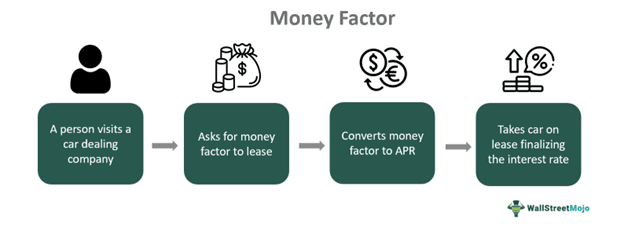
When a lender derives the money factor in lease, several factors are considered: lease term, lease charge, residual value, and capitalized cost. It is denoted in decimal point value and can sometimes be a confusing component for an average customer. It is also referred to as a lease fee or lease money factor.
Key Takeaways
- The money factor is a lease amount an individual pays monthly for leasing an asset, similar to interest with a loan.
- It is typically associated with vehicles or when leasing a car. The dealer calculates it and applies it to the lease to determine the interest rate.
- If it is lower in the lease, the better the interest rate is realized by an individual in a lease term.
- When leasing a car, the price tag and actual value are accounted for in the leasing process. A person should always inquire about it.
How Does Money Factor Work?
The money factor is a lease term value that indicates the lease fee. When an individual decides to lease a car, they only pay for the amount that the vehicle depreciates during the lease term, not the retail purchase price. Just like a loan, the lessee will make monthly payments to the car dealer. These monthly payments include interest, taxes, and depreciation.
The money factor in lease is the interest charged for leasing the vehicle. When it comes to leasing a car, there are many traps that an average person can fall into. For example, most leasing vehicles come with a potentially expensive mileage restriction. This means there is a cap that a lessee can put in miles on a vehicle annually. According to the Federal Highway Administration, US drivers average around 13000 miles annually. Alongside this, people are unaware of many associated costs and hidden charges, like low residual value and early termination costs.
People often debate whether to lease a car or buy a new one, as each option has pros and cons. One of the key benefits of vehicle leasing is low capital requirements and repair costs, no reselling issues, and a variety of cars to choose from. Additionally, if needed, the lessee can buy the car at the end of the lease term after paying all the monthly installments decided on the money factor auto lease.
How To Calculate?
Money factor formula = Lease charge / (Capitalized cost + Residual value) x Lease term
Where:
- Lease charge is the sum of monthly fees.
- Capitalized cost is also known as lease price, which is the price of the leased car.
- Residual value is the value of the car post-lease.
- Lease term is the time of the lease, usually denoted in months.
- It is converted into APR by multiplying it by 2400.
Examples
Let us explore these examples to understand the concept better:
Example #1
Suppose Raven starts her new job recently and plans to buy a car. She doesn’t have enough money to buy the car with a cash payment, so she decides to lease one. The car dealer prepares the document and presents it to Raven.
The lease is for four years, and both Raven and the car dealer agree on the lease price of $45,000. After the lease is over, the car will still possess a value of $9,000, and the sum of monthly payments is $7,200.
Raven applies the following formula.
Money factor – 7200 / [(45000 + 9000) x 48] = 0.0027777
For conversion of the money factor to APR, she multiplies the value by 2400 = 6.6666%
Example #2
As per data in 2019, 4.3 million cars were leased by the end of 2019, and the cost of financing is expressed differently than traditional loans. The car dealers have used the money factor indicator to adjust and regulate the annual percentage rate (APR). Some firms mention it clearly in the lease documents, but the lessee can also deduce it. The 2019 year data suggests that the average monthly lease payment was around $487 compared to $548 for a new car and $411 for a used car. Moreover, only 35% of new cars were under $30000, which was 54% in 2012.
People will likely convert the money factor to interest rate to understand its impact. The report stresses that consumers have shifted their choices to more expensive SUVs and pickup trucks from smaller, cheaper vehicles. At the same time, the lease term has been stretched to 70 months, previously 67 months.
Money Factor Vs. APR
The differences between the two concepts are listed below:
| Money Factor | APR |
|---|---|
| It is used for lease. | The annual percentage rate is used for loans. |
| It is represented in decimal point value. | It is expressed as a percentage. |
| It is the financial rate on a lease. | It is the total interest paid on a loan during the term. |
| It is not included in the lease cost, so individuals need to ask to find out. | APR is clearly stated in loan agreements. |
Frequently Asked Questions (FAQs)
Frequently Asked Questions
What is a good money factor?
Its value is directly proportional to the lease interest rate. Generally, lower money factor values indicate lower interest rates. A value around 0.0025 is often considered favorable, equivalent to a 6% APR.
Is the money factor negotiable?
Yes, individuals can negotiate for a good rate with the car dealer. It also significantly depends on a person’s credit score. If the credit score is high, the individual has a better chance to reduce its value and vice versa.
Does the money factor change based on the kind of car being leased?
Depending on the kind of car being leased, the financial consideration may change. The money component that the leasing business determines might be influenced by variables such as the market demand, the vehicle’s value, and the rate of depreciation.