


Introduction
Every finance department, from a 50-person startup to a Fortune 500 multinational, runs on the work of financial planning and analysis or FP&A professionals. The FP&A career path has become one of the most accessible entry points into corporate finance, precisely because it blends accounting fundamentals, Excel-based modeling, and business storytelling into a single, learnable skill set. Unlike investment banking, FP&A does not gatekeep entry behind a narrow campus recruiting window or an elite pedigree.
This guide lays out a structured, step-by-step FP&A career path for beginners: what to learn first, which certifications matter, and how to translate coursework into an actual analyst offer. It also answers one of the most common questions among aspiring finance professionals: how to become an FP&A analyst.
In short, the fastest route to becoming job-ready involves mastering the three financial statements, learning budgeting and forecasting mechanics, and building forward- and backward-looking financial models in Excel. Pairing that technical foundation with a recognized certification further strengthens your readiness for an entry-level FP&A role.
Readers who follow this sequence in order, rather than jumping straight to advanced modeling, tend to build durable competence instead of surface-level familiarity.
Key Takeaways
- Build a strong foundation in financial statements before learning budgeting, forecasting, or financial modeling.
- Develop skills like financial modeling to become job-ready for entry-level FP&A roles.
- Learn budgeting, forecasting, and cost management to support business planning and decision-making.
- Practical projects and hands-on experience matter more than certifications alone.
- Follow a structured FP&A career path roadmap instead of skipping foundational concepts.
What Is the FP&A Career Path?
The FP&A career path refers to the progression from foundational finance knowledge to a professional role responsible for budgeting, forecasting, variance analysis, and financial modeling within a company. In other words, the career path in financial planning and analysis takes professionals from entry-level analyst roles to leadership positions such as FP&A manager, director, or vice president of finance.
Unlike equity research or investment banking, which analyze companies from the outside, FP&A analysts work within the business. They translate operational activity into financial insights that guide pricing, headcount, and capital allocation decisions.
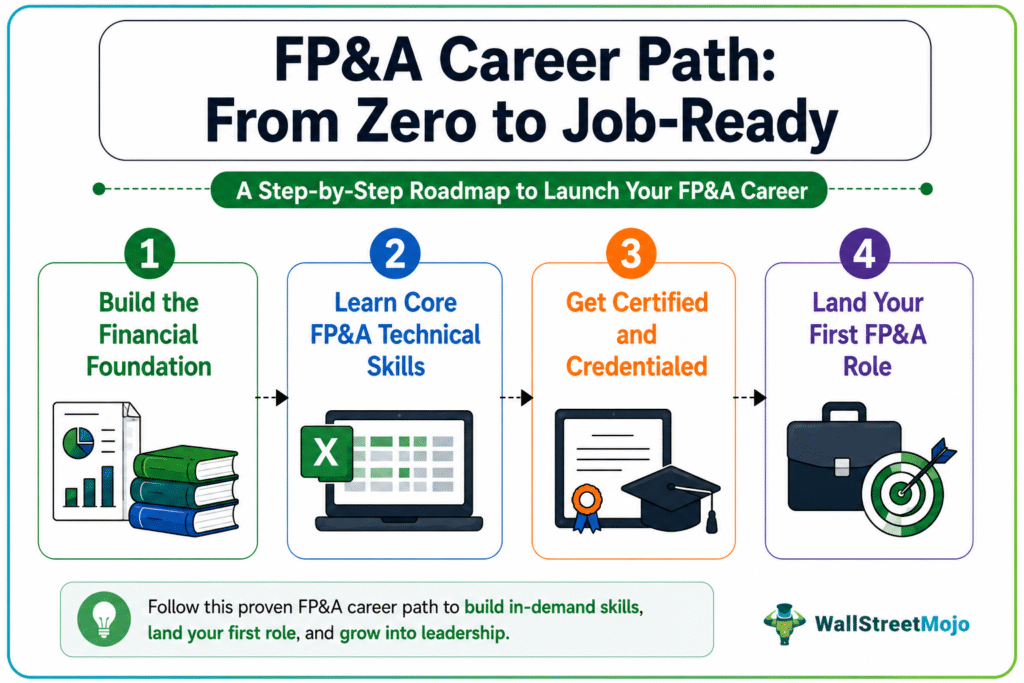
The journey to becoming an FP&A professional is best approached as a sequence of skills, with each stage building on the previous one. The following FP&A career path roadmap provides a practical learning path.
Step 1: Build the Financial Foundation
Before touching a financial model, a learner needs fluency in the three core financial statements: the income statement, balance sheet, and cash flow statement. These are not independent documents. Instead, they are interconnected and must be understood as a single financial system. Net income flows into retained earnings on the balance sheet, and that same figure becomes the starting line item for the cash flow statement. Recognizing this linkage is what separates someone who can genuinely interpret a company’s financial health from someone reciting formulas.
Alongside gaining financial statement literacy, individuals should understand the following concepts in this stage:
- Time value of money: Understand present value, future value, and discount rates, which underpin nearly every valuation and budgeting calculation.
- Accrual versus cash accounting: Learn why profit and cash rarely match in the same accounting period.
- Depreciation and cost classification: Differentiate between fixed and variable costs, which directly influence budgeting and cost-volume-profit analysis. Skipping this layer is the most common reason learners plateau later when models stop making intuitive sense.
Step 2: Learn Core FP&A Technical Skills
Once the conceptual base is solid, the FP&A career path for beginners shifts toward applied technical skills that appear in nearly every job description. These competencies enable analysts to support planning, decision-making, and business performance.
- Budgeting and forecasting: Analysts need working knowledge of fixed, flexible, zero-based, and activity-based budgeting, along with forecasting techniques such as time series and regression analysis. Employers increasingly expect rolling forecasts rather than static annual budgets.
- Financial modeling: The three-statement model is the backbone skill, since it forces an analyst to connect the income statement, balance sheet, and cash flow statement into one dynamic spreadsheet. From there, discounted cash flow (DCF) modeling, capital budgeting techniques like NPV and IRR, and scenario or sensitivity analysis using Excel data tables round out the toolkit.
- Cost management: Job order costing, process costing, activity-based costing, and standard costing methods matter heavily for FP&A roles inside manufacturing, retail, and consumer companies.
- Excel proficiency: XLOOKUP, INDEX-MATCH, pivot tables, and NPV/IRR functions remain the daily tools of the trade, and increasingly, familiarity with AI-assisted Excel workflows is becoming a differentiator on resumes.
Step 3: Get Certified and Credentialed
A professional FP&A certification is not mandatory to start an FP&A career. However, structured learning can significantly accelerate the process by helping you build budgeting, forecasting, financial modeling, and business analysis skills in the right order.
The Financial Planning and Analysis Course by WallStreetMojo follows a practical, step-by-step curriculum covering FP&A fundamentals, budgeting, forecasting, financial statement analysis, cost management, and strategic decision-making. Through practical examples and detailed explanations, learners develop the practical skills employers expect from entry-level FP&A professionals.
For professionals seeking additional credentials later in their careers, certifications such as FPAC, CMA, or CPA can further strengthen their profiles, depending on their career goals.
Step 4: Land Your First FP&A Role
Entry-level titles to target include FP&A analyst, financial analyst, budget analyst, and business finance analyst. In India, the average starting salary for FP&A analysts is 10.1 LPA, while in the US, an FP&A analyst earns an average annual salary of $66,417. That said, note that the salary varies across different companies, location, experience level, and role.
Also, it is one should remember that a resume that showcases practical FP&A skills and relevant project work is more likely to attract employers’ attention than one that only lists coursework.
Mistakes to Avoid on the FP&A Career Path
Many aspiring FP&A professionals delay their progress by making avoidable mistakes during the learning process. Becoming aware of these pitfalls can help you build job-ready skills more efficiently.
- Jumping straight to DCF modeling before mastering the three financial statements, making it difficult to build and explain reliable models during interviews.
- Treating Excel as optional, even though Excel remains the foundation of budgeting, forecasting, financial modeling, and most FP&A tools.
- Ignoring soft skills, despite FP&A analysts spending significant time communicating financial insights and explaining variances to business stakeholders.
- Pursuing certifications without practical application, resulting in theoretical knowledge but limited job-ready FP&A skills.
Conclusion
Breaking into financial planning and analysis does not require a finance degree or years of unpaid networking. It requires a sequenced approach: financial statement fluency first, budgeting and forecasting second, modeling and certification third, and a job-ready portfolio last.
Learners who follow this FP&A career path roadmap consistently build stronger fundamentals than those who jump straight to advanced modeling. For anyone ready to move through this sequence with structured lessons and practical examples, the Financial Planning and Analysis Course offers a practical starting point toward becoming job-ready.
Frequently Asked Questions
What does a career path in financial planning and analysis typically look like?
Most professionals begin as FP&A analysts or financial analysts, progress to senior FP&A analyst or senior financial analyst, then advance to FP&A manager, director of FP&A, or vice president of finance. Each stage requires broader business partnering responsibilities alongside stronger financial planning, forecasting, and modeling expertise.
Do I need a finance degree to start an FP&A career path?
No, a finance or accounting degree helps with campus recruiting, but employers often place greater value on practical financial modeling skills, relevant certifications, and hands-on project experience.
How long does it take to become job-ready for an FP&A role?
Someone studying consistently for 10-15 hours per week can typically build foundational competency in three to four months. Note that an FP&A course provides the structured foundation, but applying the concepts through practical exercises, financial models, and case studies is essential for building analyst-level proficiency.
Is the FPAC certification worth it for an FP&A career path?
For professionals committed specifically to FP&A rather than investment analysis, FPAC is the most targeted credential available, and it correlates with measurable salary premiums at the manager and director level.
What skills matter most for an FP&A analyst role?
Three-statement financial modeling, budgeting and forecasting methods, ratio analysis, Excel proficiency, and the ability to communicate variance drivers to non-finance stakeholders usually matter most.
What is the difference between FP&A and traditional accounting?
Accounting records what already happened through historical financial statements. That said, FP&A involves using that data to build forward-looking budgets, forecasts, and models that inform business decisions.