
What Is Model Deployment?
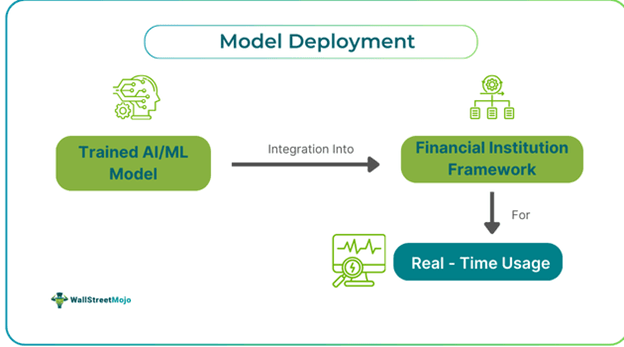
Model deployment refers to the process of embedding a trained artificial intelligence (AI) or machine learning (ML) model into the financial institution’s framework for real-time usage. It serves various purposes, including fraud detection by flagging suspicious transactions. Additionally, it enables automated trading decisions using real-time data.
You are free to use this image on your website, templates, etc..
Bank loan officers use credit scoring models based on it to evaluate borrower’s creditworthiness. It can be used in predictive maintenance in manufacturing companies to determine potential failures. Many AI/ML engineers and data scientists play a crucial role in their careers. It needs domain knowledge, best practices, and technical skills.
Model Deployment In Finance Explained
Model deployment in finance can be stated as the process of implementing and creating operational AI/ML models inside a production environment to undertake real-time predictions and generate insights. It can be done by conjoining the existing system with trained models, setting up the necessary infrastructure, and allowing seamless interactions with different components.
ML models are trained by data scientists using historical financial data. These models get validated on unseen data to assess their performance and make sure they don’t overfit the training data. Data scientists, operations teams, and Machine Learning Operations (MLOps) engineers integrate the models into the production environment for real-time data extraction, analysis, and processing. Financial institutions set an efficient monitoring mechanism to track the performance and behavior of ML models concerning production to ensure compliance with data privacy rules and reduce model bias risk.
Finally, these models use continuous integration and deployment to enhance ML models efficiently. Model deployment in the finance sector comprises using AI/ML models for work like assessing credit risk, automating trading plans, and detecting fraudulent transactions. These models evaluate real-time transactional data in large volumes, offering details to flag potential forged activities and maximize investment decisions.
Examples
Let us use a few examples to understand the topic.
Example #1
Let’s assume a scenario where a bank uses credit scoring modeling implementation. When a customer applies for a loan, the bank’s system analyzes creditworthiness, income, outstanding debts, and other relevant factors using a sophisticated credit scoring model. The model then generates a credit and risk score and helps the bank make informed credit decisions.
Once approved, the model is continuously monitored and updated with new data to ensure its accuracy. This streamlined process improves the bank’s ability to effectively evaluate loan applications, reduce human error, and maintain consistency in decision-making., which ultimately benefits both the bank and its customers.
Example #2
An article published on 13 December 2023 discusses the use of LangChain programs with large language models (LLM) utilizing Oracle Accelerated Data Science (ADS) v2.9.1 upon Oracle Cloud Infrastructure (OCI). LangChain, which is basically a structure for fundamentally LLM-based bundles, simplifies work like model connections & prompt engineering. The ADS SDK improves organizational deployment and provides a Pythonic point of interaction for controlling ML model lifecycles.
The article features the handled OCI Information Science environment that empowers adaptable HTTP endpoints for real-time model predictions. The full deployment of OCI data science model deployment with LLM can be obtained from the provided ADS user guide and blogs.
Importance
It has a lot of importance in the finance world, including:
- It helps organizations in deploying practical operationalized AI/ML tools for use by end-users or integrated into current systems.
- It enables the generation of instant insights, helping in real-time predictions.
- Using cloud platforms has helped scale resources down or up per demand, leading to cost efficiency and optimal performance.
- These models provide feedback loops facilitating continuous product improvement, aiding organizations to enhance or refine their models.
- It ensures seamless interactions amongst various components as a result of integrations of AI/ML models into existing software programs or tailored applications built around them.
- It transforms into a real-world impact-making tool by becoming usable and easily accessible.
- It helps in careers related to AI/ML-based professionals.
Challenges
The deployment of models in the finance sector has faced multiple challenges, as outlined below:
- One is to ensure that models work within memory restrictions. The other is to make them scalable to handle large transaction volumes with no latency.
- Create models with compatible tools and condense efforts into a single application for deployment.
- Ensuring efficient information exchange between ML engineers and software developers, ensuring model deployment within a production environment.
- Enabling accessibility, quality, and availability of data for model deployment and training.
- Formatting, cleaning, and organizing data for utilization in ML models.
- Making sure that models adapt to external environment changes and perform efficiently in production surrounding
- Monitoring model performance continuously and addressing problems concerning model drift due to variations in the external environment.
Thus, it is evident that machine learning model deployment —whether using SageMaker, Azure, or Databricks—faces similar challenges as outlined above.
Key Takeaways
- Model deployment is the technique of integrating an optimized AI or ML model right into a financial institution’s framework to function in real-time concerning fraud detection and credit scoring.
- It plays a couple of roles, such as detecting fraud with the aid of suspicious transaction reports and automatically letting enterprises make decisions based totally on real-time statistics.
- It has significance in real-time forecasting, profitability, non-stop product development, seamless interactions, transforming into impact-making tools, and aiding career improvements in AI/ML professionals.
- The challenges faced in finance include memory constraints, scalability, compatibility, efficient information exchange, data accessibility, adaptability, and continuous monitoring of model performance.
Frequently Asked Questions (FAQ)
Frequently Asked Questions
Which open-source tool is used for model deployment?
The open tool commonly used is BentoML, which offers various specialties to users. It allows for the creation, installation, and scaling of machine learning applications by handling pre-processing, post-processing, and custom code in a containerized format, while also bundling trained models. It helps simplify serving machine learning models having a REST API, facilitating model packaging and abstracting away complexities for reproducible deployments.
What is model deployment in data science?
The components used to evaluate both measures are the same, making it easy to calculate ARR from relative risk. The formula for calculating ARR is EER-CER, while the relative risk formula is CER/EER.
What is model deployment in machine learning?
In machine learning, deploying a model comprises deploying a trained model within a production environment to facilitate prediction or decision-making based on new data. Many open-source tools help simplify the process.