

“Earn up to $100,000” is really a formula with a base, a rate, a cap and a payment clock. Here is how to model it properly.
Referral headlines love a round number. “Refer a company. Earn up to $100,000.” It is a good line, and it is also a formula with a base, a rate, a cap and a set of conditions. For anyone who models cash flows for a living, the useful question is what an introduction actually has to produce before that number means anything.
Start with why the program exists. AI developers have used up much of the openly available text on the web and are looking for real-world business data licensed with the owner’s agreement. SourceX licenses that data directly from companies and pays them for it, and it rewards partners who introduce qualifying companies.[2] One introduction is all it needs. The math below shows what that introduction is worth, and when it turns into cash.
The formula, and the base it runs on
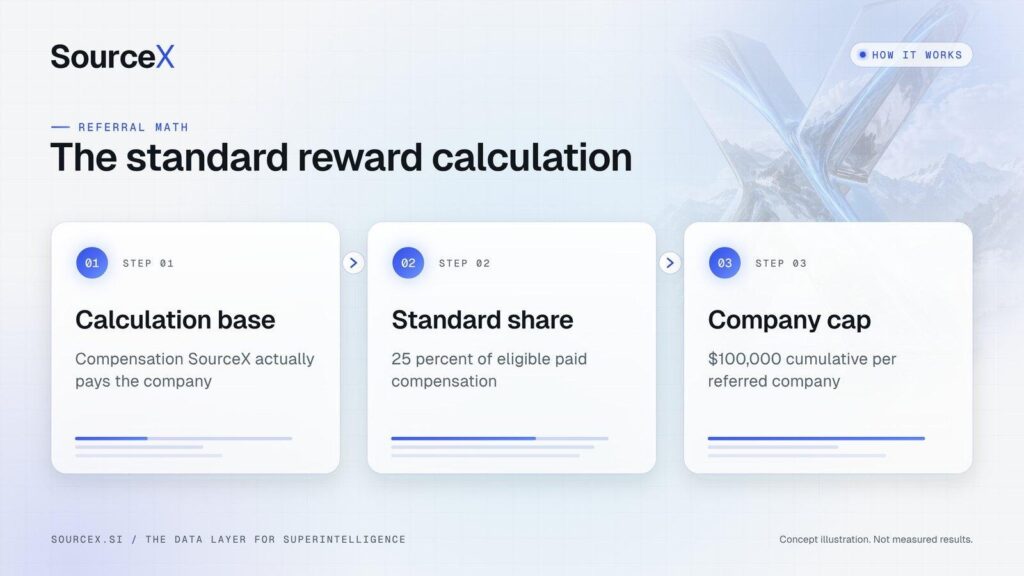
Under SourceX’s standard terms, the cumulative reward for a referred company is the smaller of two numbers: 25% of the eligible actual supplier payout, or $100,000.[1] Written as a spreadsheet would see it:
Reward = MIN(0.25 × eligible cumulative payout, $100,000)
Most mistakes come from feeding the wrong number into the first input. The base is the actual supplier payout, meaning the compensation SourceX actually pays the referred company, excluding separately itemized taxes and expense reimbursements.[1] It is not a proposed dataset value, an indicative estimate or whatever a downstream buyer pays SourceX.
For illustration, suppose a referred company receives $100,000 in licensing compensation plus a separately itemized $3,000 expense reimbursement. The base is $100,000, so the standard reward is $25,000. Using $103,000 would overstate it by $750.
One detail surprises people. SourceX pays the reward separately, and it does not reduce the supplier’s compensation. For the referred company, the introduction costs nothing.
Apply the rate, then the cap
Here is the standard calculation at several payout levels. The amounts are illustrative, not forecasts or reported transactions.
| Eligible cumulative supplier payout | Standard cumulative reward |
|---|---|
| $100,000 | $25,000 |
| $200,000 | $50,000 |
| $400,000 | $100,000 |
| $800,000 | $100,000 |
The breakpoint sits at $400,000. Below it, the reward scales linearly at 25 cents per dollar paid. Above it, the marginal reward drops to zero. At $800,000, an uncapped calculation would give $200,000, and the cap holds it at $100,000, an effective rate of 12.5%.
That is what “up to $100,000” means in practice: an upper bound reached only when a referred company’s actual payout hits $400,000 or more, not a typical or guaranteed outcome. A signed Schedule A or addendum can set different terms for a specific partner, and signed exceptions control, so model the agreement you actually have.
Why a second deal does not reset the cap
The cap is cumulative per company, not per transaction.[1] Most SourceX supplier agreements are a one-time fee per agreed dataset, but some provide for recurring deliveries, so the cumulative rule matters.
For illustration, a referred company first receives $200,000 of eligible compensation, then $300,000 under a later deal. The first payment supports a $50,000 reward. The combined payout is $500,000, so the cumulative reward is MIN($125,000, $100,000), which is $100,000. The second deal adds $50,000, not $75,000. A tracker that treats each new payment as a fresh calculation will overstate the total every time.
Attribution comes before arithmetic
A perfect calculation is worth nothing if the credit does not belong to you. Before submitting introductions, a partner needs an approved account and a signed Channel Partner Agreement.[1] Attribution runs on a 90-day window. Only one partner is credited per company, and an existing application or relationship can block credit.
In modeling terms, attribution is a binary multiplier that sits in front of the whole formula. If two advisers both know the same founder, only one row in anyone’s tracker should carry a non-zero reward, and a company that had already applied on its own carries zero for everyone.
The company also has to qualify. SourceX’s strongest fit is a knowledge-work company with 50 or more full-time employees at peak, and operating, acquired and wound-down companies can all qualify, though not every company does.[2] Licensed professionals, accountants included, should check their own rules on referral fees before accepting one.
When the reward becomes cash
Timing is where an estimate and money earned part ways. A submitted lead, a meeting or a signed supplier agreement alone does not trigger payment.[1] The reward is payable only after SourceX has paid the referred company and the other conditions are met: the acquisition partner’s acceptance and payment, SourceX finance approval, and the partner’s tax and payment details. The deadline is 60 calendar days after the later of final acceptance and completed handoff.
The word “later” does real work in that sentence. For illustration, if final acceptance happens on March 1 and the completed handoff on March 10, the 60-day count starts from March 10. In a model, store both dates, take the later one with MAX, and add 60 to get the deadline rather than hard-coding a single trigger date.
The supplier’s clock runs separately. SourceX reviews delivered data for up to 30 days, and standard supplier payment follows within 60 calendar days of a valid invoice after Closing unless the signed terms differ. Treat those as two distinct timelines in any model.
Build a tracker someone else can audit
Keep one row per referred company with its attribution status, governing rate and cap. Keep supplier payments in a separate table, each linked to its company, and sum them for the base. Calculate the cumulative reward with MIN, subtract rewards already paid, and keep “calculated” and “payable” in different columns. Then run two quick tests. A company with no paid supplier compensation should show zero. A company already at the cap should show no further reward when a new deal is added.
If you work with business owners, advisers or acquirers and the math holds up, review the SourceX referral program and its current terms, then get approved before the first introduction. The headline is easy to remember. The formula tells you what it is worth.
1. SourceX referral partner program terms (version 2026-10-22.2)
2. SourceX company referral program