


What Is Model Calibration?
Model calibration is a setup where model parameters or pricing function inputs are determined to fit the observable outputs. It is a reverse optimization task where a solution must be derived after trying out many different parameter settings.
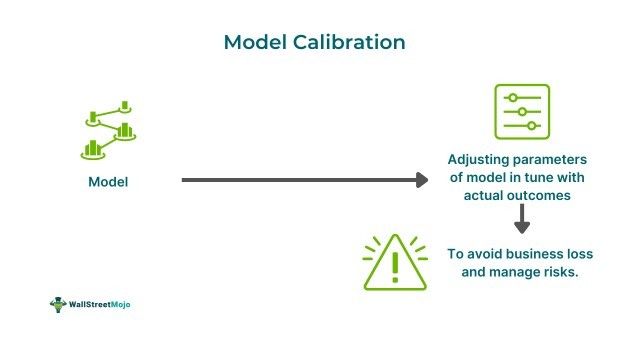
Calibration helps in the reduction of model risk. A model with calibration produces less biased results and prevents the institutions from making incorrect decisions. Accurate reading of the underlying data is required for financial institutions to implement models properly. This helps them reduce financial losses. Calibration can be difficult as it requires understanding the model and its data.
Key Takeaways
- Model calibration is setting model parameters to be consistent with the outcomes. The process involves the adjustment of parameters till they align with the actual results.
- Several model calibration techniques are used, such as Monte Carlo Simulation, Maximum Likelihood Estimation, Historical Simulation Etc.
- In finance, it helps predict volatility, hedging, pricing models etc. They help make informed decisions, manage risk and reducing business losses.
- The models are important especially in predicting using unstable data sets.
Model Calibration In Finance Explained
Model calibration sets the model parameters to orient the model prediction with the outcomes. It is a process in which model predictions are compared to historical data, and parameters are adjusted until the model output matches the actual outcome. This, hence, can be time-consuming.
In finance, the model is one where the parameters have values in tune with market observations. Calibration involves finding values of those parameters where it can replicate the price of calibration instruments in the market. It is a step to value instruments like scalable bonds, swaptions and structured instruments.
There are several techniques to achieve calibration in models. Techniques such as Monte Carlo Simulation, Maximum Likelihood Estimation, Historical Simulation, Etc. Historical simulation uses historical data to calibrate model parameters. The maximum likelihood estimation method focuses on finding parameters to maximize the likelihood of observed data. The Monte Carlo simulation method generates random scenarios and compares the predictions with actual outcomes.
Therefore usage of related data and appropriate technique of calibration is a must. It improves reliability. Otherwise, the misinterpretations could lead to significant financial losses due to incorrect predictions, and businesses could face regulatory sanctions. Furthermore they also help in making informed decisions.
Examples
Let us look into some examples to understand the concept.
Example #1
Imagine Dan is a trader who wants to develop a model to predict stock market volatility. He uses a historical simulation method. This is one of the model calibration techniques that uses historical data to find patterns. Under this method, he gathers information on all the past centuries to gain insights and periods of volatility. This will help him obtain calibrated volatility estimates to make informed decisions, such as in hedging strategies.
Example #2 – A Real-Life Example
A paper titled Deep Calibration of Financial Models studies using artificial neural networks or ANNs to calibrate financial models. They are an alternative to other traditional labor-intensive methods. The authors compare ann-based calibration to real-world frameworks. The study finds that ANN-based methods are competitive and provide stable long-term parameters. It states that they help provide reliable risk reports that can be used for business decisions.
Importance
Given below are some points that highlight the importance of calibration in models
- Calibration is needed when decisions are based on probability estimates. They are also helpful in measuring the effectiveness of a model.
- They are used in making decisions in classification tasks on class probability.
- They are used in testing the estimated probability of an increase or decrease in stock prices to guide investment choices.
- They help estimate the efficacy of various models through reliable comparisons.
- They are a potential approach to be used in models with unbalanced data sets.
- It is an important aspect of machine learning and improves the accuracy of predictions and the reliability of such outputs.
Model Calibration vs Model Validation
Given below are some of the differences between both concepts
Concept
- Model calibration is the approach used to make models that can produce the actual output in the model. This requires continuous trials of parameters until the result is achieved.
- Model validation is the approach to demonstrate models that provide reasonable outcomes and sensitivities based on alternative conditions or assumptions.
Essence
- Calibration is the process of adjusting the constants and other parameters of the model in the evaluating models to replicate the observed data to produce more reliable results.
- Validation is the next step, followed by calibration. It is the application of calibrated models and the observed data’s compared results.
Process
- During the calibration process, the parameters of the models are adjusted numerous times, a very large number of times, to be in tune with the measured outcome.
- During the model validation process, the ability of the calibrated model to hold out to different data model inputs is checked.
Frequently Asked Questions (FAQs)
Frequently Asked Questions
What is model calibration in machine learning?
Machine learning model calibration ensures that the evaluated class probabilities correspond to the naturally occurring outcomes. Machine learning model calibration helps in trusting the model prediction through accuracy.
What is model calibration vs training?
Model training typically refers to trying to fit the model to the data. It refers to the techniques implemented to make the model result and actual result in tune with each other. On the other hand, calibration is adjusting parameters to the model to gain the desired output.
What is the difference between model calibration and estimation?
Calibration fits the parameters in the data, and model estimation refers to fitting the parameters into training data. This helps in determining the initial model parameters.
What is PD model calibration?
PD model calibration is transforming a set of rating probabilities of defaults that are grade level to average PD level. This PD level is determined by changes in the PD in the underlying portfolio.