
What Is Portfolio Monitoring?
Portfolio monitoring is the process of keeping close track of the invested companies in the portfolio. It can be one company or several, and it is typically the responsibility of the portfolio manager to monitor the financial performance of the companies. Venture capital and private equity firms must analyze metrics and active funds.
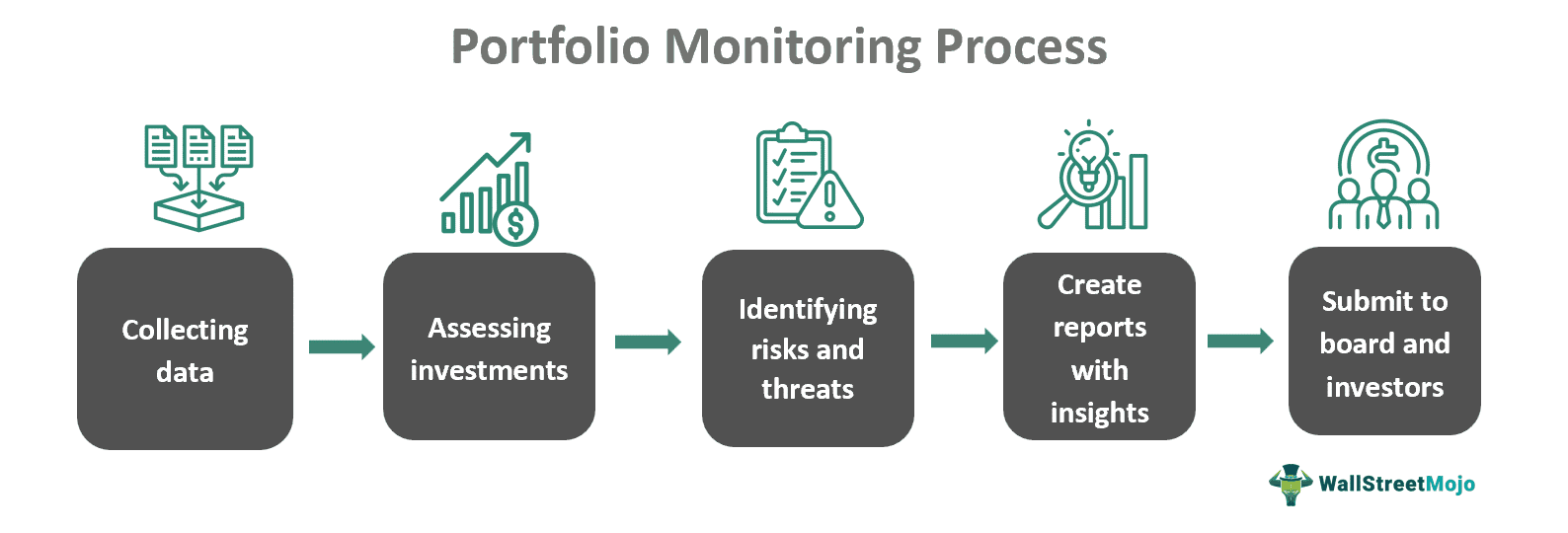
For the entire time and life cycle of a company that is backed by private equity and venture capital (VC) firms, the process remains the same—collecting relevant data, metrics, and information and turning them into meaningful insights to produce a report for all stakeholders. It includes the board, investors, and internal team members to assess the portfolio’s health, growth, and financial standing.
Key Takeaways
- Portfolio monitoring is the tracking of the financial performance of companies backed by private equity and venture capital firms to understand the portfolio’s health.
- In private equity firms, the portfolio manager has the responsibility to collect data, analyze, and present a well-detailed report to stakeholders, investors, and board members.
- The collection of accurate data, the assurance of value creation, real-time analytics, lack of transparency, data complexity, failure to report, and data corruption are some of the major challenges of portfolio monitoring.
- VC firms and many investors tend to use software packages and cloud-based services offering digital platforms with a variety of tools to track and monitor portfolios.
Portfolio Monitoring Explained
Portfolio monitoring is the responsibility of a portfolio manager to constantly track the investments, financial performance, and growth of companies backed by private equity and venture capital firms. It goes hand in hand with portfolio management and can be termed as a crucial part of it. For retail investors, it can be defined as the simple act of checking on their investments and making timely adjustments in their portfolios to mitigate risks and maximize returns by proper asset and capital allocation to attain healthy diversification while, at the same time, seeking suitable entry and exit trade points to initiate trades.
In a nutshell, venture capital and private equity are used alongside, but the former means funding startups and new businesses with high growth potential for long-term growth. In contrast, venture capital refers to investing capital in non-traded and private firms that are not publicly listed. In both scenarios, portfolio monitoring assists in understanding the real-time market conditions, financial standing, and prospects of the companies in the portfolios of a private equity or VC firm.
Although many problems arise, people tend to use portfolio monitoring software and digital platforms developed by leading service providers in the financial services sector. This enables VC firms and other investors to use unique and well-integrated tools to apply and gain knowledge about the portfolio’s health and growth.
Examples
Below are two examples based on the concept:
Example #1
Suppose a venture capital company comes across a new company that manufactures eco-friendly footwear for men and women. The firm seeks potential in the startup and decides to fund the company. The VC firm has appointed Anthony as a portfolio monitoring manager to track the company’s growth, performance, and work.
By the end of the first quarter, Anthony has to collect all the relevant data, information, financial metrics, and outcomes of technical indicators, including sector growth, asset allocation, investment returns, current growth, and potential risks, and write a full-fledged report informing the VC firm board members, stakeholders, and other team members about the company and its current financial position and market value.
It is a simple example. This entire process is called portfolio monitoring. Based on the reports submitted by Anthony, the VC firm will discuss, study, and decide the further course of action and their investment value.
Example #2
In May 2022, Acuity Knowledge Partners, with its digital platform FolioSure, announced its success in transforming portfolio monitoring through accurate tracking and full integration of tech stack and process, allowing private equity and venture capital firms to make portfolio company performance comparisons and take complete control of their portfolio lifecycles.
Robert King, the CEO of Acuity, expressed how the global pandemic has escalated the adoption of digital platforms across different industries. He also explained how they are observing an uptick in demand from their clients and the industry for digital platforms to solve fund operations, especially for portfolio-related services. The company is headquartered in London and operates from 10 different locations across the globe. It is a cloud-based portfolio monitoring software solution that is also renowned for its data operations functions. It is a leading research analytics and business intelligence consulting firm in financial services.
Benefits
The various benefits of the concept are as follows:
- Helps identify trends, find room for improvement, and make timely adjustments.
- It eventually leads to better portfolio management.
- Not only opportunities but also risk factors are sighted and mitigated to maximize returns.
- Determines the overall portfolio health and ensures stakeholders and investors that their money is safe.
- When private equity uses software for portfolio monitoring, it increases its visibility and offers real-time data analytics and reporting.
- Companies backed by private equity are linked to value creation by proper monitoring of the funds, utilities, and resources.
- Timely reporting of portfolio monitoring by portfolio managers keeps everyone informed and on track with how the company is performing with valuable insights.
Challenges
Various challenges of the concept are as follows:
- Choosing the right companies because private equity and venture capital investors do not want to support a company that is not profitable or is unable to create value.
- One of the biggest challenges is having no access to real-time data and analytics coupled with data complexity and volume.
- Many companies tend to lack transparency when it comes to reporting market and financial results.
- Most firms using monitoring software come across problems like lack of integration, failure to report, communication breakdown, not supporting the data model, and data corruption.
Portfolio Monitoring vs Portfolio Management
The critical differences between the two concepts are:
| Portfolio Monitoring | Portfolio Management |
| It is the evaluation of companies and their performance that resides in a portfolio. | It is defined as making decisions and adjustments and regulating the portfolio as required. |
| It is a subsection or part of portfolio management | Portfolio management is a bigger process and aspect. |
| Tells about the current position and potential risks of the portfolio and its companies. | It is the action of regulating investments according to financial objectives, minimizing risks, and maximizing returns. |
Frequently Asked Questions (FAQs)
What does a portfolio monitoring analyst do?
A portfolio analyst is responsible for collecting and analyzing data, including the project data, and creating in-depth reports for the board, investors, other stakeholders, and internal team members. They work closely with different business units and IT to write reports and study the trends and impact of investment decisions.
What is the role of a portfolio monitoring officer?
The main responsibility of a portfolio monitoring manager is to create timely reports, mainly quarterly, and present them to the investors, stakeholders, board members, and other key portfolio participants with the right insights, information, and valuable data informing them about the current scenario so that they can make sound financial decisions.
What are some portfolio monitoring tips for venture capital investors?
The key portfolio monitoring tips for venture capital investors are:
- Venture capital investors must have a clear view and investment objective.
- Try to involve more and more with the company they have invested in and supporting
- Make sure the company is more interested in creating value rather than just profits.
- Check whether the money is being used for the right reasons or not.