
What Is Liquidity Risk Management?
Liquidity risk management refers to a company or individual’s ability to manage their portfolio and finances so that they can meet their short-term obligations. Liquidity risk itself poses a scenario where the entity does not have sufficient funds or lacks capital and will not be able to pay deposits, debts, or meet financial obligations.
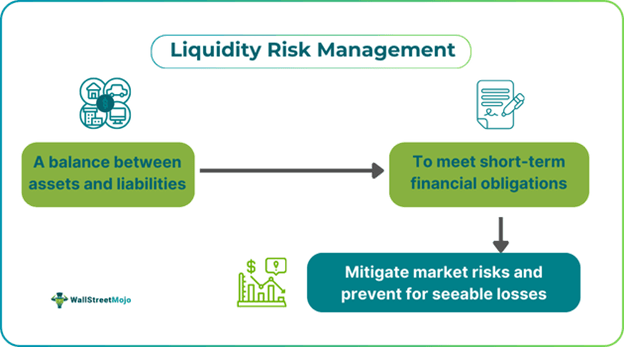
Every company must maintain its cash and other income sources to ensure that it does not face any potential liquidity risk in the foreseeable future. Liquidity risk management is practiced by all, from banks to corporations, fund managers to retail investors, to ensure that they always have sufficient funds available and do not have to bear any loss in the market.
Key Takeaways
- Liquidity risk management is the process of regulating income sources and maintaining sufficient funds to meet short-term financial obligations.
- Ideally, a good liquidity ratio for any company is considered 2:1, which technically means the assets should be double the liabilities.
- Liquidity risk is associated with two main aspects: market and funding liquidity risk. It can be measured through a current ratio, dividing current assets by current liabilities.
- It is managed through stress testing, scenario analysis, fund diversification, application of liquidity ratios, setting limits, tracking cash flows, and maintaining a balanced portfolio.
Liquidity Risk Management Explained
Liquidity risk management is the strategy to create a balance between company assets and liabilities to make sure the daily operations are well funded and the company has sufficient cash or liquid assets to cover any type of abrupt short-term financial obligations or pay off debts. Every business operating actively in the market needs cash to function in their daily operations, pay off debts, and meet or be prepared for any short-term cash requirements or abrupt expenses.
Liquidity risk is something every business, individual, bank, or financial institution goes through and applies different strategies to avoid or mitigate. Without a good liquidity ratio, it becomes challenging for any enterprise to survive in the market in the long term. Liquidity risk has two main elements: market liquidity and funding liquidity risk. The former is a situation where a company cannot make transactions at current market prices because of market disruption, making market liquidity risk management essential. Still, the latter is a scenario where a firm goes through insufficient funding and so fails to meet its financial obligations.
Good liquidity risk management helps companies optimally allocate funds and understand the cash inflows and outflows to regulate a plan for future investments, projects, and expansion. From an investor’s perspective, the liquidity ratio plays a crucial financial metric role in assisting investors in deciding on their investments. Rather than struggling to keep business functioning, good liquidity risk management helps corporations operate long-term and set new goals and business objectives.
How To Measure?
Liquidity risk is measured by using the quick ratio and current ratio.
Current ratio = Current assets/Current liabilities
Quick ratio = (Current assets – Inventory – Prepaid expenses)/Current liabilities
Both current and quick ratios are liquidity ratios used to gauge a company’s ability to pay its short-term obligations. The only difference is that the quick ratio also accounts for inventory and prepaid expenses. Many market participants, analysts, investors, and management consider 2:1 to be an ideal liquidity ratio.
How To Manage?
Liquidity risks affect both banks and businesses. Here are the measures taken by both to manage liquidity risk:
- Maintaining a balanced portfolio of liquid assets that can easily be turned into cash at the time of need without losing its value.
- Track and regulate their cash flow management by using liquidity risk management software, optimizing the asset-liability maturity profile and always maintaining optimal cash to meet any abrupt cash flow needs.
- Performing fund diversification to avoid dependency on any single funding source. Banks create a mix of wholesale funding, retail deposits, and other financing aspects. This also helps banks to become more stable and resilient.
- Banks also strategize to create a balance between asset and liability to minimize liquidity risk through funding, investments, lending and other pricing methods.
- Companies and banks both are known to conduct stress tests to identify market conditions and forecast potential liquidity shortfalls that can impact the smooth functioning of operations. Through this they are able to foresee and be prepared for any form of possible liquidity risks.
- Many liquidity ratios can be used to understand the financial position and future performance of a company or bank, such as liquidity coverage ratio or net stable funding ratio. They both can be utilized to determine short-term and long-term liquidity assurance, respectively.
Importance
The importance of liquidity risk management is:
- To keep a business or financial institution running smoothly and function without any financial crisis.
- Help banks and firms mitigate potential risks or prepare for them by forecasting future risks that can impact daily operations or obligations.
- Liquidity risk management helps manage cash flow based on which a company or bank can plan their future investments or operations.
- Without liquidity risk management, a company can fail to meet its financial obligations, which impacts it financially and causes it to lose its market reputation and goodwill.
- Investors can measure liquidity risk through different ratios, and if a company does not have a steady liquidity ratio, it will discourage investors from investing in it.
- Liquidity simply refers to cash availability. If there is a high liquidity risk, the company or bank will definitely face issues running its daily operations and paying off debts and other liabilities.
Frequently Asked Questions (FAQs)
What is the liquidity risk management framework?
Investment banks apply this framework with the following objectives –
- Induce confidence that they are able to maintain sufficient liquidity to meet their funding requirements.
- They are using the right tools to identify, monitor, and report liquidity risks and are in control to make strategies to mitigate them.
- The framework devises limits and creates a contingency plan based on scenario analysis and stress testing.
How does liquidity risk management relate to liquidity risk’s impact on the bond market?
Liquidity risk impacts both issuers and investors in the bond market. When liquidity dries, it makes it difficult for issuers to sell bonds. Likewise, if an investor wishes to sell a bond, they would have to sell it at a lower price and take a loss. Liquidity risk management assists in making strategies to manage liquidity through diversification of investments, seeking advisors’ help, or investing in short-term bonds.
What are the types of liquidity that are resolved through liquidity risk management?
The different types of liquidity are listed below:
- Market liquidity refers to a company’s capacity to trade assets without affecting their price.
- Accounting liquidity – A company’s capability to pay immediate financial obligations through its existing assets.
- Funding liquidity – This is more associated with banks and financial institutions; it refers to their ability to generate cash by selling assets or borrowings.
- Operational liquidity – This ensures that a business has enough liquid assets to pay any expenses, such as rent, utilities, operational costs, payroll, and so on.