


Devanning Meaning
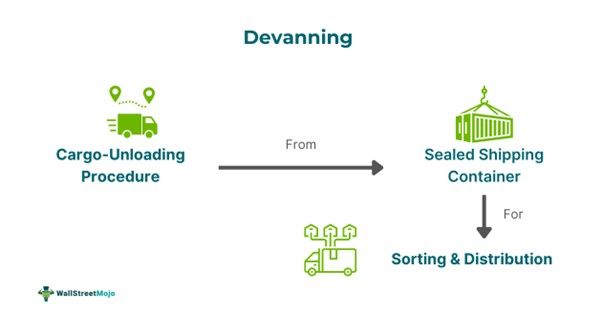
Devanning refers to the procedure of unloading cargo out of a sealed shipping container and sorting it out for further distribution. It provides efficient and quick item access, inventory management, optimum order fulfillment, distribution process streamlining, damage identification, quality control checks, and enhanced customer service.
You are free to use this image on your website, templates, etc..
It comprises sealing the container opening, taking goods outside the container, and arranging them as pallets for inventory. It can be done digitally or manually, depending on the complexity and size of the container, such as Full container loads (FCL) and container load (LCL) container freight station (CFS).
Key Takeaways
- Devanning means cargo unloading from sealed containers for distribution after performing efficient inventory management and quality control checks.
- Its best practices involve efficient planning, effective teamwork, precise record-keeping, and considering it as a dynamic process with technology adoption and automated execution.
- It has benefits like enhanced efficiency, reduced costs, minimized cargo loss, improved inventory management, streamlined supply chain, optimized warehouse space, and promoting clear communication among stakeholders.
- It faces challenges such as supply chain congestion, complex prioritization, safety risks, large volumes, staff shortages, inefficiencies, and the integration of digital technology in logistics and supply chain management.
How Does Devanning Work?
The devanning definition can be stated as a vital process in the supply chain and logistics management industry consisting of unloading and unsealing goods from shipped containers. Then, the goods inside are separated so that they can be prepared for further distribution and storage. Moreover, it forms a delicate and crucial part of storage operations, impacting the efficiency, speed, and performance of the supply chain.
Its working follows a series of steps detailed below:
#1 – Preparation and planning
It is essential to plan and prepare appropriately before initiating the devanning process, which comprises determining the goods inside the container, leaving space for unpacking them and arranging for the workforce and equipment needed for a smoother finish.
#2 – Unloading container
It requires meticulous safety and care protocols, using correct equipment such as conveyor belts or forklifts, depending on the nature of the cargo.
#3 – Inventory management and sorting
The unpacked items have to be organized and sorted systematically, using accurate apps and software for inventory management, such as RFID technology and barcode scanning. As a result, the items can be tracked and their records updated in real time.
#4 – Inspection and quality control
It provides an opportunity to conduct extensive quality control inspections, guaranteeing that every product has been carefully inspected for faults, damages, or miscellaneous concerns. Hence, it assures that clients and customers receive high-quality and damage-free items.
#5 – Labeling and repackaging
After the quality inspection and sorting, if non-adherence to packaging guidelines occurs, items may need to be repackaged and labeled. This helps in the efficient handling and tracking of items across the supply chain.
Examples
Let us use a few examples to understand the topic.
Example #1
Let us assume that the German ship Humpty Dumpty has arrived at an Old York port full of containers containing buttons destined for various garment manufacturers across the USA. Since the USA has a large area under it, efficient supply chain management, from unloading to the distribution of buttons, has to be carried out.
Hence, the first step is to unload and open the cargo containers of buttons for sorting. This is done using manual labor, and then digitally, the buttons are palleted into various boxes destined for different manufacturers’ locations across the United States. Hence, the cargo unloading procedure helps reduce delays, prohibits inventory disruptions, and keeps the button delivery schedules to all manufacturers on schedule.
Example #2
An article published on October 31, 2023, discusses Tilling Timber’s use of Combilift’s Combi-SS slip sheets for container unloading at its locations in Melbourne, Sydney, Brisbane, Adelaide, and Perth. Tilling Timber, a family-owned business with 60 years of innovation, has embraced technology early, including Weinig molders, and has maintained a 20-year partnership with Combilift. This partnership introduced the Combi-SS slip sheets to solve supply chain issues faced before COVID-19, reducing container hire times and enhancing safety. Tilling operates a significant fleet of forklifts across Australia and continues to innovate in collaboration with Combilift, setting industry standards.
Best Practices
Let us look at some of the best practices of cargo unloading procedure to make it successfully listed below:
- Space must be efficiently planned for smooth storage and movement, inventory management, quality control, racking for vertical space, and sorting provisions deployed.
- Effective collaboration and communication must exist between the cargo unloading procedure team, transportation teams, and warehouse staff, ensuring coordination, on-time information, and swift issue resolution to aid seamless operations.
- Accurate record-keeping and documentation related to inventory lists, container details, and quality control reports must be maintained. These are critical to trace and comply with, aiding issue resolution throughout the supply chain.
- The cargo unloading procedure is an evolving process that focuses on ongoing analysis, evaluation, and increased opportunities. These opportunities also include technological adoption, automation execution, and feedback gathering to homogenize operations more.
Benefits
Let us look at some significant benefits of the cargo unloading procedure process as listed below:
- Devanning a container speeds up freight movement using automation to enhance efficiency.
- The use of minimal physical labor and maximizing storage processes reduces logistics costs.
- Professional services minimize cargo loss and damage, maintaining product integrity.
- It enables improved inventory management and tracking and improves accuracy.
- It ensures a smoother flow of the supply chain through streamlining of logistics operations.
- It also saves a lot of time and enhances overall operational efficiency.
- It optimizes space usage inside warehouses and maximizes storage capacity.
- It leads to effective and more transparent communication among all stakeholders, which in turn leads to problem resolutions and better coordination.
Challenges
It also poses some complex challenges in logistics and warehousing, as listed below:
- Congestion problems may result from setbacks in the supply chain that hinder smooth operations and increase devanning fees.
- Many times, businesses face staff shortages, which affect the personnel required for unloading and sorting containers.
- It may lead to inefficiencies as it becomes challenging to identify stock inside containers.
- Prioritizing containers for unsealing from cargo often turns complex, affecting workflow efficiency.
- It requires utmost care in handling goods to avoid damage and accidents, which add to increased safety risks.
- Large volumes of handling of unsealing containers comprise huge goods volumes, resulting in logistical challenges.
- It has been the most complex task in logistics and supply chain management.
- Integration of new systems and adaptation to them for systematic unloading using digital technology may pose particular challenges.
Frequently Asked Questions (FAQ)
Frequently Asked Questions
How long does devanning take?
Usually, it takes one to two hours to complete the cargo unloading procedure, but its timing varies. Its timeframe entirely depends on the type of container and the working of the logistics company managing the process.
After devanning where the goods are kept?
The goods procured from the container after the cargo unloading procedure are taken to the logistic center or warehouse for storage until it is time for shipment. After that, they are differentiated according to destination and type, arranged for quick retrieval, and then marked for conveying and tracking on a digital system.
What does finished devanning mean?
It is another term used in logistics to denote the successful unloading of cargo from the shipping container. After that, it gets opened, sorted, and kept in a logistics center or warehouse prior to the commencement of shipping. The entire process consists of segregating goods according to their destination and type, sorting them for quick retrieval, labeling, monitoring, and moving items using an automated system directed to their desired place of delivery.