


AI-assisted 3D production is often sold as a speed story. For an investment decision, that is incomplete. A model that appears quickly but needs repeated correction may cost more than a conventional blockout. A useful business case connects the output to labor, review, rework, approval, and reuse.
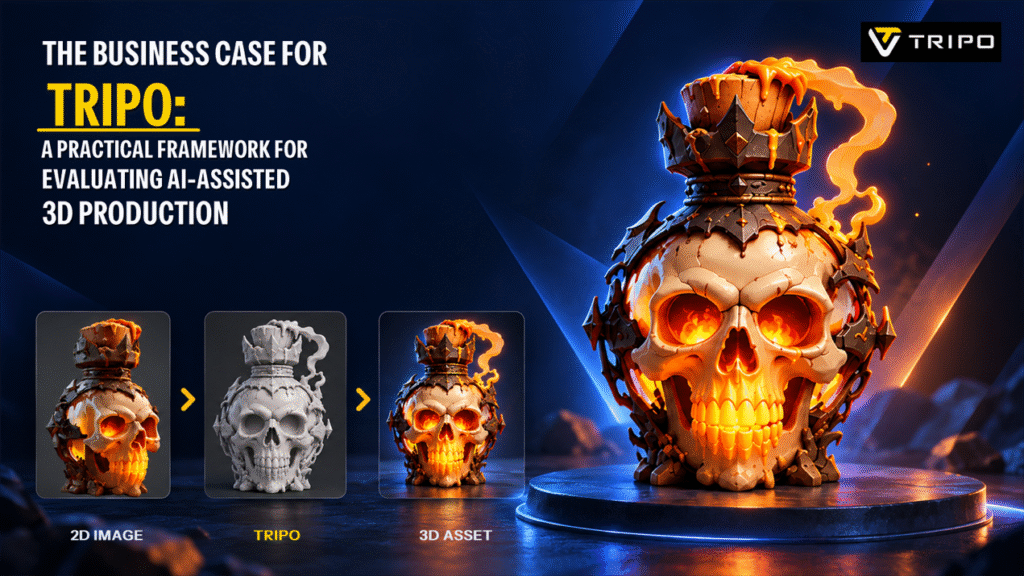
Consider a small entertainment product team evaluating an original fantasy skull lantern for a seasonal digital campaign. The reference has an ivory skull, a dark bronze thorn frame, orange light in the eye sockets and mouth, and a waxed candle top. The object has enough fixed features to support a fair comparison, while its unseen rear and internal structure expose the cost of assumptions.
What Is a Tripo Cost-Benefit Analysis?
A Tripo cost-benefit analysis compares the observed cost of a manual 3D task with the cost of completing the same task through an assisted workflow. It includes artist time, reviewer time, retries, corrections, and incremental tool expense. The analysis should stop at a defined approval point rather than treating a concept model as a finished production asset.
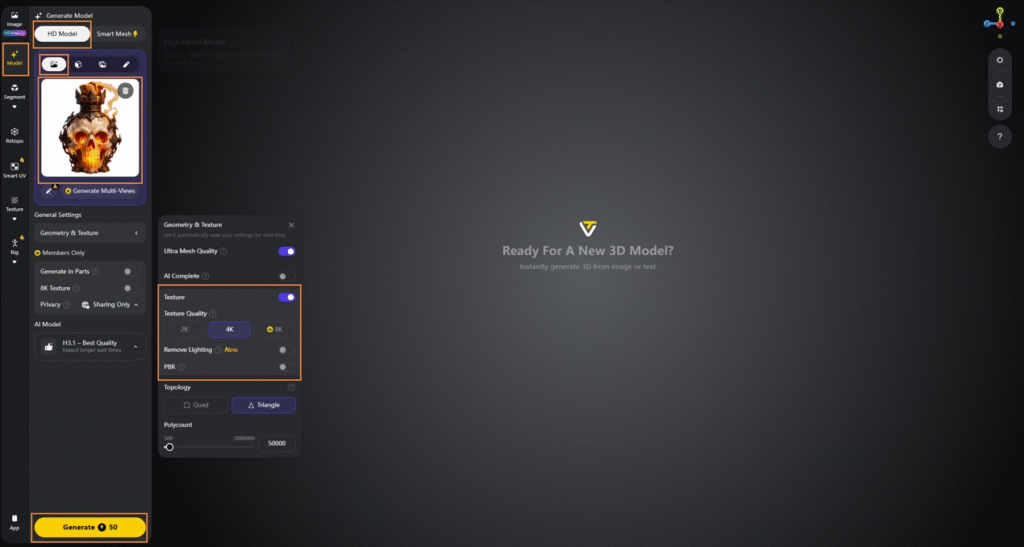
The method works best as a controlled pilot, not as a forecast based on broad claims about AI. The team records what happened with one asset class, then decides whether the evidence supports a wider test. Generation results can vary, so the labor spent reviewing unsuccessful candidates belongs in the calculation.
Define the Unit of Analysis
Start with one measurable unit: one reviewable skull-lantern concept for an internal campaign scene. Acceptance means that an art director can inspect the silhouette and major forms from several angles and decide whether the concept merits further cleanup. Dimensional manufacturing accuracy, animation, and a final game-ready mesh remain outside this test.
The manual baseline must use the same reference and the same approval gate. Include the time required to interpret the skull cavity, candle opening, thorn frame, and hidden rear surfaces. Reviewer time also counts. Forty minutes spent explaining or rejecting a confusing result is a real project cost, even when the first modeling pass has already ended.
Build the Cost and Benefit Ledger
Use the same approved skull-lantern image for the Tripo Image to 3D Model test and preserve it with the manual brief. The first output is a cost-observation point, not proof that the lantern is production-ready. Record preparation, candidate selection, correction, and approval time separately; then apply the same acceptance gate used for the manual blockout. Current product controls and commercial conditions should be verified when the pilot is run.
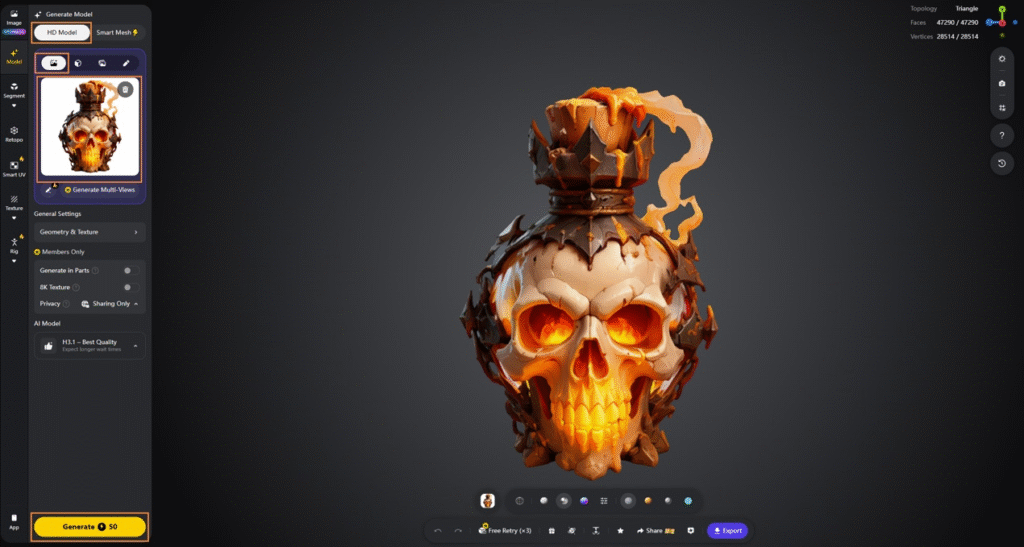
Track active labor separately from elapsed waiting time. Record reference preparation, candidate review, correction, and handoff as distinct lines. If the workflow is retried, count the review effort for every candidate. Exploration that looks inexpensive can still consume costly senior attention.
The skull lantern anchors the comparison. Its front silhouette, paired eye sockets, separated teeth, candle crown, bronze frame, and ivory-to-metal material boundary provide visible checkpoints. The figure below is an illustrative review map that separates the supplied concept, a neutral geometry study, and multi-angle inspection hypotheses. It is not a Tripo Studio screenshot or a measured generation result.
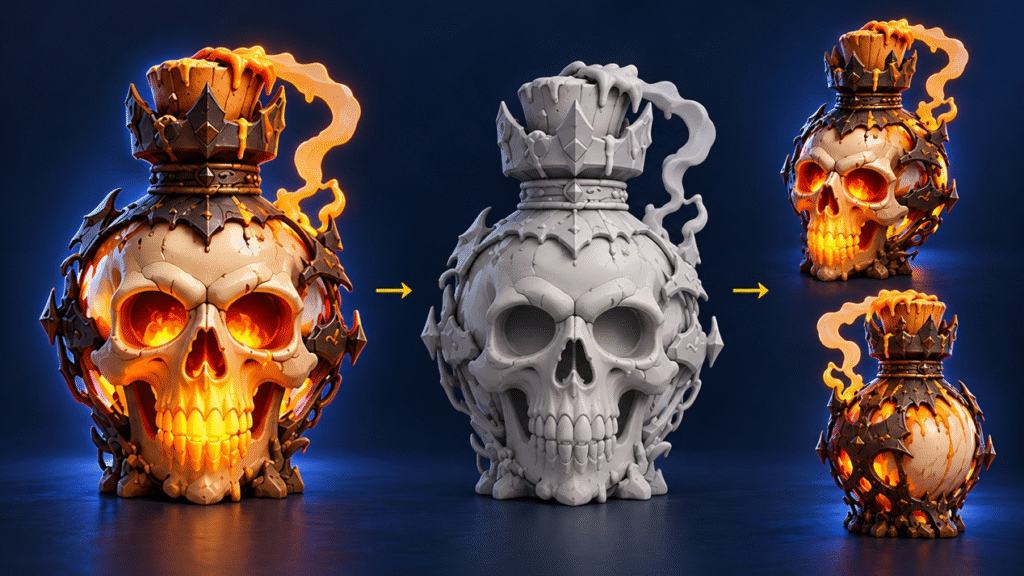
The acceptance checklist should cover eye-socket symmetry, jaw and tooth separation, crown opening, continuity of the thorn frame, base stability, and the boundary between bronze and ivory surfaces. The rear, underside, inner cavity, and frame thickness are not fully shown. Mark them as design assumptions. The flame and smoke are presentation effects, not guaranteed solid geometry.
Calculate Value for the Skull-Lantern Pilot
Two simple calculations keep the pilot readable:
Effective assisted cost per accepted concept = total assisted pilot cost / number of accepted concepts.
Net pilot value per accepted concept = manual baseline cost per accepted concept − effective assisted cost per accepted concept.
Assume the manual blockout takes six hours at an illustrative internal rate of $40 per hour, or $240. If the assisted route requires three hours of active labor plus $8 in allocated tool cost, its observed cost is $128 and the pilot value is $112. If retries raise labor to five hours, assisted cost becomes $208 and the value falls to $32. These figures are examples; a real team should replace them with its own rates and recorded minutes.
Test the Result Under Different Assumptions
Run the ledger under three conditions. The base case uses observed pilot results. The conservative case assumes extra retries and a longer correction pass for the hidden geometry. The favorable case assumes the same input discipline can be repeated and that one approved lantern is reused in more than one campaign scene. If the economics work only in the favorable case, the business case is not yet robust.
Also examine who saves time. Two hours saved by a junior artist may be offset by ninety minutes of creative-director review. On the other hand, an earlier three-dimensional review may reveal that the crown is too tall or the thorn frame is too busy before a detailed asset is commissioned. That avoided downstream work can be valuable, but it should be documented rather than assumed.
Set a Decision Rule for a Limited Rollout
A sensible next step is a narrow asset class, not a company-wide mandate. A team might approve Tripo-assisted concept props with clear silhouettes and tolerable hidden-surface ambiguity, while excluding assets that require exact dimensions or engineered internals. Recheck the economics after ten accepted concepts and compare them with the original manual baseline.
Finance should support the next stage only if accepted concepts show lower observed labor, earlier rejection of unsuitable concepts, or measurable reuse without shifting hidden work to senior reviewers. The skull-lantern pilot makes that tradeoff visible. It also gives the creative team a practical record of where image-to-3D assistance helps and where conventional modeling judgment remains necessary.