


What Is Rural Credit?
Rural credit is any loan or financial assistance offered to rural citizens mainly for agricultural and farming needs or to open small businesses in rural areas. Farmers mainly take such credits. It operates like a financial mechanism to promote agricultural growth and rural entrepreneurship.
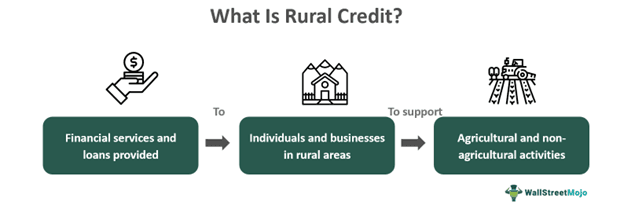
These credit facilities are structured in a way that allows farmers and rural citizens to invest in equipment, technology, and farming utilities to improve their livelihood and promote the economic well-being of rural communities. At the same time, it uplifts the agricultural sector’s growth, contributes to enhanced productivity, and fosters the development of the rural population.
Key Takeaways
- Rural credit refers to loans, lending schemes, and credit facilities offered to the farmers and rural population for agricultural, farming, and rural entrepreneurship activities.
- The primary sources of rural credit are commercial banks, agricultural cooperatives, NBFCs, agricultural credit programs, regional rural banks, credit communities, and microfinance institutions.
- There are five main types of rural credit loans: short-term, medium-term, long-term, production, and consumption-based rural credit schemes.
- With rural credit, easy loans with low interest rates, swift repayment terms, and high accessibility are offered to the rural population for the upliftment of rural and farmer communities.
Rural Credit Explained
Rural credit refers to the borrowing activities where farmers and rural populations take loans from banks, credit unions, and other financial institutions to fund agricultural requirements, farming activities, purchasing new machinery, equipment, land, resources, and rural entrepreneurship. These funds are used to open new small businesses, shops, and small-scale enterprises. In simple terms, loans given for agricultural and small business purposes in rural areas are termed rural credit.
The financial needs and structure of the rural population differ significantly from those of urban areas. In urban areas, people often take loans for education, cars, home appliances, real estate property, and business ventures. In contrast, the rural population primarily focuses on using funds to enhance their agricultural operations and farming activities or start small businesses to thrive in rural settings. Their financial needs revolve around agriculture, farming, crop production, and small businesses.
There are mainly five types of rural credit categories:
- Short-term credit: These loans focus on seasonal farming needs, crop production, and cultivation activities, typically with a repayment period of less than one year.
- Medium-term credit: These loans are offered for purchasing livestock, equipment, and agricultural improvements, with a repayment period ranging from one to five years.
- Long-term credit: These loans are provided for land development, agro-processing units, and infrastructural development, with repayment periods extending beyond five years.
- Production credit: This category involves loans needed for crop production and agricultural inputs, similar to short-term credit, but can sometimes cover longer durations based on the production cycle.
- Consumption credit: These loans are given to meet the household consumption needs of rural families and ensure their financial stability, covering expenses like food, healthcare, and education.
Sources
The institutional sources of rural credit –
- Commercial banks – Such banks have specialized agricultural and rural lending departments and understand the needs of farmers; therefore, they have specific loan products such as crop loans, working capital credits, farm equipment loans, and rural entrepreneurship lending facilities.
- Regional Rural Banks – Also known as RRBs, are financial institutions designed explicitly by governments to mandate financial services and credit facilities in rural areas. They are level-deep compared to commercial banks and operate on a regional level sponsored by commercial banks.
- Microfinance institutions – These are termed MFIs and target underserved areas with farmers and micro-entrepreneurs who are in need of small loans and credit assistance. Such are people who do not have access to traditional banking and financial services.
- Cooperative credit communities – These are mostly credit societies and cooperative banks formed by people with common economic interests. They operate like credit unions, offering financial assistance to members, farmers, and rural citizens based on mutual understanding and principles.
- Non-Banking Financial Companies – These are non-banking firms that provide financial aid and lend money to farmers for livestock, agricultural, and farming activities, including small businesses.
- Government Agricultural Credit Programs – These are government-authorized programs with the sole objective of supporting agriculture and rural development. Such programs offer subsidized interest rates, direct lending initiatives, credit guarantee schemes, and easy access.
- Agricultural cooperatives – Farmers form a pool of resources and funds to offer loans and utility help to members for their agricultural needs.
- Development finance institutions – Again, these are institutions that belong to different countries to contribute rural credit assistance and offer resources for farming activities.
Need
The critical requirements for rural credit are –
- The foremost need is agricultural growth and financial assistance to farmers with a need for more savings and a shortage of funds to capitalize on investments.
- Such lending activities are often observed as social welfare activities; communities in rural areas are always in need of such assistance for their education, healthcare, housing, and farming activities.
- Rural credit is needed because the rural population needs more access to formal banking solutions and traditional banking facilities.
- Rural credit mainly concentrates on economic diversification by supporting rural development, agriculture, and nonagricultural and small business activities.
- It creates structured loans as per the agricultural cycle; farmers often need loans during a specific period or season, and rural credit facilities make it possible for them.
- Rural credit bridges the gap between rural populations with no savings, collateral, and knowledge, as well as traditional financial services that have no accessibility.
Examples
Here are two examples of rural credit.
Example #1
Suppose John is a farmer with a small piece of land where he grows wheat. Recently, he discovered a nearby piece of land available for sale. John believes he can grow rice there and is very interested in purchasing the property. Although he has some savings, he needs a loan to buy both the land and a tractor.
John is apprehensive about approaching big commercial banks, so he decides to visit a regional rural bank. The bank’s management welcomes him and informs him about a new farmer’s loan designed explicitly for purchasing machinery and equipment. The loan terms are straightforward, and the interest rates are low. John is pleased with the rural credit program and decides to borrow the money from the regional rural bank.
Over the next few years, John successfully repays the loan. As a result, he now owns two farming lands and a tractor, significantly enhancing his agricultural operations. This example demonstrates a simple rural credit program. However, in real banking scenarios, there are many other factors and complexities to consider.
Example #2
According to reports, Bangladesh Bank, the central regulatory body of the nation’s banking system, has noted a significant reduction in rural credit. Bangladesh’s commercial banks have been highlighting the decline in the disbursement of formal credits in rural areas. Bankers have identified several contributing factors, including rising costs of funds and production, inflation, and high interest rates, which have led to a substantial decline in rural credit demand.
As per Bangladesh Bank data, up to June 2023, all banks together had invested Tk 14.46 trillion in various sectors across the country, with rural areas receiving 12.02% of this amount. By the end of December 2023, the share of bank loans in rural territories had decreased to 8.05%. Experienced bankers believe that higher inflationary pressures and increased interest rates have dramatically affected the operations of cottage, micro, small, and medium enterprises (MSMEs) in rural areas.
Importance
The importance of rural credit is –
- It enables rural populations to expand their agricultural activities and start new businesses.
- Rural credit plays a vital role in agricultural growth and development, along with the upliftment of rural areas and communities.
- With proper rural credit, new businesses are formed, which eventually leads to employment opportunities and work.
- Rural credit empowers the rural population and assists in reducing poverty by allowing them to grow and break their cycle of poverty.
- From the banking perspective, financial institutions connect with more and more customers looking for credit facilities.
- Rural credit ultimately gets utilized for irrigation systems, transportation, agricultural machinery, and equipment that constitute infrastructure development.
Frequently Asked Questions (FAQs)
Frequently Asked Questions
How to improve rural credit?
The following steps can be taken to improve the rural credit scenario – – More agricultural and rural entrepreneurial programs should be launched. – Banking management needs to understand the actual needs of rural areas, their communities, and farmers. – Focus more on the social welfare of rural areas rather than offering loans and binding farmers for a long-term period. – Collaboration of banking institutions and rural communities to work together.
What are the features of the rural credit system?
The main features of the rural credit system are – 1. Low interest rates – The loans are designed in such a way that they offer better services at a low interest rate for farmers, given their rural issues and capital problems. 2. Farmer’s equity – In case the farmer defaults on the loan, their property is liquidated at a fair price, and once the due amount is cleared, the rest is given back to the farmer. 3. Farmer’s convenience: The whole credit structure is developed around the farmer’s convenience, such as term period, easy installments, and so on.
What are the problems of rural credit?
The problems with rural credit are – – Rural credit agencies need to meet the needs of marginal farmers. – In rural areas, the risk of default is high, and banks can lose their money. – The credit needs of well-to-do farmers are given more importance than needy farmers, as they have better creditworthiness.