


Introduction
Anyone researching the best investment banking courses for beginners quickly runs into the same problem: dozens of providers claim to teach “Wall Street skills,” yet few explain how their curriculum actually prepares a newcomer for the job.
A genuinely beginner-friendly investment banking course does three things well. It starts with accounting and Excel fundamentals rather than assuming prior exposure. It then sequences financial modeling and valuation in a logical order. Finally, it connects technical skills to real interview and on-the-job scenarios.
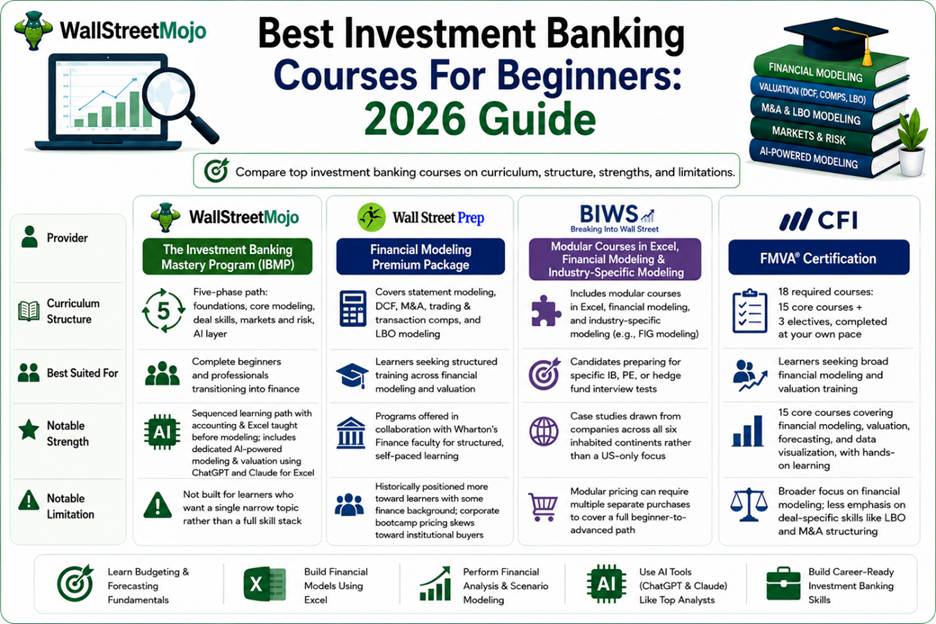
This guide compares investment banking programs from several well-known providers, including Wall Street Prep, Breaking Into Wall Street (BIWS), the Corporate Finance Institute, and WallStreetMojo. Rather than presenting a one-sided ranking, this guide evaluates each program’s strengths and limitations. It helps readers identify the best investment banking courses for beginners online based on curriculum depth, structure, and career alignment rather than marketing claims alone.
Key Takeaways
- The best investment banking courses build from accounting and Excel fundamentals to financial modeling, M&A, and LBO skills.
- Course selection should consider curriculum structure, deal-skill depth, instructor credibility, and your existing finance knowledge.
- WallStreetMojo’s IBMP follows a structured five-phase path from foundational finance skills to AI-powered modeling workflows.
- AI-assisted modeling and valuation using ChatGPT and Claude for Excel are increasingly important in modern investment banking workflows.
- Strong investment banking training can support career preparation as demand for financial analyst roles continues to grow.
What Makes An Investment Banking Course Genuinely Beginner-Friendly?
A course qualifies as beginner-friendly when it does not assume the learner already understands accounting, corporate finance, or Excel modeling conventions. Programs built primarily for practicing analysts or MBA candidates often skip foundational material, which leaves newcomers struggling to follow DCF or LBO modules. The best investment banking courses for beginners open with accounting for financial analysts, ratio analysis, and Excel for finance. After that, they introduce three-statement modeling, DCF valuation, and deal-specific skills like M&A and LBO modeling.
Comparing the Leading Investment Banking Course Providers
The table below compares the best investment banking courses for beginners across curriculum structure, learner fit, strengths, and limitations. The comparison is based on information published on each provider’s own course pages.
| Provider | Curriculum Structure | Best Suited For | Notable Strength | Notable Limitation |
| WallStreetMojo | The Investment Banking Mastery Program (IBMP) includes Five-phase path: foundations, core modeling, deal skills, markets and risk, AI layer | Complete beginners and professionals transitioning into finance | Sequenced learning path with accounting and Excel taught before modeling; includes dedicated AI-powered modeling and valuation modules using ChatGPT and Claude for Excel | Not built for learners who want a single narrow topic rather than a full skill stack |
| Wall Street Prep | Financial Modeling Premium package covering statement modeling, DCF, M&A, trading and transaction comps, and LBO modeling | Learners seeking structured training across financial modeling and valuation | Programs are offered in collaboration with Wharton’s Finance faculty for structured, self-paced learning | Historically positioned more toward learners with some finance background; corporate bootcamp pricing skews toward institutional buyers |
| Breaking Into Wall Street (BIWS) | Includes modular courses in Excel, financial modeling, and industry-specific modeling, for example, FIG modeling | Candidates preparing for specific IB, PE, or hedge fund interview tests | Case studies drawn from companies across all six inhabited continents rather than a US-only focus | Modular pricing can require multiple separate purchases to cover a full beginner-to-advanced path |
| CFI | The FMVA Certification includes 18 required courses, combining 15 core courses and three electives, completed at the learner’s own pace. | Learners seeking broad financial modeling and valuation training | Fifteen core courses covering financial modeling, valuation, forecasting, and data visualization, with hands-on learning | Broader focus on financial modeling generally, with less emphasis on deal-specific skills like LBO and M&A structuring compared to IB-focused programs |
Curriculum Depth: Where WallStreetMojo’s IBMP Differentiates Itself
Most comparison articles stop at listing course topics. A more useful comparison looks at sequencing. WallStreetMojo’s Investment Banking Mastery Program follows a five-phase structure. The first phase covers investment banking, corporate finance, Excel, and accounting fundamentals.
The second phase moves into financial modeling, DCF, and trading comps. Next, the third phase adds M&A and LBO modeling, followed by financial markets and risk topics. This sequencing is particularly relevant when evaluating the best investment banking courses for beginners because advanced modeling builds on these foundational skills.
The final phase introduces AI-powered fundamental analysis, financial modeling, and valuation using ChatGPT and Claude. This progression takes learners from foundational concepts to advanced investment banking and AI-assisted workflows.
This progression matters for beginners because each phase builds directly on the one before it. Thus, it does not require learners to jump into DCF or LBO modeling without first understanding financial statements.
The program is directed by Dheeraj Vaidya, CFA, FRM, a former J.P. Morgan and CLSA equity analyst who has trained more than 100,000 students and professionals over two decades. His experience across investment banking and equity research brings practical perspective to the curriculum. It also gives learners exposure to modeling and valuation concepts shaped by real-world financial analysis rather than purely academic instruction.
Common Mistakes Beginners Make When Choosing an Investment Banking Course
Beginners researching top investment banking courses for beginners tend to repeat a few avoidable mistakes. Let us find out what they are.
- Skipping accounting fundamentals: Jumping straight into DCF or LBO modeling without first understanding financial statement mechanics leads to confusion later. This is because every valuation model depends on correctly linked income statement, balance sheet, and cash flow logic.
- Choosing based on brand recognition alone. A well-known course provider name does not guarantee that the curriculum matches a learner’s actual starting point. Some programs assume prior modeling exposure, which frustrates true beginners.
- Ignoring how AI tools are now used in the workflow. Investment banking analyst work increasingly involves AI-assisted model auditing and Excel automation. Courses that still teach purely manual workflows without covering how tools like ChatGPT and Claude for Excel fit into a 2026 analyst’s day-to-day work leave a gap in practical readiness.
- Overlooking deal-specific modeling. Some of the best investment banking certification courses for beginners cover financial modeling broadly but spend limited time on M&A and LBO modeling, which are core technical tests in actual IB interviews.
Career Outcomes And Market Context
Investment banking falls within the broader financial analyst occupational category tracked by the U.S. Bureau of Labor Statistics. Employment in this category is projected to grow 6% from 2024 to 2034, faster than the average for all occupations. The BLS also projects about 29,900 openings each year.
This demand backdrop is one reason the best investment banking courses for beginners continue to attract finance graduates and career changers.
Conclusion
Choosing among the best investment banking courses for beginners comes down to matching curriculum sequencing, instructor credibility, and deal-skill depth to a learner’s actual starting point rather than relying on brand name alone. Wall Street Prep, BIWS, and CFI each serve distinct learner profiles, while WallStreetMojo’s IBMP offers a structured, beginner-first path from accounting through AI-powered modeling. Reviewing the Investment Banking Master Program curriculum directly is a practical next step for anyone ready to compare course content in full detail.
Frequently Asked Questions
What is the best investment banking course for someone with no finance background?
The best investment banking courses for beginners typically start with accounting fundamentals, ratio analysis, and Excel before introducing financial modeling and valuation. This approach suits complete beginners because it avoids assuming prior technical exposure.
How long does it typically take to learn investment banking fundamentals?
This varies by provider and depends on the learner’s pace, prior background, and how many modules the course covers, ranging from a few weeks for narrow topic courses to several months for comprehensive, multi-phase programs.
Do employers recognize online investment banking certifications?
Recognition varies by provider and employer. Programs built and taught by instructors with verifiable buy-side or sell-side experience generally offer stronger practical credibility than programs focused primarily on issuing certificates.
Is CFI’s FMVA or a dedicated investment banking course better for beginners?
CFI’s FMVA offers broad financial modeling and valuation training, while dedicated investment banking programs typically go deeper into deal-specific skills like M&A and LBO modeling, which matter more for IB-specific interview preparation.
Do I need a finance degree before taking an investment banking course?
No, beginner-focused courses are designed to teach accounting and modeling fundamentals from the ground up. That said, a background in finance, economics, or accounting can help learners move through the material faster.
How is AI changing investment banking training programs?
Courses increasingly incorporate AI-assisted modeling and valuation workflows. These include using ChatGPT or Claude for Excel to build, audit, and review financial models. This reflects the growing role of AI tools in investment banking analyst workflows in 2026.