
What Is SEC Form 10?
SEC Form 10 is the general form that is filled out by any company that wishes to sell or issue securities. It is a legal and regulatory compliance that every entity must comply with. This form allows the registration of a class of securities for trading in U.S. exchanges. The form can be filed voluntarily and is applied to a specific type of company.
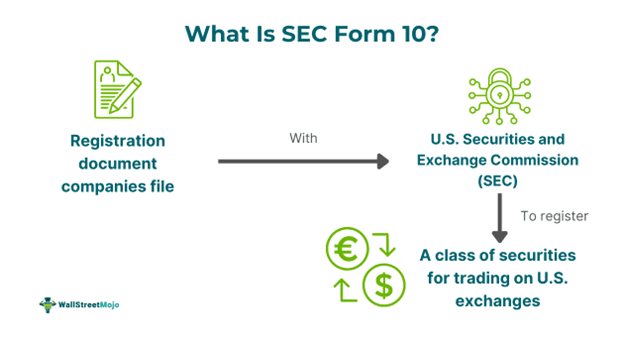
The sole objective of SEC Form 10 is to maintain and encourage transparency and disclosure of all the relevant and crucial information an investor needs to know before making an investment decision. Form 10, along with all its extensions, such as 10(k) and 10(q), can be found online using the SEC’s EDGAR tool for free. Although it is mandatory, more is needed.
Key Takeaways
- SEC Form 10 is a regulatory compliance form filed online by companies willing to issue or sell their securities and try to get their securities traded in U.S. exchanges.
- Although it is not sufficient, it is mandatory with the purpose of information disclosure along with all the details required by investors to make an informed decision.
- It is voluntarily filed as the requirement under Section 12(b) or (g) of the Securities Exchange Act of 1934, along with its other extensions using the EDGAR tool.
- Companies that have over $10 million in assets and 500 shareholders or more fulfill the eligibility criteria to file the SEC Form 10 and must adhere to all the subsequent filings that come with it.
SEC Form 10 Explained
Companies use SEC Form 10 to register a class of securities for trading on U.S. exchanges. This filing is required under Section 12(b) or (g) of the Securities Exchange Act of 1934. Not all companies are required to file SEC Form 10; they must meet specific criteria to be eligible.
Filing SEC Form 10 is part of the regulatory compliance process, but it is not sufficient to register securities for trading on its own. Companies must also comply with additional regulatory requirements, including validation by the Financial Industry Regulatory Authority (FINRA). Once SEC Form 10 is effective, the company must be prepared to fulfill ongoing reporting requirements, such as annual reports (Form 10-K) and quarterly reports (Form 10-Q).
SEC Form 10 is an extensive document that can be accessed online through the SEC’s EDGAR database. The form includes detailed information about the company’s financial statements, beneficial owners, management, legal proceedings, and descriptions of directors and officers. The filing process involves submitting multiple copies, including digital and manual signatures, along with all necessary exhibits.
The filing process for SEC Form 10 is complex and triggers additional forms that companies must file periodically. These include annual reports (Form 10-K), quarterly reports (Form 10-Q), and current reports (Form 8-K).
Components/Elements
The main elements of the SEC Form 10 that need to be present and attached during the filing process are –
- The type and nature of the business of the company filing the Form 10 to issue securities.
- The issuer must mention all the risk factors associated with business operations, projects, and other professional investments.
- The company must disclose all relevant financial information required by investors to make informed investment decisions.
- All properties and assets owned by the company must be disclosed with proper paperwork and documentation.
- The company must reveal the security ownership of management and other beneficial owners, including directors and executive officers.
- Details of executive compensation, relationships, associated transactions, and director independence must be included.
- The company must disclose details of any legal proceedings they are associated with or involved in.
- The market price of the registrant’s common equity, related stockholder matters, and dividend details must be disclosed.
- Information on recent sales of unregistered securities and a description of the securities to be registered.
- Financial statements and supplementary data must be included, along with the indemnification of officers and directors.
- Additional statements, exhibits, legal proofs, and any disagreements with accountants on accounting or financial disclosure must be provided.
How To File?
The main steps and requirements to file the SEC Form 10, along with the eligibility criteria, are as follows –
- Companies with over $10 million in assets and 2,000 shareholders, or 500 shareholders who are not accredited investors, are required to file SEC Form 10.
- Three complete copies of the registration statement, including all paperwork, such as financial statements, legal documents, proofs, and exhibits, must be filed with the SEC.
- Five copies without the attachment of exhibits must also be filed with the SEC.
- One complete copy with all paperwork must be filed with each U.S. exchange where the entity is interested in registering for the trading of any class of securities.
- One complete copy of the registration statement and one complete copy with each exchange must be manually signed. If not manually signed, they must possess typed or printed signatures.
- Financial statements must not be omitted, but specific information about foreign subsidiaries can be omitted to a certain extent.
- If certain information is omitted, the form must include a statement informing about the omission, and the subsidiaries involved must be mentioned separately.
- The Form 10 registration typically becomes effective 60 days after filing unless the SEC accelerates or delays the effectiveness.
Examples
Below are two examples of SEC Form 10. The first example is a hypothetical scenario, but the second example is from real-world news –
Example #1
Suppose a company with $18 million in assets and 540 shareholders wants to issue and sell securities across U.S. stock exchanges. As per the criteria, it meets the threshold for filing SEC Form 10. To proceed, the company must file SEC Form 10 with the Securities and Exchange Commission (SEC), providing detailed information such as the business type, financial statements, risk factors, properties, legal proceedings, supplementary data, recent sales of unregistered shares, executive compensation, exhibits, and dividend information.
The Form 10 registration typically becomes effective within 60 days from the date of filing. During this period, the company’s management must prepare to meet ongoing reporting requirements, including filing subsequent forms such as Form 10-K (annual reports), Form 10-Q (quarterly reports), and Form 8-K (current reports).
The purpose of filing SEC Form 10 is to ensure transparency and provide all relevant information required for investors to make informed decisions. However, more than filing Form 10 alone is required; the company must also comply with other regulatory requirements and processes to maintain its listing and ensure continuous disclosure.
Example #2
Here is a press release from Forestar Inc., a construction and development company based in Texas, announcing its filing of the SEC Form 10-K. All its information is available online on the analytics platform Quantisnow, which provides details regarding the company’s financial information, reports, and statements.
The SEC Form 10-K is an annual report used to provide comprehensive information about a company’s financial statements and business conditions, including audited financial statements, to the SEC. The form includes detailed information about the company’s financial performance, risk factors, management’s discussion and analysis, and other essential data. The platform Quantisnow also offers live feeds, alerts, and analyst ratings, providing users with real-time updates and insights into Forestar Inc.’s financial status and performance.
Importance
The importance of SEC Form 10 is –
- SEC Form 10 is a critical component of the Securities and Exchange Commission’s (SEC) regulatory framework, overseeing U.S. stock exchange movements and operations.
- It encourages transparency, disclosure, and the flow of information, enabling investors to make informed decisions based on accurate and comprehensive data.
- The voluntary filing of SEC Form 10 and subsequent filings of its extensions contribute to the framework established by the SEC and the Securities Exchange Act of 1934. It also aligns with the Financial Industry Regulatory Authority’s (FINRA) requirements.
- SEC Form 10 applies to companies that meet specific eligibility criteria set by the SEC, ensuring that only qualifying companies are required to comply with these extensive reporting and disclosure standards.
Frequently Asked Questions (FAQs)
What is the difference between SEC Form 10 and S-1?
The main difference between Form 10 and S1 is that the former automatically becomes effective after 60 days of filing, regardless of whether the issuer has responded to the SEC’s comments. Still, with the latter, the SEC renders comments within 30 days post-filing, and only upon satisfaction will the SEC declare the registration statement effective.
What is SEC Form 10 K.T.?
SEC Form 10-KT is filed when a company changes the end date of its fiscal year. It is a transitional report. This SEC form is filed until the new 12-month period of the fiscal year ends; once the newly dated fiscal year is in effect, the company goes back to the standard SEC 10-K form. Both forms share details about the company’s business and balance sheet.
What is the biggest difference between a SEC Form 10-K and a 10-Q?
Both are extension forms of the standard SEC Form 10 and are triggered as the Form 10 becomes effective 60 days after filing. The only main difference between a 10-K and a 10-Q is that with the 10-Q, financial reporting is done quarterly, three times a year, including unaudited financial statements, but with Form 10-K, financial reporting to the SEC is due annually and must include all audited financial statements.