
What Is Market Risk Management?
Market risk management is the process of monitoring, analyzing, identifying, and informing about any potential risks and helping investors and companies mitigate such risks and protect their investments and portfolios. Risk management also helps optimize returns by allowing adjustments to be made as per market conditions.
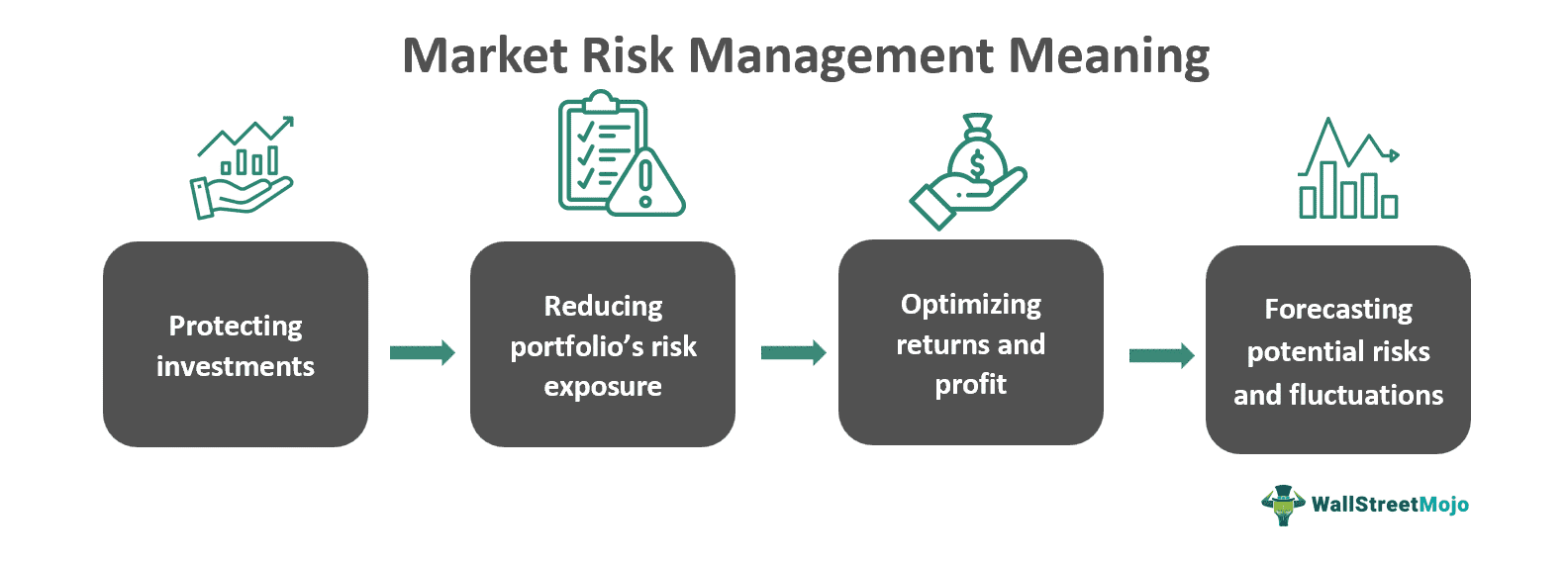
It is used by brokerage firms, institutional investors, traders, and even retail investors to ensure that their investments or portfolios remain secure and stand firm through the ups and downs of market conditions. Market risks are inevitable and occur due to multiple factors; hence, the strategies are also employed to safeguard portfolios and, most importantly, explore different financial markets.
Key Takeaways
- Market risk management is the monitoring of market conditions parallel to investments and portfolios to mitigate and reduce risk exposure and protect assets across markets.
- There are five main types of market risks: interest risk, liquidity risk, country risk, currency risk, and commodity risk, which define different factors that can affect investments.
- The most common strategies are hedging, stopping loss orders, fundamental analysis, diversification, dollar cost averaging, and active portfolio management.
- Market risks are bound to occur, but with proper risk management skills and strategies, one can protect their money and portfolio and maximize returns.
Market Risk Management Explained
Market risk management definition refers to a process performed by individuals and organizations to safeguard investments and trades in financial markets. It is evident that no investor, market participant, analyst, or financial advisor seeks loss in the market, but again, market risks are inevitable and always run parallel to investments. This is where it comes into play. In a nutshell, it refers to the whole process of reducing risk exposure and optimizing returns, whether it is a single investment or an entire portfolio.
There are many different types of market risks in financial markets, such as interest rate risk, which is directly caused by the shift in interest rates; country risk, which is defined by the economy’s condition along with any form of global event such as natural disasters, wars, disease outbreaks, political unrest. Liquidity risk denotes how easily the investments can be converted into cash. Some risks only exist in certain markets, such as commodity risk linked to the commodities market or the currency risk that exists in forex and depends on foreign exchange rates.
There are market analysts and financial experts who develop testing market risk models to gauge the number of losses securities a particular industry would suffer under multiple market conditions and assist in setting risk limits and denoting risk tolerance for investors to safeguard against market ups and downs. There is no guarantee that a particular strategy will always work, and there are absolutely no tricks to beat the market. Still, it allows people to stay aware and informed and take calculated risks, earning the best returns possible.
Strategies
The strategies used in this concept are:
- Diversification – It is by far the most common and adored strategy among investors and other market participants. In simple terms, it refers to spreading investments and allocating funds in a variety of asset classes rather than putting all money in one asset. This way, the portfolio stays protected against market fluctuations, and the overall risk is reduced.
- Stop Loss Orders – This an essential and common market risk management strategy, which involves using stop loss orders at a predetermined price level or point so that in case of a price decline in stocks, it automatically gets executed for a sell order, limiting potential losses.
- Active Portfolio Management – This strategy is simple in theory but demands constant monitoring and adjustments in the portfolio. It requires the time and skill of an investor or fund manager who can interpret market conditions and make steady yet informed decisions.
- Hedging – Advanced investors mostly apply this market risk management strategy, and it is primarily associated with options or futures contracts to offset potential losses.
- Fundamental Analysis – Again, this strategy requires knowledge and skills to properly evaluate a company’s financial position, industry trends, past performance, ratio analysis, and data understanding through technical indicators and metrics. It is a highly recommended strategy to identify undervalued stocks.
- Dollar-Cost Averaging – In this strategy, the investor keeps on investing a consistent amount of money in the financial markets at regular intervals without giving second thoughts about the market conditions. It induces financial discipline in people, and they can leverage market volatility to accumulate more shares at a low price.
Examples
Below are two examples of capital market risk management:
Example #1
Jack is a new investor, but he is not naive when it comes to money management. He invested a reasonable amount of money in the stock market but has only bought shares of four companies, three of which belong to the banking sector. The fourth is steel industry stocks.
Although his portfolio is small, he regularly reads market news, follows advice, and watches interviews with market experts. He is also taking an online course on personal finance and stock market fundamentals. He performs a VaR analysis of his portfolio, which tells him that his portfolio is at high risk of exposure to potential market risks.
Jack finally decides to diversify his portfolio and allocate the same funds to five more stocks. Now, he has nine stocks in his portfolio, but most importantly, it is well diversified now because the capital is well allocated in stocks across different sectors. It is a simple example. Jack not only diversifies his portfolio but stays informed and updated about market news and does not panic.
Example #2
In December 2023, Credit Agricole CIB was associated with Opensee for a new risk market management solution. Credit Agricole is a French international banking group also known as La Banque Verte. It is headquartered in Montrouge, France. The solution will work to consolidate the bank’s datasets for its global market lines.
Opensee’s self-service tools will enable the bank’s global markets management to monitor and report risk exposure in all of its transactions and trading activities. It will also store all of the bank’s market data in a single depository. A higher level of data accuracy will reduce operational risk, giving managers quicker access to better oversights.
Importance
The importance of capital market risk management is:
- It is of foremost importance because it helps market risk management analysts prevent and mitigates risks associated with securities and assets.
- Risk management assists in comparing risks across various asset classes, trading units, and portfolios.
- Helps investors in performance evaluation and predicting potential risks and foreseeable threats with different stocks and financial instruments.
- With proper risk management of the market, capital allocation and timely revision of portfolios become easy and effective.
- With effective management, investors can perform an efficient portfolio diversification across all asset classes.
- It helps reduce the risk exposure of securities against different forms of market risks and protects investments.
- The concept is not limited to only the stock market but can also be implemented in different financial markets such as crypto, forex, options, and commodities.
Frequently Asked Questions (FAQs)
What is VaR in market risk management?
VaR stands for value at risk. It is one of the most preferred methods to measure market risk. The whole technique involves statistical analysis that quantifies potential losses along with the loss probability linked to a stock or entire portfolio. The method is based on assumptions and, hence, has a degree of inaccuracy attached to it.
What is market risk management in an investment portfolio?
It refers to monitoring each investment in a portfolio. A portfolio can be made of stocks from different sectors, or it could also include assets across different markets, such as commodities, currencies, or crypto. However, forex market risk management is more complex and linked to currency rates. The whole objective is to ensure the investment remains protected against any form of market risk by implementing specific strategies.
What is the checklist for market risk management?
The checklist for market risk management is as follows:
- Diversifying the portfolio by exploring different asset classes.
- Reading news and market updates to stay informed.
- Learn about the fundamental analysis and interpretation of technical indicators and metrics.
- Check on individual risk tolerance and move forward, keeping that in mind.