
What Is Data Generating Process (DGP)?
The data generating process (DGP)in econometrics is a standard set of rules defining a procedure for generating data from raw sources. The main goal of DGP is to use this raw data and process it in a better way for analysis and other purposes.
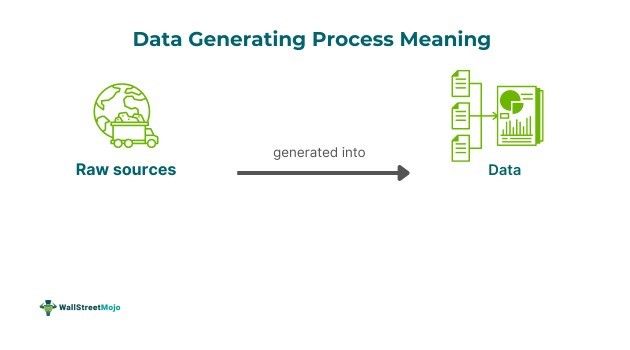
The data generating process model has various applications in the statistical world. It sets out rules and methods by which data must be created and generated. Plus, it helps in model selection and machine learning processes. However, there is quite a difference within each process.
Key Takeaways
- The data generating process (DGP) is a standardized method used in econometrics and machine learning. It helps in obtaining and generating data from raw sources.
- The application of DGP is visible in machine learning and statistics. Data scientists use it to determine the probability of events.
- The types of DGP include probability-based and non-probability-based generating processes. Data graphing and DGP have a strong relationship between them.
- For example, firms might use the consumer’s reviews and feedback, convert them to data, and determine their tastes and preferences.
Data Generating Process Explained
The data generating process in econometrics refers to the rules and procedures that must be followed and observed while generating data from raw data sets. The DGP was developed by data scientists for their purpose. With the help of raw data, an analysis or estimation of future trends is possible. For example, a survey of the existing product’s feedback can help the firm generate results that can improve the system.
The first process in machine learning is understanding how the data is generated. However, to generate it, the accumulation of data is equivalent. There are various ways to collect information for data analysis. Some of them include surveys, samples, and population. If the main lead is inappropriate, it can cause errors in the modeling and analysis. Therefore, it is vital to reconsider the samples as the data sources may have randomness. Since the data is derived from different sources and environments, it does not guarantee the results.
The data graphing and data generating process models have an interlink between them. Using the generated data, analysts can easily plot them on the graph and find their relationship. As the data generating process in machine learning is prevalent, similar use is seen in finance, too. Firms usually try to extract journal entries from ledger accounts to prepare financial models for their business. The financial statements have positive distributed variables determining the company’s future growth.
Types
Let us look at the types of data generating processes to comprehend the concept better:
- Probability-Based: In the probability-based data-generating process, a certain level of probability is involved. In short, every element selected from a population or sample has a probability of generating the data. In addition, there is a random selection involved.
- Non-Probability Based: A non-probability data generation is opposite to the type mentioned above. It does not follow a probability procedure. Instead, methods like quota, snowball, and convenience sampling are used.
Examples
Let us look at a few examples to understand it better:
Example #1
Suppose Gloss Ltd is a firm that deals in consumer goods. In total, there are four to five subcategories of products. Every product has a certain feedback, reaction, and application in the market. With the launch of two new products, Gloss Ltd started selling free samples and performing retail sales. By the end of three months, raw data was obtained. Some included surveys, product reviews, market reports, and other methods.
Using this raw dataset, the firm used the probability method to determine the consumer’s interest in the product. If its results are positive, the company can continue producing it. Or else it can lead to minimal market share. Similarly, Gloss Ltd can also use local data generating processes in its financial analysis and modeling.
Example #2
A recent 2023 study conducted by BMC Medical Research Methodology states that the iterative bisection method can generate data in Monte Carlo simulations. These data processes are a key element in designing Monte Carlo simulations. Analysts and investigators can easily create data and find similar features between them as they are vital. Hence, the produced datasets also have specific characteristics. Likewise, this process can also be used to identify the numeric values of the parameters in the data generating process.
Importance
Let us look at the significance of the local data-generating process in the field of machine learning:
- The DGP is useful for determining the relationship between the variables and the associated probability.
- It helps the researchers and investigators find whether the data set is valid.
- Modeling and analysis are possible with the data-generating process. For example, analysts can use financial data to predict the business’s future revenue.
- Using the DGP model, it is easy to calculate the probability for certain variables. Likewise, this method can be used to test other similar models with the same sample size.
- It helps in calculating the error rate and deficiencies within the model.
Frequently Asked Questions (FAQ)
Frequently Asked Questions
What is the data generating process in time series?
In time series, data generating processes use time intervals. The components of the time series include trends, cyclic variation, seasonality, fluctuations, and more. In addition, certain factors also contribute to the process, like exogenous variables outside the model. It helps the users to select the coefficients for the model and prepare it.
What is the data generating process and the probability distribution?
Data generating processes and probability distribution have a strong link between them. Yet, they differ in major ways. The former generates data using the probability distribution channels. However, the process can be deterministic or stochastic.
What are the methods of generating data?
Among the various methods for data generation, observational study and randomized experiment are the supreme ones. As a part of an observational study, the researcher might observe the entire sample size or population and generate data. Or else, they can pick any random samples and continue with the process.