
What Is Tracking Invoices And Payments?
Tracking Invoices and Payments is the process of monitoring and managing the cash inflow and outflow of the company. Invoices are documents used to notify vendors, clients, and suppliers that a payment is due. It works both ways; either the company issues it to its customers and clients or receives it from suppliers and vendors for payment collection.
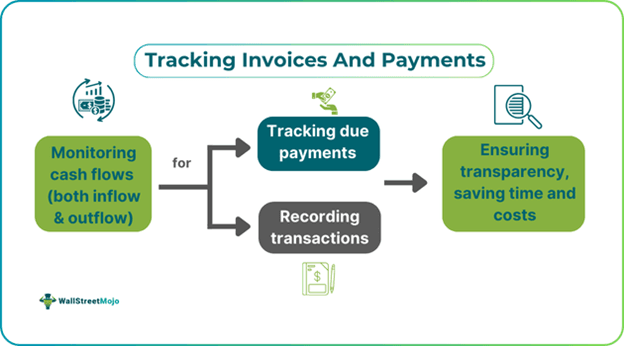
When invoices are tracked, their status from the time they are sent to and received by the concerned parties to the moment the payment is done is tracked. Invoices hold important information about the products sold or services rendered and are also useful to record all the transactions between two parties. At the same time, they help in identifying errors and discrepancies in the records.
Key Takeaways
- Tracking invoices and payments is the accounting practice businesses adopt to monitor, track and manage bills and payments issued to or received from different parties.
- It helps to track cash flow, monitor and manage expenses, inform clients and suppliers of overdue payments, and track transactions for all the products sold and services rendered.
- The main steps to track invoices and payments are to select accounting software, train employees, detect flagged invoices, review invoice reports, communicate with suppliers and strategize plans.
- The three main ways to track invoices and payments are through manual input, accounting software usage, and outsourcing of the entire invoicing process.
Tracking Of Invoices And Payments Explained
Tracking invoices and payments is the accounting practice whereby companies monitor the payments due for the services delivered or received and manage cash flow through collecting payments and settling bills with different parties involved in the business. Invoices are documents shared between parties to alert them about payments and help keep a record of all transactions between two or more parties. Invoices typically have information about the date, amount, payment status, underlying product or service, invoice number and other details that help companies track orders and ensure they are paid on time.
Tracking invoices and payments is essential for cash flow management. A good invoice tracking and payment system helps determine a company’s financial performance, saving time and effort for business owners and inducing smooth payment collection and processing of receipts.
Choosing the right invoicing and accounting practices plays an integral role in monitoring invoices and payments. When a business receives dozens of invoices daily or weekly, it becomes challenging to cater to them all on time. With good accounting practices and the right methods, simultaneous handling of invoices and payments becomes smooth and easy.
There are mainly three ways a company strives to track invoices and payments:
- Manual input, which involves a lot of paperwork, files of reports, documents, bills, receipts and invoices and every process is done manually by employees.
- Through an accounting software, online platform or fintech application in the office. Using it as a primary framework to track and record transactions also helps in automating different tasks.
- By outsourcing the entire accounting or the invoicing process to a third party.
How To Keep Track Of Invoices And Payments?
The steps to keep track of invoices and payments are:
- Selecting an accounting software: Most companies, irrespective of their size and nature of business, rely on accounting software that they install in their offices and use it as a primary tool to monitor, manage and understand the cash flow through invoices.
- Training employees: The management trains every employee working with the company’s accounts to understand and become familiar with the accounting software, the invoice and payments practices adopted by the firm, and other basic standards followed by the business related to payments.
- Following up on flagged invoices: Using the accounting software, the company identifies flagged invoices, both issued and received, to make sure the payments are settled.
- Reviewing and reconciling invoices regularly: This is a crucial step that must be followed. The company or the accounts team must regularly review and reconcile invoices to keep a well-maintained track record of all financial transactions.
- Opening communication with parties: The company, as an active business, must communicate the invoice’s status and overdue payments with all the parties involved in the transactions, including clients, suppliers, vendors, and other important participants.
- Devising future financial strategy: Using accounting software, a business can strategize their future payment tracking and adopt new policies for better monitoring of cashflow and improved management.
Examples
Here are two instances of tracking invoices and payments –
Example #1
Suppose Tulip launches a clothing store, displaying women’s jeans. She markets the product with whatever resources she has and sells the jeans at a very affordable price. Within nine weeks, she opened a small store, given the frequent new and big orders she received from multiple clients. To fulfill these orders, she connects with suppliers for services.
Soon, Tulip realizes that she has accumulated a lot of payments along with the one she has issued. Thus, she hires a team of three women, installs accounting software, and trains them on the best invoicing practices. Furthermore, she follows up on the invoices to identify the flagged ones and takes some time out every week to check and review invoices and reports.
The software helps Tulip settle payments with her suppliers and collect the overdue payments from the vendors and clients. She could track the payments smoothly and keep a detailed record of transactions.
Example #2
In March 2024, Corcentric, a financial solutions provider firm, confirmed integrating AI technology into its services to enhance the accuracy and efficiency of invoice tracking and payment processing for its customers. The sole purpose of this is to remove the need for manual invoice management, as it generally induces errors and mistakes in accounting.
This implementation will likely overcome the current challenges by facilitating touch-free improvements in invoice processing. The AI feature would help extract unique or customized data, refine invoice verification and enhance error and fraud detection mechanisms. The automation of Corcentric’s accounts payable (AP) solutions comes with data capture features that increase the speed, productivity and efficacy of operations and reduce the costs for customers.
Frequently Asked Questions (FAQs)
Frequently Asked Questions
Can Excel track invoices and payments?
Yes, businesses can create a template and follow it to record invoices and check if payments are done or are overdue. Although Excel has its formulas and formatting functions that can automate certain tasks, it is considered a manual way of monitoring invoices as the data must be typed in. Hence, most companies nowadays opt for accounting software or online tools for tracking invoices. If you have small orders and limited invoices to handle, Excel can be used for tracking purposes.
How does the VA help track invoices and payments?
A virtual assistant helps in tracking invoices and payments by – – Using software to manage, create and share invoices with business owners and other parties, taking care of the paperwork. – Enabling operations from different locations, managing invoices, and handling bill-sharing tasks online. – A virtual assistant takes care of all the paperwork and digital files needed. – They also follow up on unpaid invoices and send alerts to business owners.
How important is it to choose the right method to track invoices and payments?
The importance of opting for the right method to track invoices and payments is as follows – – Saves time and effort and reduces management costs – Promotes transparency and seamless payment collection – Through the right method, invoices help in recording transactions – Offers a brief overview of cashflow and financial performance – Helps avoid late payments, miscommunication, confusion, poor cash flow and a bad reputation.