


What Is Permanent Life Insurance?
Permanent life insurance is a life cover with no expiry date. The life insurance provider or company enters into a contract with the policyholder. They commit to providing lifelong protection and cash value build-up benefits unless the policy gets terminated because of non-payment of the premium.
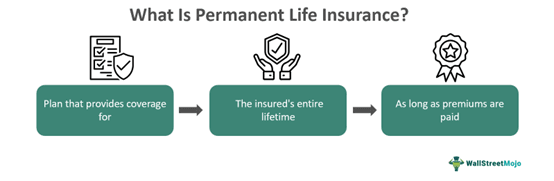
Thus, many permanent life insurance policies provide dual benefits to the insured, I.e., death benefit and cash value accumulation. Also, it provides added tax benefits to the policyholder on cash value growth and withdrawals. However, its insurance coverage costs more than the term life insurance plans, I.e., the policyholder has to pay a considerable premium for such policies.
Key Takeaways
- Permanent life insurance provides lifelong coverage, offering both a death benefit and a cash value accumulation feature.
- Policyholders can access funds from the cash value account and take loans for various purposes, such as education, marriage, or home expenses.
- While permanent life insurance offers coverage for the insured’s entire life, term life insurance provides coverage for a specified term. However, it typically has higher premiums compared to term life insurance.
How Does Permanent Life Insurance Work?
Permanent life insurance is complete coverage that provides cash value account benefits to the insured until they are alive and guarantees a payout to the beneficiaries after their death. It is, therefore, more advantageous than term life insurance, which expires after a particular period.
It is a suitable insurance option for those who wish to leave behind a legacy for their beneficiaries in the form of insurance payout. Let us now understand the workings of the best permanent life insurance. The policyholder must pay regular premiums to the insurance provider to keep the policy active. After the insured’s demise, the insurance company hands over the payout or death benefit amount to their beneficiaries, as mentioned in the policy. The payout of the insurance amount is often tax-free.
Such policies also accumulate cash value over time by maintaining a portion of the premium in the policyholder’s cash value account. The insurer invests this money in plans that provide tax-deferred earnings. Policyholders can borrow funds against such an account or withdraw for various reasons. However, such borrowings cannot be made during the waiting period, which extends for some time after the rider purchases the plan. Also, such a life cover is flexible enough, thus allowing for increasing or decreasing the death benefit, adjusting the premium payments, and choosing an investment strategy for the cash value. The insured can also choose to surrender the policy for its cash value or use it to pay the premiums.
Types
There are several types of policies, each with different features, benefits, and costs. The best option depends on the rider’s needs and financial situation. It includes:
- Whole Life Insurance: The premiums remain fixed throughout the policy’s lifetime. Thus, the insured may pay premiums for 10, 20, 30, or even 100 years in such an insurance plan. Also, the cash value builds up comparatively slowly in such policies.
- Universal Life Insurance: This policy is quite flexible as it provides for the adjustment of death benefits and premiums per the policyholder’s financial condition. Also, the policyholder can maximize their insurance payout by adding cash value to their death benefit in universal life insurance.
- Variable Life Insurance: This policy offers the freedom of selecting the investment strategy for their cash value, such as stocks and bonds. Thus, variable life insurance is also one of the high-risk forms of permanent life coverage but may yield considerable returns.
- Indexed Universal Life Insurance: This policy aids the insured in availing of the features of universal life insurance and aligns their cash value growth with the broad securities index. Setting the minimum and maximum return rates helps investors to avoid losses and make significant gains.
Examples
Let’s understand the concept with the help of some examples.
Example #1
Suppose Mark, a 30-year-old entrepreneur, chooses a variable life insurance policy with a $750,000 death benefit, allowing him to invest premiums in stocks and bonds for potential cash value growth. Five years later, as his business thrives, he increases premium payments and adjusts his investment strategy. Tragically, at age 40, Mark passes away due to illness, but his beneficiaries receive the full $750,000 death benefit, ensuring financial stability. Additionally, the accumulated cash value provides his family with extra support for their future financial needs.
Example #2
Suppose Sarah, a 40-year-old mother of two, decides to purchase a permanent life insurance policy to safeguard her family’s financial future. After careful consideration, she opts for a universal life insurance policy with a death benefit of $1 million. Sarah pays monthly premiums of $300, which remain flexible to accommodate changes in her financial situation.
Ten years later, tragedy strikes, and Sarah passes away unexpectedly.
However, because she diligently maintained her premium payments, her beneficiaries—her husband and children—receive the full death benefit of $1 million from the insurance company. In addition to the death benefit, the cash value accumulated over the years provides her family with additional financial stability during their time of need, ensuring they can cover immediate expenses and maintain their standard of living in the absence of Sarah’s income.
Example #3
In October 2026, MassMutual introduced two new participating whole life insurance policies: Whole Life Guard 10 Pay and Whole Life 95. Both offer lifelong coverage and tax-deferred cash value accumulation, with the potential to earn policy dividends, which are not guaranteed. The launch highlights how Permanent Life Insurance products can offer different premium-payment structures while supporting long-term financial protection and legacy planning.
Pros And Cons
The various advantages of investing in a permanent life cover are discussed below:
- Lifetime Coverage: The policyholder gets guaranteed coverage until they die. This ensures that beneficiaries receive the death benefit irrespective of when the policyholder dies.
- Cash Value Accumulation: A portion of the premium of such policies is contributed to the cash value account. The insured can withdraw cash from this account or borrow against it for the child’s education, house down payment, business, or meeting retirement expenses.
- Tax Benefits: The permanent life insurance policies offer several tax treatments, including tax-deferred cash value growth and tax-free withdrawals.
While such coverage is better than the term life plans in terms of benefits, the following are some of its disadvantages that cannot be overlooked:
- Expensive: These policies have higher premiums than term life insurance since they offer coverage for the policyholder’s entire lifetime and accumulate cash value.
- Complexity: Such plans are challenging to comprehend, especially for novices or individuals unfamiliar with insurance products. Therefore, the insurance agent or financial advisor must explain the plan’s features, benefits, and costs to the policyholders.
- Limited Investment Options: Since the cash value accounts offer lower returns than the other investment products, it is not feasible to invest in such plans just for cash value accumulation.
- Penalty on Non-Repayment of Cash Value: If the policyholder fails to repay the borrowed sum against the cash value, such due amount is adjusted from their death benefit.
- Involves High Risk: As it involves the cash value component, frequent tracking of the investments is required.
Frequently Asked Questions (FAQs)
Frequently Asked Questions
How much does permanent life insurance cost?
A whole life insurance plan may annually cost somewhere between $180 to $3000 for a young person, I.e., a minimum of 25years old, depending upon their age (up to 55 years) and the coverage value (I.e., between $250000 to $1000000).
Can you cash out permanent life insurance?
Yes, it typically has a cash value component that accumulates over time. Policyholders have the option to surrender their policy and cash out this accumulated cash value. However, surrendering a policy may result in tax implications and potential fees, so it’s essential to carefully consider the decision and consult with a financial advisor to understand the full implications before proceeding.
Is it good to have permanent life insurance?
Yes, this policy offers lifelong coverage and the potential for cash value accumulation, making it suitable for those seeking long-term financial protection and estate planning. However, it comes with higher premiums compared to term life insurance. Evaluating individual financial goals and needs is essential to determine if the policy aligns with one’s overall financial strategy.