


What Is Private Equity (PE) Fund Structure?
Private equity (PE) fund structure refers to a framework that states how a private firm will be operated and how the returns will be allocated among investors when the business seeks investment from institutional investors, public pensioners, and affluent individuals instead of public listing.
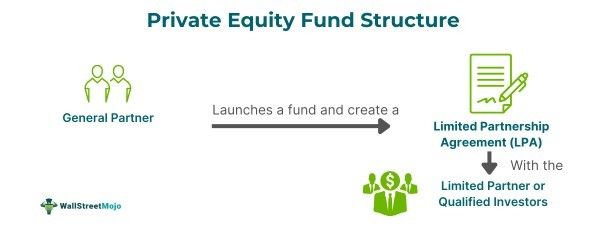
Such investments are closed-end, comprising General Partners (GPs), Limited Partners (LPs) and the respective fund. Although the GPs’ liability is unlimited, they are responsible for managing the PE funds, for which they charge a certain management fee. However, the LPs’ liability is finite to the extent of their invested capital.
Key Takeaways
- A private equity fund structure refers to the formation of a close-end fund offered to qualified investors rather than the public listing of stocks.
- A GP is the legally recognized individual or firm responsible for launching, controlling, and exiting the private equity fund.
- They are exposed to the obligations and debts associated with the fund. In return, they get a management fee and carry.
- An LP is an institutional investor or high-net-worth investor who has a finite liability up to the extent of their invested capital.
Private Equity Fund Structure Explained
A private equity fund structure is an arrangement whereby the general partners (GPs), and limited partners (LPs) proceed with a limited partnership agreement (LPA) for the management, administration, and operations of a private equity fund. Unlike publicly traded stocks, PE funds secure capital from qualified investors like high-net-worth individuals, institutional investors, insurance companies, endowments, pension funds, etc. The PE funds can be traced back to the beginning of the 1900s. However, they became popular during the 1980s when venture capital was considered a major source of funding in the US technology sector.
There are different types of private equity fund structures, including venture capital, mezzanine debt, leveraged buyouts, distressed debt, private placement loans, or fund-of-fund portfolios. These are generally initiated through limited partnership deals between the GPs and the LPs. These funds are only available to qualified investors who can invest $200,000 or more and can take the substantial risk of losing all their money if the investment incurs a complete loss. Moreover, these funds are not available for exchange in the secondary markets until their exit phase. Indeed, these investments are not highly regulated by the government and regulatory bodies since they are close-end investments that are not available for public trading.
Fund Structuring Options
A private equity fund structure requires substantial investment and involves significant risk because these funds are less regulated, although they have the potential to provide impressive ROI. Let us now have a look at the private equity fund structure diagram below:
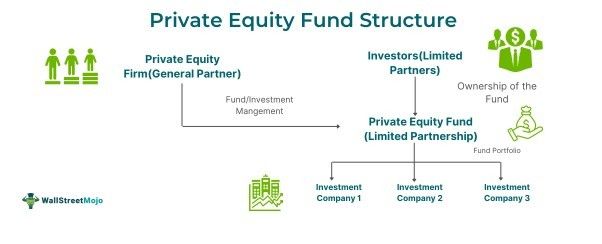
Hence, it is essential for the investors to closely scan the structure of such funds for the following components:
#1 – Fees
The general partners (GPs) are liable to receive management and performance fees. Since the GPs are responsible for the administration and operational management of the investment, they charge a 2% management fee of the total value of the assets under management (AUM). Such fees include their deal fees, salaries, and other administrative or operational charges. Also, they receive a performance fee, which can be up to 20% of the fund’s profits. As these fund managers work for their interests and that of the investors, they deserve such an incentive.
#2 – General Partners
A general partner (GP) is a person or entity that oversees the operations and management of a fund within a private equity fund structure. They are exposed to unlimited liability for the total debts or obligations associated with private equity firms. GPs are the deal leads who play a significant role in the funds’ performance by sourcing deals and securing investments from qualified investors. They also receive management and performance charges.
#3 – Limited Partners
The limited partners (LPs) are qualified investors like high-net-worth individuals, pension funds, institutional investors, insurance companies, endowments, etc., who invest large amounts in private equity funds. Also, the liability of the LPs is restricted to their invested money, just like the equity shareholders. Moreover, they are not responsible for fund management nor have any control over the investments, unlike GPs. The PE funds diversify the investment portfolio of the LPs while offering a significant return on investments.
#4 – Limited Partnership Agreement
A limited partnership agreement (LPA) outlines the terms and conditions to which a limited partner agrees while investing capital in a fund under a private equity fund structure. It mentions the risks and obligations of both the LPs and the GPs. The LPA further states the fund duration, which is usually 10 years. The various stages in a fund’s life cycle include:
- Fund constitution and organization;
- Fundraising period, which extends up to 12 months;
- Sourcing a potential deal and investing in it;
- Portfolio management lasting for 5 years; however, it can be extended for a year;
- Exit the position through different exit options like secondary market listing, initial public offerings, and trade sales since the GPs have to introduce a new fund or because of the investment structure.
#5 – Investment and Payout Structure
The private equity fees provided to the GPs rely primarily on the proven performance of previous funds. While the LPs receive the return on investment, the GPs are eligible for the management fees and performance charges or carry. The PE funds charge a maximum of 2% management fees based on the overall assets under management (AUM) value for legal services, marketing, deal sourcing, salaries, data and research expenses, and other variable and fixed costs. Moreover, these funds are liable to get a carry, amounting to 20% of the total fund’s profits. These charges motivate the fund managers to perform better.
Examples
The PE fund structure helps budding companies secure capital without listing on the public exchange for trading. Below are some of the relevant examples:
Example #1
Suppose ABC firm launches an XYZ private equity fund, which aims to allocate a total sum of $100 million. The GP, I.e., ABC firm, sources a potential deal with the PQR Real Estates Pvt. Ltd., which is a growing real estate firm with promising future returns to the investors. Now, ABC firm undertakes various activities like data and research, marketing, and legal procedures for the successful launch of the fund.
The fund secured investments from institutional investors like insurance companies and pension funds, who were termed the LPs in this real estate private equity fund structure. Also, the minimum required investment was ascertained as $200,000, and the management fee was 1.7%. At the same time, the GP is eligible for a 20% share in the fund’s annual profits. The fund has a life cycle of 10 years. In the span of 7 years, the GP generated a 12X return for the investors and then exited the position through IPOs.
Example #2
On May 19, 2021, the top global investment firm, KKR, released the KKR Real Estate Select Trust Inc. (KREST). It is a registered closed-end fund with continuous offerings focused on financing income-generating commercial real estate, private real estate debt, prime single-tenant properties, and preferred equity interests. The fund also has the flexibility of global investment along with developed markets like Asia and Europe. The total assets under management (AUM) account for $28 billion as of March 31, 2021. Further, KREST will represent its daily net asset value (NAV) reporting, quarterly tenders, daily subscriptions via ticker, and monthly distributions and will benefit from REIT tax treatment with 1099 tax reporting.
Also, the fund is specifically designed for individual investors, offering greater transparency and accessibility compared to traditional institutional funds. KKR has invested over $150 million from its corporate balance sheet to seed KREST, ensuring a solid alignment of interests and providing a fully deployed, income-generating portfolio from the outset.
Frequently Asked Questions (FAQs)
What is the difference between GP and manager in private equity fund structure?
The general partners (GPs) have the legal right to manage a fund and make relevant decisions. They also assume the liability for all the debts involved in the fund.
On the contrary, a fund manager or management company serves as an operating firm comprising investment professionals who administer the investments and ensure proper capital allocation.
What are the benefits of a private equity fund structure?
Limited partners (LPs) can expect immense returns with these types of investments. Moreover, they can efficiently diversify their investment portfolios, accelerate their financial growth, fulfill their interests, and be assured of the fund’s active management.
A well-defined PE fund structure can help the GPs exhibit their fund management skills and derive huge profits over the fund’s lifetime. Also, it facilitates their easy exit from the previous fund to seek new opportunities
What is the limitation associated with a private equity fund structure?
The PE funds investments are restrictive, I.e., the fund managers cannot put the capital in all types of assets. Such a restraint is essential to avoid interest conflicts and safeguard the investors from unreasonable risks.