


What Is Innovation Ecosystem?
An innovation ecosystem is a chain of people, utilities, resources, and other entities that come together to form a collaborative force that operates together to develop new products, services, strategies, frameworks, models, and even general ways of living. It is a complex community that is a significant catalyst in the innovation process.
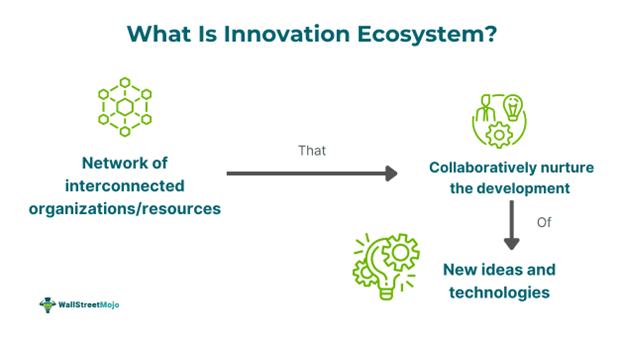
A proper innovation ecosystem comprises corporations, venture capitalists, investors, foundations, government agencies, universities, even mentors, and media, each playing a concrete role in bringing life to new ideas through financial and physical investment and support. It can be seen as a collective effort to create an efficient and effective environment.
Key Takeaways
- An innovation ecosystem is an environment formed through the collaboration of various entities, individuals, products, and services to accelerate practical innovation.
- There are primarily three types of innovation ecosystems: city innovation ecosystems, industry innovation ecosystems, and corporate innovation ecosystems.
- Innovation ecosystems consist of six key components: people, policy, funding, culture, market, and infrastructural support.
- With modern technology, innovation ecosystems are becoming increasingly vital for the corporate, financial, and social growth of an economy.
Innovation Ecosystem Explained
An innovation ecosystem is a network of various participants working together to foster new ideas, skills, products, and services through innovation and technology. An ecosystem creates an environment that supports a specific agenda or objective. The purpose of an innovation ecosystem is to bring together people and various parties who contribute new ideas, insights, and information backed by funding and resources to take action and bring these ideas to life.
There are mainly three types of innovation ecosystem frameworks based on their existence and establishment across different locations and areas:
- City innovation ecosystem: Comprises coworking spaces, seminars, research centers, institutions, and urban government policies that encourage innovation.
- Industry innovation ecosystem: Includes small and large corporations, entrepreneurs, local startups, and venture capitalists.
- Corporate innovation ecosystem: Refers to innovation labs, consultants, dynamic workspaces, and collaborative creators.
Multiple regional innovation ecosystems exist with different objectives. They can be research centers, colleges, or university campuses, providing environments for creators to work on their research. For instance, Silicon Valley in the U.S. is a prominent startup ecosystem where young entrepreneurs generate creative, life-changing ideas and seek support, resources, and funding to develop them. Some of the key benefits of an innovation ecosystem include faster overall growth, transparency in collaboration and communication, and shared goals with diverse perspectives.
Components
Professor Daniel Isenberg, during his research at Babson College and Harvard Business School, introduced six components of the innovation ecosystem –
- People – The first and foremost component of innovation ecosystems is people. This includes entrepreneurs, investors, venture capitalists, stakeholders, network builders, and innovators themselves. All these individuals play a crucial role in devising the right ecosystem, bringing together their knowledge, skills, and experiences.
- Market – An active and free-flowing marketplace. It does not have to be physical; it should have a broad scope of work, supply chains, and a customer base for the growth of an innovation ecosystem. This marketplace also acts as a location of direct access and solutions.
- Policy – When a complex community of different collaborators comes together, including the government, there are several policies and regulations that the ecosystem has to follow and come under obligations in the form of legitimacy. There are regulatory frameworks, intellectual property rights, contracts, tax benefits, funding research, and bankruptcy and labor laws.
- Culture – It goes without saying that culture is the social glue that binds and holds each aspect together. Only with the right culture can activities such as mistakes, failures, errors, and even calculated risks be made. The right culture always encourages ambitious projects, creativity, innovation, and technology.
- Finance – Funding capital and money are the lifeblood of innovation ecosystems. Finance includes microloans, private equity, debt access, angel investors, and, most importantly, the requirement of money without which no research, innovation, or technological advancement can be tried or tested. Whether it is seed money, first round, second round, or bridge financing, each plays its role in the development of new products and services.
- Infrastructural support – The last component is the infrastructural support. This allows the ecosystem to have a physical location, a geographic place that not only has its address but boundaries as well. It is the place where research is done, classes are taken, and transportation, logistics, telecommunication, and cyber security are installed. It is the meeting ground for associations, investors, startups, and support groups, and they are provided with legal, accounting, and banking services.
How To Create?
The process to create an innovation ecosystem follows as follows –
- Inducing support, not competitiveness: The aim should be to support the initiation of the innovation ecosystem with collaboration and collective effort, and it should never, by any means, create competition in society or the market.
- Seeking funding and participation: Without money and resources, no community can flourish, and no objective can be achieved; therefore, maximum participation and capital funding through multiple sources shall be arranged.
- Regulating active information flow: The innovation ecosystem must have a free flow of ideas and information so that maximum resource cultivation and brainstorming can be introduced and efficient testing and scaling design can be performed.
- Designing innovation tool kit: In this stage, the ecosystem is given physicality; it can be a coworking space or an accelerator with different systems and frameworks, such as A.I., high-speed internet, communication, design thinking, 3D imaging, and so on.
- Promote innovation culture: This is again a critical stage where the whole culture of innovation is promoted at different levels, from industry-wide to city or location-wide. Training and workshops are organized to bring people together with new ideas and insights so that actionable plans can be made for them. It also includes event organizing and seminars.
- Remain flexible and dynamic: The last phase is more of a practice that refers to being flexible and dynamic with the operations. There should be fewer or no barriers regarding new ideas and the entry and exit of members, and the whole innovation ecosystem should be seamless and welcoming.
Examples
Below are two examples of innovation ecosystems:
Example #1
Suppose there is a community college for science and engineering that the government partially funds. Students not only study there but are also provided with resources for their personal and professional research and analysis. The college receives additional funding from a group of ethical and ESG investors who aim to contribute to society.
All students, faculty, and management collaborate to generate new ideas through brainstorming sessions. When a project is finalized, the college ecosystem seeks further funding to enable students and physicists to work on it on the college campus.
The college is well-equipped with essential communication tools, gadgets, utilities, power supply, internet connections, and everything innovators need for their experiments. Additionally, the college has a dedicated research and development team. Whenever they create a new product or service, it is immediately tested, and if it solves real problems, the college connects with government authorities for its manufacturing and marketing.
Example #2
The World Health Organization (WHO) contends that the international community’s response to the COVID-19 pandemic was a catastrophic failure. In response, the WHO is developing a pandemic treaty aimed at preventing future pandemics and improving preparedness to save lives and reduce the disease burden.
However, a bipartisan group of U.S. senators is concerned that the treaty could undermine intellectual property laws and disincentivize research and development into vaccines. They argue that such provisions could destroy the innovation ecosystem that recently produced critical innovations like mRNA vaccines and Paxlovid. The senators are calling for the treaty to undergo extensive public feedback through studies and hearings.
The WHO aims to finalize the draft treaty in time for it to be formally debated at the World Health Assembly beginning on May 27. The senators believe that the treaty, as currently drafted, contains provisions that would significantly undercut the innovation ecosystem, which has recently demonstrated its value.
Importance
The importance of the innovation ecosystem is –
- The innovation ecosystem enables innovators to turn ideas into realities by providing the necessary support and resources.
- It facilitates technological advancements that address and solve real-world issues.
- It serves as a meeting place for innovators, investors, entities, and corporations, fostering collaboration and collective action.
- An open innovation ecosystem helps discover and learn new skills and expertise, diversifying the economy and building bridges between businesses, governments, and customers.
- It provides a platform for brainstorming, resource sharing, and creative thinking.
- Innovation ecosystems generate new jobs and business opportunities, helping to reduce unemployment and underemployment.
- New technologies and innovations emerging from the ecosystem simplify processes and bring ease to industries and customers.
- Innovation ecosystems attract capital and financial investments, translating innovative ideas into tangible products that impact daily life.
- They operate as leading examples of how businesses, institutions, and entities can collaborate with the right ideas to improve the world.
Frequently Asked Questions (FAQs)
Frequently Asked Questions
What is the lifecycle of an innovation ecosystem?
The lifecycle of an innovation ecosystem comprises four stages. In the birth stage, goods, services, and products are well understood by all members of the ecosystem. During the expansion stage, the ecosystem spreads across different territories, exploring new areas and opportunities. In the leadership phase, the focus shifts to the establishment and consolidation of the entire framework. The final stage, self-renewal, occurs when the ecosystem connects with larger ecosystems and matures independently.
What are the risks of an innovation ecosystem?
The risks of an innovation ecosystem include several types of challenges. Initiative risks refer to the uncertainties associated with project management. Interdependence risks involve problems that arise from collaboration and coordination among innovators and members of the ecosystem. Integration risks are linked to strategic management, contingencies, and process execution.
Who are the main players in an innovation ecosystem?
Several key groups are the main players in an innovation ecosystem. Innovators bring ideas and information to work on, while the government oversees laws and regulations. Corporations support management and assets, and entrepreneurs develop strategies and procedures. Investors provide the capital funding and resources necessary for the ecosystem to thrive.