


What Is Month-End Close?
The month-end close process is the act of recording and finalizing transactions of a financial nature every month at the end with regard to an organization. The process involves checking and balancing transactions and checking the accuracy of cash levels, budgets and all the records used to substantiate the numbers.
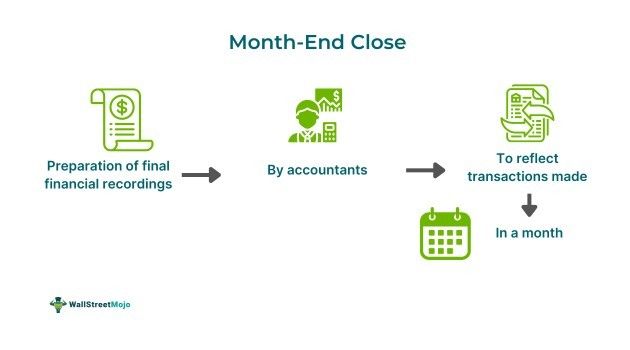
It forms part of the primary functions a finance team has to execute. The process forms the foundation that provides information for monthly financial reporting. The reports are later used for financial analyses, forecasting and solving budgeting issues. The interested parties, such as investors and shareholders, can make decisions based on the records.
Key Takeaways
- Month-end close is the finalizing and closure of all the transactions in an organization that happens in one month.
- The process can be sped up by clearly planning and communicating the deadlines, roles, rules and process.
- Best practices focus on ensuring accuracy, using technology for automation, meeting deadlines and continuous improvements.
- The checklist includes tracking incoming cash, checking bills payable, and proper documentation of inventory and fixed assets. It also includes recording of accrued vacations, taxes, expenses etc, among other things.
Month-End Close Explained
The Month-end close process is recording financial data and analyzing them for business review at the end of the month. It forms the base for preparing financial statements. The use case involves the determination of the company’s financial strength, provision of data for executive decision making and management of operations.
The process helps maintain accurate records and minimize discrepancies. These help in getting through trouble-free audits by professionals. Accurate records help determine the company’s strengths and weaknesses and make decisions for improvement.
Additionally they also help reduce the risks the business faces through continuous monitoring of finances. They help in correcting issues promptly. The process helps the management determine if the resources are utilized properly and efficiently. It also helps in understanding if the implemented plans have resulted in achieving business objectives. These make an organization financially strong and help in gaining funding for expansion.
The process is simple. The accounting teams record transactions, check for accuracy and prepare reports. However, the execution of the process is difficult. Accurate collection and recording requires continuous and meticulous practice of recording information, and checks should be done periodically. These help in the preparation of reports. It typically takes 5-10 days of preparation.
Process
Given below are some of the month-end close activities involved in the process.
- Collect information on monthly costs and income: Cost of payroll, insurance, vendor payments, utility bills, travel fees, bank loan costs etc. Shall be recorded. Proper debit and credit records shall be maintained. Similarly, income from investments, debts, rents, sales revenue etc. Shall be billed accurately to the respective customers.
- Accounts payable and receivable updating: Organizations shall ensure that the bills are paid on time and ensure they are recorded properly. Similarly, accounts receivables shall be checked by ensuring that the customers have paid the credit amounts.
- Ensuring order of accounts: Reconciliation of accounts helps in understanding the mistakes made in financial reports. Organizations shall check the records to find any unfair practices in recording information. The bank accounts and financial records should tally to ensure zero fraud.
- Petty cash account: Organizations that deal with cash shall count physically if there arises a need. There shall be mismatches due to carelessness.
- Inventory checking: Checking inventory not only helps in monitoring the stock it also helps in planning for upcoming months.
- Fixed assets: These are items that add value to a business. They are vital for the organization’s functioning and depreciate over the years. These changes shall be recorded accordingly.
Balancing of paid-in-full and paid-in-advance accounts.
- Recording of payment in advance: The savings accounts help cover the costs of organizations to pay in advance. Similarly, accrued accounts record the income and costs that have already happened. Balancing the two concepts reveals what is the actual earnings for the month. Comparing prepaid and spending accounts can reduce paying twice.
- Report, review and repeat: The reports shall reveal the value, cash flow and profitability of the business. After preparation, it shall be reviewed by a professional to ensure accuracy. However, the next month shall have the same process repeated by implementing lessons from previous recordings.
Checklist
Given below are some of the month-end close activities lists that can be checked off while preparing the month-end balances
- Track money that comes in.
- Check records of bills payable.
- Check entries of originations that match with outside statements such as of banks and vendors.
- Account for petty cash (adjust outstanding checks and deposits).
- Gather financial transaction information (profit and loss report, account books and balance sheets).
- Proper documentation of inventory and fixed assets (account for depreciation).
- Record and write off accounts receivable and payable by looking for past dues or unapplied credits.
- Record any accrued vacation or payroll (employee reimbursements).
- Record accrued taxes such as sales, property etc.
- Record expenses such as maintenance and supply costs.
Examples
Let us look at some examples to understand the concept.
Example #1 – A Hypothetical Example
Let’s say Dan is an accountant, and he recently joined a company that manufactures clothes. The accounts department was already in full swing to close the accounts. But unfortunately the receivable sections did not tally with the balances. He had checked all the records, and all were accurate using a month-end close software. It was then he understood that there was a missing petty cash entry and he asked a junior staff about it and found a cash bill. On checking it with the amount, it was tallying.
Dan, fortunately, could find it. Otherwise, the amount would not have tallied and resulted in the loss of revenue recording in the business books. This would have been avoided by careful planning.
Example #2 – Another Hypothetical Example
Let us take another example of a small electronic business. The company was named ABC Ltd. ABC Ltd was preparing its month-end close balances. The company accountants noticed a huge loss of income. The expenses did not tally to the income they received, but the sales were recorded. On checking the inventory, they noticed that a few more items from the inventory were missing, meaning there had been a fraud happening. Upon further investigation, they found that there were sales made without records, and this had been going on for a while. This explained the reason for the loss of revenue. The process thus helped in detecting fraud and presenting an accurate financial strength of the business.
How To Speed Up The Process?
Given below are a few pointers that help in faster closing of month end closing process
- Standardization of process: Streamlining all related activities helps reduce confusion and increase the efficiency of the accounts team. This involves everybody being aware of the roles, processes, rules and deadlines.
- Make use of automation: Technology helps immensely in recording financial statements. Repetitive tasks, especially, can be automated to save time and effort. This also greatly reduces the risk of errors.
- Continuous reconciliation: Accurate reconciling of records shall be done periodically and not wait until the month’s end. This can help the process become smoother and easier towards the end.
- Task prioritization: Some tasks may be more important than others. Some can be hard, and some easy. Prioritizing and categorizing them can help in the easy and efficient completion of the process.
- Workload distribution: Team members shall be given work equally or proportionately. Overworking shall be avoided at all costs to minimize the chances of errors.
- Planning, communication and preparations for exceptions: The team members shall be aware of the process and clearly assigned what shall be completed by when. This shall include communication of the progress thus far. Expecting the unexpected is important. It helps the team be prepared for contingencies.
Best Practices
Given below are some of the best practices that one can adopt in a month-end closing process
- Focusing on quality: Rushing the collection, recording and reporting processes does no good for the business. It maximizes the chances of errors and misinterpretation. Accuracy helps in transparent and efficient tracking of key performance indicators.
- Meeting deadlines: Ensuring accuracy and not rushing doesn’t equate to skipping deadlines. It involves proper planning from the accounts team to execute things properly. Sticking to a schedule, proper planning and organizing can help in achieving this.
- Automate the processes wherever possible: Technology can be of immense use, and utilizing it to an organization’s advantage ensures efficiency. Automation can be used to remind the month-end close schedule and recording activities. This also helps with accuracy.
- Finding areas of improvement: The problems of previous recording practices shall be taken note of and avoided in the next process. This helps prevent making time consuming and costly mistakes.
Frequently Asked Questions (FAQs)
Frequently Asked Questions
Is month-end close hard?
<p>It can be a complex process if there is no planned-out <i>month-end close schedule</i>. It requires planning, organization and execution of activities to collect, record and reconcile data. The process adopted can vary according to the size and accounting practices adopted by the firm. </p>
What is the month-end closing for payroll?
<p>It is finalizing the employee compensation for the month and reporting them. These details include taxes, benefits and other unnecessary details. The <i>month-end close activities </i>include updating and recording payrolls, generation of reports, accounting for them etc. </p>
Why do companies do month-end?
<p>The process helps in understanding how much of a deviance has been there from the objectives the organization has set. It reveals the utilization of resources from the beginning period till the last date. It reveals the cost incurred, efficiency achieved, etc. </p>
What are the problems with month-end closing?
Entry errors, delayed processing, and incomplete recording are all problems associated with the process. In the case of the use of month-end close software, there may be technical glitches that can be a hindrance to timely data processing.