


What Is Port Management?
Port Management refers to the administration and control of port operations for the timely loading and unloading of cargo in a given region. Considered an integral part of global shipping, its purpose is to manage a port well and ensure its efficient functioning. This, in turn, boosts trade relations, brings foreign investment, and promotes economic growth.
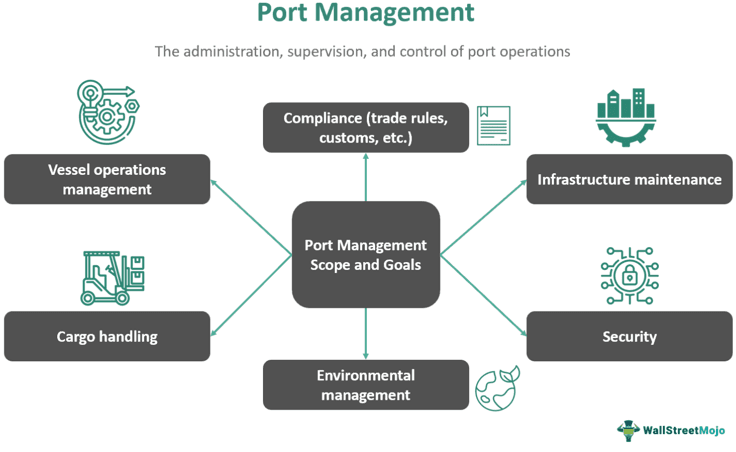
It facilitates global trade and commerce by strengthening the international supply chain and logistics. Reducing transportation costs, lowering lead times, minimizing shipping delays, building infrastructure, and supporting the timely delivery of goods across international borders are some of the chief goals of port management. Also, managing finances (budgeting, cost control, revenue generation, and financial reporting) is crucial for a port’s sustainability.
Key Takeaways
- Port management is a business approach employed to manage ports and related operations. It allows entities to supervise and control operations at multiple ports in a specific region or country.
- It plays a significant role in enabling intercontinental trade and business through the dispatch of ships, cargo, containers, goods, etc.
- The four key financial metrics are port activity, accounting indicators, financial performance, financial capacity, and investment indicators.
- Global shipping lines and maritime trade depend on efficient port operations. It contributes to economic development and international trade.
Port Management Explained
Port management is a business term used to signify the management of ports and related offices. Intercontinental or international trade relies heavily on the effectiveness and efficacy of port operations. It deals with dispatch activities (ships, cargo, containers, etc.) and customs duties. It involves maintaining comprehensive and up-to-date knowledge of port conditions and routes connected to it. Therefore, a port that sees high activity or involves complex procedures requires effective administration.
Port management companies, logistics specialist firms, shipping companies, etc., typically undertake the task of overseeing operations at ports with diverse ownership structures (privately owned, owned by governments, public-private partnerships, etc.).
Port management systems are vital to the success of global shipping and logistics programs. Port security is a key aspect of port operations, where the safety of cargo, ships, and people is prioritized. Compliance with international trade laws and customs is mandatory, making port operations tracking and monitoring critical. Automation and digitalization play key roles in fulfilling these obligations. They help entities streamline tasks, assign responsibility, track progress, monitor completion, and maintain records.
Business entities may treat port management operations like corporate management, where industry professionals, customers, port managers, and policymakers, among others, become essential participants. They measure port performance and use this information for statistical purposes, process improvements, trade route research, etc. Such assessments include determining a port’s operational, financial, and quality-related performance.
For instance, policymakers may study port performance reports to understand trends in domestic and international trade and commerce. Port managers may use such data to improve internal cargo handling processes, packaging, shipping, etc. Using financial indicators to ascertain port performance in monetary terms ensures better decision-making.
Four categories of financial indicators are used in port management operations. They are:
- Accounting: These metrics help measure business profitability.
- Port activity: They measure profitability in terms of cargo per unit.
- Financial performance: It throws light on the financial capacity of port authorities in the context of its investments.
- Financial capacity and investment: It gives entities a quantifiable view of their financial position in the port business.
Role In Global Shipping
Global shipping and port management are critical to international trade. Ports enable the movement of cargo/goods across international borders. Here are some key contributions of port management and logistics to global shipping.
- International trade boost: It supports international trade through the management of port operations, vessel traffic, cargo handling, pilotage (safe navigation), etc. It ensures a smooth flow of goods across ports.
- Infrastructure development: It also includes overseeing existing operations and leveraging potential expansion opportunities. Port management companies or other relevant entities may undertake the development of new ports and build or expand new or existing terminals, docks, and berths.
- Operations optimization: Optimizing shipping operations is possible via process modeling. These models simulate port functions by employing a hierarchy approach to ensure tasks are managed based on their complexities, importance, priorities, or other relevant parameters.
- Port security and safety: Through effective port management and logistics, businesses can ensure the safety of ports, vessels, containers, and cargo ships. It reduces vessel maintenance hassles, prevents theft, smuggling, and terrorism, and promotes compliance with international trade regulations, domestic guidelines, port rules, and customs regulations.
- Technology integration: Technology integration improves resource utilization, boosts productivity, reduces costs, and minimizes service lead times. It also strengthens compliance (customs, import-export rules, etc.).
- Environmental management: It helps protect natural habitats and ecosystems. It aims to reduce the overall ecological impact of international shipping and logistics. It helps control pollution, build wastewater treatment facilities, and take emission control measures. Through effective port operations management, entities can follow sustainable practices, meet environmental regulations, and reduce their carbon footprint.
- Port performance forecasts: Forecasts are essential to develop long-term strategies that meet global demands. They help entities plan investments, make capital budgeting decisions, improve operational performance, and enhance competitiveness in global markets.
Examples
Let us study some examples in this section to discuss the concept in greater detail.
Example #1
Suppose Carol is a businesswoman in charge of managing five ports in the United States. She inherited her father’s port management company, SafeGoods & Co. In the initial stages, Carol found managing port operations challenging. However, Kevin, a senior executive, proposed the implementation of a shipping and port management system to streamline operations.
The idea was to help Carol manage each port and its business in a centralized manner, where she and her team could track every activity, flag problems, and ensure compliance. This would also enable Carol to report to her clients (government agencies and private entities) in a systematic manner and update them about the state of affairs at each port.
Carol knew smuggling was a threat. Hence, she followed stringent verification, tracking, and monitoring processes at each port. This assured clients that Carol handled every aspect of port operations, assigning each function the priority and importance it deserved while ensuring no illegal activities were executed at any of the ports.
Over the years, Carol’s company has established a reputation for delivering efficient, effective, and compliant port management services. Her business grew, and she bagged more port management contracts from various entities.
Example #2
According to an April 2024 post, the United Nations Conference on Trade and Development (UNCTAD) has released a program on port management titled UNCTAD TrainForTrade Port Management Programme. It aims to enhance the efficiency and competitiveness of port management services through knowledge sharing between various stakeholders, trade participants, and entities.
Improving trade flows and boosting economic development across multiple countries are some noteworthy objectives of this program. It also talks about the need to develop, retain, and upskill people involved in port operations management through effective talent management.
This illustrates the importance of port management and why focusing on building efficient port management services, operations, and systems is essential for global financial prosperity.
Example #3
A January 2024 news article shows the importance of introducing well-thought-out business models to enhance service quality across ports. The Port Authority of Thailand (PAT) implemented the New Business Model of Bangkok Port to improve international trade operations by strengthening international logistics.
PAT also signed other deals with entities such as Sahathai Terminal Public Company Limited for inbound vessel management. The authority aims to attract new investors, expand import-export operations, build better infrastructure than before, and increase the country’s competitiveness on a global scale.
This is a classic example of effective port management as it focuses on every aspect of port operations that makes international trade with a country lucrative.
Importance
Port management is a crucial part of the cargo and shipping business. It is significant in the maritime industry, too. Let us understand how.
- Facilitates trade and commerce: Global supply chain and logistics depend on well-planned port operations. Without port management, international and domestic trade and commerce would ground to a halt.
- Promotes economic growth and development: Well-managed ports attract investments and corresponding or allied growth opportunities. They create job opportunities and support a country’s economic growth.
- Creates a smooth channel for operations: Through advanced port management and logistics techniques, it is possible to improve and optimize port operations. Reduced delays, swift movement of goods, decreased costs, and improved transparency are some resultant benefits.
- Builds positive relations with stakeholders: It helps build positive relationships with investors and stakeholders, such as shipping lines, labor unions, government agencies, terminal operators, and insurance companies.
- Enables personnel training: It assigns great importance to human resource and personnel training for port security, operational safety, and regulatory compliance. By acquiring the required skills through comprehensive training, they can perform their duties effectively and efficiently.
Frequently Asked Questions (FAQs)
Frequently Asked Questions
What are the four types of port management models?
The following are some of the popular port management models in logistics. – Public service ports: They are owned and operated by government agencies to deliver services of public interest. – Private ports: Profit is the priority of these ports owned and managed by private entities. – Landlord ports: When ports owned by governments or port authorities are leased to external operators, landlord ports are created. – Hybrid ports: Such ports follow the processes and protocols of public, private, and landlord ports to ensure flexibility and accommodate evolving internal trade needs. – Corporatized service ports: They follow a corporatized operations plan. Governments or port authorities typically own these ports.
What is port management software?
<p>It refers to software applications used for managing and monitoring port operations. This digital solution enables entities to oversee dock operations, track goods in transit, and streamline port operations. For instance, the Port Management Information System (PMIS) allows port operators to manage cargo and ships and control vessel traffic. </p>
What are the stages of port management?
These models focus on operations planning, scheduling, and handling. Off-port-limits operations, port operations and berthing management, ship operations at the berth/terminal, and port and terminal operator’s logistics networks broadly cover the stages of port operations. These functions/stages may differ from one port to another, depending on their services.