


Introduction
Every finance graduate eventually asks the same question: does an equity research career actually pay off, or is it a grueling entry point with a short shelf life? The role sits at the intersection of accounting, valuation, and market judgment, and it remains one of the most cited stepping stones into asset management, investment banking, and private equity.
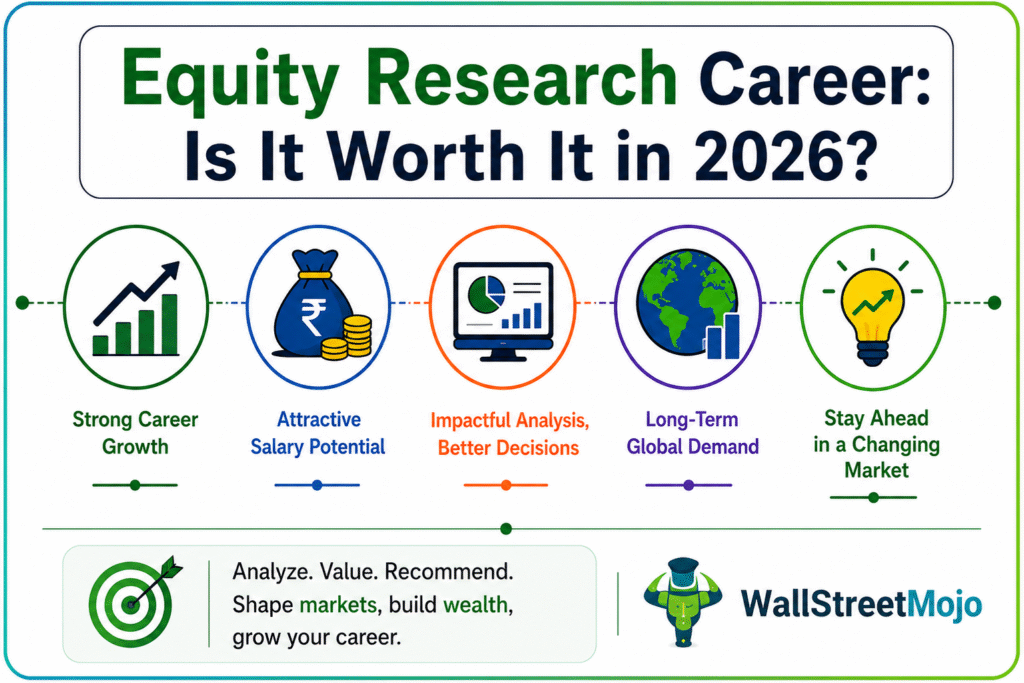
In short, equity research involves analyzing a company’s financials, industry position, and growth drivers to produce buy, sell, or hold recommendations for institutional and retail investors. This article compares the realistic salary bands in India and globally and the career scope over the next decade. Additionally, it compares the main ways aspiring analysts build these skills, including the CFA Program, self-study, and structured online courses. By the end, readers will have a data-backed framework for deciding whether this equity research career path suits their skills and risk tolerance.
What Is Equity Research, And Why Does It Matter To Investors?
Equity research involves evaluating publicly traded companies through financial statement analysis, industry benchmarking, and valuation modeling. Within the field, analysts generally work on either the sell side or the buy side. Sell-side analysts publish research reports for institutional clients. Buy-side analysts work internally at mutual funds, hedge funds, and pension funds to guide portfolio decisions.
The output matters because it directly shapes capital allocation. A well-reasoned research note can move institutional positioning. Conversely, a flawed model can mislead an entire desk. This is precisely why firms weight technical rigor, particularly in DCF modeling, ratio analysis, and trading comps, so heavily during hiring.
Key Takeaways
- Equity research offers strong career potential for professionals who build technical expertise in accounting, valuation, modeling, and market analysis.
- Equity research analyst salary varies based on certain factors, for example, experience, location, employer, etc.
- Career progression typically moves from research associate to analyst, senior analyst, and eventually portfolio management or research leadership roles.
- AI is reshaping equity research, automating repetitive tasks while increasing the value of analysts who can direct and verify AI-assisted workflows.
- The CFA Program provides long-term credibility, while structured courses can add practical modeling, valuation, and Excel-based skills.
- Job prospects remain positive, with BLS projecting approximately 29,900 financial analyst openings annually from 2024 through 2034.
Equity Research Career Path: Roles, Progression, And Buy-Side vs Sell-Side
The equity research career path typically follows a progression from supporting senior analysts to independently managing sector coverage, with responsibilities and career opportunities expanding at each stage. The table below outlines the typical equity research career path, including the experience, responsibilities, and progression associated with each stage.
| Career Stage | Typical Tenure | Core Responsibilities | Common Next Step |
| Research Associate | 0-2 years | Building models, updating comps, drafting sections of reports | Senior Associate |
| Equity Research Analyst | 2-5 years | Owning sector coverage, publishing recommendations, client calls | Portfolio management, PE, IB lateral move |
| Senior/Lead Analyst | 5-10 years | Managing junior staff, high-conviction calls, media visibility | Head of research, buy-side portfolio manager |
| Portfolio Manager (buy-side exit) | 8+ years | Capital allocation decisions across a fund | Fund leadership |
Sell-side research (investment banks, brokerages) tends to offer faster exposure to multiple sectors and client interaction. In contrast, buy-side research (mutual funds, hedge funds) offers longer holding-period thinking. Moreover, generally, it offers better long-term compensation once an analyst proves a strong track record. Many professionals treat sell-side equity research as a training ground before moving to the buy-side or into investment banking.
Equity Research Analyst Salary: India And Global Benchmarks
In India, equity research analyst salary typically ranges from ₹10.8 lakh to ₹12 lakh per year for an experience range of 0-7 years. Also, note that besides experience, other factors influence the salary of such professionals. Some top-paying cities in India include Chennai, Bengaluru, Gurugram, and Mumbai. In the USA, the average annual salary of equity research analysts is $137,372 as of August 3, 2026.
Beyond salary, certifications and technical skills in areas such as DCF modeling, trading comps, and AI-assisted financial workflows can strengthen an analyst’s career prospects.
Equity Research Career Scope: Job Market Outlook and the AI Factor
Is the equity research career scope actually growing, or is it being displaced by automation? The honest answer is mixed but leans positive for analysts who adapt. Broader business and financial occupations, which include research-adjacent roles, are projected to grow faster than the average for all occupations through 2034. The BLS wage data, from May 2024, put median annual pay for this group at $80,920, compared with $49,500 across all occupations.
Financial analyst roles specifically are projected to have roughly 29,900 openings per year on average from 2024 to 2034. BLS attributes demand partly to new investment opportunities, expanding businesses, emerging markets, and the growing volume of financial data. Many openings will also come from replacing workers who change occupations or retire.
Artificial intelligence is reshaping the job rather than eliminating it. Large language models and Excel-integrated AI plugins now handle repetitive tasks such as first-draft model building, variance commentary, and industry summarization. This is allowing analysts more time to focus on judgment calls, management interaction, and thesis conviction.
Analysts who can direct AI tools inside Excel, rather than simply consume AI-generated output, are becoming disproportionately more valuable to research desks. This shift is why structured programs increasingly pair traditional valuation training with AI-powered modeling modules rather than teaching either in isolation.
Skills, Certifications, and Learning Options Compared
The table below compares the main learning paths by typical duration, cost, and the type of learner or career goal each best serves.
| Learning Option | Typical Duration | Cost Range | Best For |
| CFA Program | 2-4 years (3 levels) | $3,000-$5,000+ (exam fees) | Long-term credibility, buy-side and portfolio roles |
| University finance degree | 3-4 years | Varies widely | Foundational theory, campus recruiting |
| Self-study (YouTube, forums) | Unstructured | Free, low-cost | Supplementary learning, not standalone |
| Structured online course bundle | Weeks to months, self-paced | Low, one-time fee | Developing practical modeling, valuation, and AI workflow skills fast |
The CFA charter carries strong signaling value for buy-side and portfolio management roles. However, it demands multi-year commitment and does not, by itself, teach Excel-based modeling mechanics.
University degrees can provide a theoretical foundation, but the amount of hands-on DCF or trading comps practice may not be enough. This is the gap a focused, practitioner-led program is built to close.
WallStreetMojo’s Equity Research Course covers accounting fundamentals, ratio analysis, three-statement modeling, DCF valuation, trading comps, and AI-powered Excel workflows using ChatGPT and Claude. The course sequences these skills so learners can progress from fundamentals to job-ready modeling without having to determine what to study next.
For learners weighing the CFA Program against faster, applied skill-building, this equity research course can complement the CFA curriculum by adding hands-on practice in financial modeling and valuation. It is taught by Dheeraj Vaidya, CFA, FRM, a former equity analyst at J.P. Morgan and CLSA. Learners pursuing an equity research career can combine CFA preparation with applied modeling practice to strengthen both their theoretical understanding and practical skills.
Common Mistakes Aspiring Equity Research Analysts Make
Analysts entering the field frequently underestimate three things: the depth of accounting knowledge required before modeling even begins, the importance of clear written communication in research notes, and the need to defend assumptions under senior scrutiny. A model built on unverified assumptions can mislead an entire investment thesis. That’s why firms test candidates heavily on ratio analysis and financial statement interpretation during interviews, not just on final valuation output.
Conclusion
An equity research career remains worth pursuing for those willing to build genuine technical depth in accounting, valuation, and modeling, particularly as AI tools reward analysts who can direct rather than just consume automated output. Salary growth tends to favor advanced skills and experience, while the job market outlook remains positive despite the impact of automation. For those ready to move from theory to job-ready modeling, exploring a structured equity research course is a practical next step toward building that foundation.
Frequently Asked Questions
Is equity research a good career choice for finance graduates?
Yes, for graduates who enjoy financial statement analysis and valuation work, this can be a suitable career option. It offers strong exposure to accounting, modeling, and market judgment, and often serves as a stepping stone to investment banking, private equity, or portfolio management.
What is the difference between buy-side and sell-side equity research?
Sell-side analysts work at investment banks and brokerages, publishing research for institutional clients. In contrast, buy-side analysts work inside funds, using research internally to guide portfolio decisions rather than publishing it externally.
How much does an equity research analyst earn in India?
According to AmbitionBox, the typical salary range for equity research analysts in India is Rs. 10.8 lakh to 12 lakh per annum for 0-7 years of experience.
Is a CFA charter necessary for an equity research career?
It is not strictly required but carries strong weight for buy-side and portfolio management roles. Many analysts pair CFA study with applied modeling courses to strengthen both credentialing and hands-on skills.
Will AI replace equity research analysts?
AI is automating repetitive tasks like first-draft modeling and data summarization. That said, analyst judgment, client relationships, and conviction-based thesis-building remain difficult to automate, making AI a productivity tool rather than a replacement.
How long does it take to become job-ready in equity research?
With focused study in accounting, ratio analysis, financial modeling, and valuation, most learners reach a job-ready skill level within three to six months of structured, consistent practice.