


What is Extensible Business Reporting Language (XBRL)?
Extensible Business Reporting Language (XBRL) is a digital language and framework for communicating financial and business information electronically. Regulators worldwide mandate XBRL for financial statement generation and reporting, and it is considered the international standard for digital business reporting.
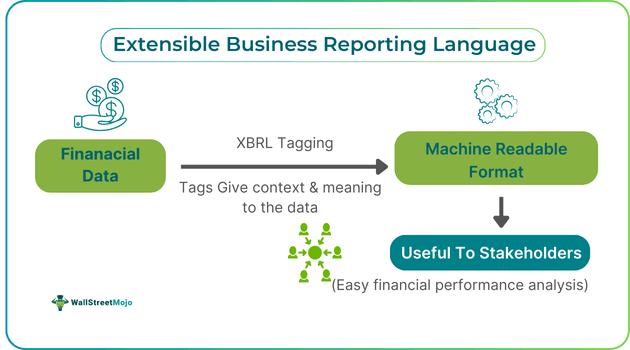
In XBRL, each piece of data is tagged with a digital label (tag), allowing it to be recognized, extracted, and analyzed by software systems. This enhances transparency in financial reporting, reduces information asymmetry, and enables investors and other stakeholders to compare the performance of various companies. XBRL also supports regulatory oversight by standardizing how financial information is reported, simplifying compliance and improving regulatory review efficiency.
Key Takeaways
- Extensible Business Reporting Language (XBRL) is a language based on XML, used for digital financial reporting. It facilitates the creation, sharing, and analysis of business reports.
- XBRL is developed through the combined efforts of non-profit organizations, companies, and government agencies.
- It assists companies in filing financial data in a machine-readable format, which can then be converted back into a human-readable format. XBRL relies on taxonomies and instance documents to function.
- XBRL’s advantages include easier compliance, cost savings, and improved efficiency. Disadvantages include the risk of incorrect filings, inaccurate credit ratings, and potential reputational damage.
Extensible Business Reporting Language Explained
Extensible Business Reporting Language (XBRL) is based on Extensible Markup Language (XML), a widely used standard for structuring and transmitting data. XBRL is designed to facilitate preparing, sharing, and analyzing financial statements and other business reports. It is a royalty-free standard developed and maintained by a consortium of non-profit organizations, private companies, industry associations, and government agencies.
XBRL framework that allows companies to file their financial data in a machine-readable format. Once submitted, computer applications can easily convert the data into human-readable financial reports. Through the use of structured elements such as columns, links, and hierarchical relationships, XBRL makes financial data searchable, comparable, and easily analyzable. This structure helps analysts and investors find and analyze the necessary information. XBRL enables automation of data collection and provides faster access to financial statements, allowing for more detailed analysis in a short time.
Examples
Let us look at some of the examples to understand the concept better.
Example #1
Suppose Dan is an investor who is considering investing in two identical companies (Company 1 and Company 2). Both companies appear promising and operate in the same industry.
Dan decides to review their financial data. Using XBRL filings, he is able to easily analyze key financial metrics such as revenue, net income, and total assets. After comparing the data, he chooses to invest in Company 2, as it has a better profit margin and a more favorable debt-to-equity ratio compared to Company 1.
Example #2
The SEC’s Division of Economic and Risk Analysis (DERA) reviewed the custom tags used in XBRL filings submitted by issuers as part of compliance with the 2009 interactive data rules. U.S. GAAP standards were applied to analyze the XBRL exhibits in Forms 10-K and 10-K/A. Custom tags were permitted when no suitable elements existed to tag specific financial data. However, the SEC has noted that the use of custom tags may reduce the comparability of financial information between companies.
Advantages and Disadvantages
Advantages associated with the use of XBRL:
- XBRL automates reporting procedures, increasing overall efficiency.
- Automation and efficient processes lead to cost savings in data reporting and management.
- XBRL is flexible and adaptable to various reporting needs, making it versatile.
- XBRL benefits all financial data supply chain participants, including companies, regulators, and investors.
- It results in faster, more accurate data handling, enhancing the analysis process.
- Easy access to high-quality, standardized information helps decision-makers act with greater confidence.
- XBRL’s standardized reporting procedures enable comparisons between companies globally.
- The framework is extensible, meaning it can be modified to meet the specific needs of individual organizations.
- Each data point is tagged throughout the reporting chain, reducing information asymmetries and ensuring accuracy.
- XBRL makes it easier for investors to analyze financial data, potentially revealing new investment opportunities.
- The use of tags (similar to barcodes) allows regulators to easily monitor compliance and oversee reporting procedures.
Disadvantages associated with the use of XBRL:
- Companies may unintentionally make errors while using XBRL, which can lead to inaccuracies in reporting.
- Market participants could base their decisions on incorrect filings, leading to poor investment decisions.
- Inaccurate data can mislead credit rating agencies, resulting in flawed evaluations of a company’s creditworthiness.
- Filing inaccuracies can damage a company’s reputation.
- As accounting and reporting standards evolve, taxonomies must be updated. This may cause problems for investor models built on older taxonomies, limiting their ability to process new information.
- Companies that use poorly structured or overly customized XBRL extensions may restrict comparability with other entities, limiting the value of standardized reporting.
Frequently Asked Questions (FAQs)
Frequently Asked Questions
What is Inline Extensible Business Reporting Language (iXBRL)?
Inline extensible business reporting language (iXBRL) is an open standard that allows financial and business data to be presented in both human-readable and machine-readable formats. It combines the capabilities of XBRL with HTML (Hypertext Markup Language), enhancing the presentation of data while maintaining the benefits of structured, tagged data for automated analysis. This allows users to view the report in a standard web browser while still enabling software systems to extract and analyze the underlying XBRL data.
Why has the SEC adopted Extensible Business Reporting Language (XBRL)?
The U.S. Securities and Exchange Commission (SEC) has adopted XBRL to improve the efficiency and accuracy of analyzing large volumes of corporate disclosures. XBRL helps reduce the time and effort required for data processing, improves the quality and consistency of financial information, and enhances the structured presentation of corporate filings, making it easier for both regulators and investors to access and analyze the data.
What are the different types of XBRL filing?
The Accounting and Corporate Regulatory Authority (ACRA) in Singapore offers four different XBRL filing formats tailored to meet the diverse needs of various industries and companies. Some of these formats include Full XBRL, XBRL FSH for Banks, and XBRL FSH for Insurance.