
What Is Max Pain?
Max Pain Price is the strike price at which the total payoff of options on a particular stock within the same expiration period is at its lowest. The total payoffs written on the stocks can be either call or put options.
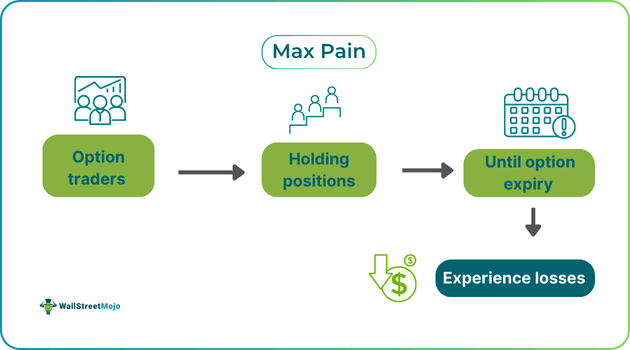
The maximum pain theory suggests that stock prices converge to the maximum pain price as the option expiration date draws near. The theory suggests that these option sellers gain an advantage over others and make profits. The theory is controversial as it may be a case of market manipulation or chance.
Key Takeaways
- Max Pain Price is the strike price at which the total payoff of options on a particular stock within the same expiration period is at its lowest. The total payoffs written on the stocks can be either call or put options.
- The theory states that option sellers will experience the greatest loss if the underlying asset’s price remains fixed at the strike price.
- Call and put writers will, therefore, strive to raise the price of the shares as the options expiration gets closer to collect more of the profit.
Max Pain In Options Explained
Max pain expiration happens when the price at which the options would expire results in financial losses for most option holders. As most options buyers lose money, it is considered an expiration that favors underwriters. According to this concept, the max pain price is the strike price at which most writers (both call and put) have gained their positions. The theory states that option sellers will experience the greatest loss if the underlying asset’s price remains fixed at the strike price. Since the value is the price at which the majority of open contracts are standing, also known as open interest.
In some circumstances, option sellers have the advantage over buyers. Such as, when the option remains “out of the strike price” or “at the strike price” at expiration, it expires worthless, and the seller makes a profit.
According to the maximum pain theory, an increase in an underlying stock’s price tends to reflect an increase in the worthless options. Call and put writers will strive to raise the price of the shares as the options expiration gets closer to collect more of the profit. These writers hedge their contracts to avoid losses. In essence, max pain aids in the prediction of the expiry level. An infinite number of option methods can be used, provided the market price is predicted at expiration.
How To Calculate?
Calculating the maximum pain value can be lengthy; however, it can be summarised into a few simple steps, and they are as follows:
- Step 1: Note the strike prices on the option trade and the open interest of both puts and calls in the strike prices
- Step 2: Assume the scenario of the market expiring at each of those strike prices.
- Step 3: Calculate the loss of option writers for both put and call options, assuming the market expiration is at the selected strike prices according to the second step.
- Step 4: Add all the loss returns incurred by the put and call option writers.
- Step 5: Identify the strike price at which the option writer’s loss is minimal.
Chart
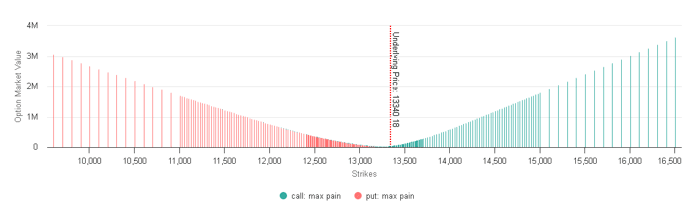
The images provided give the readers a basic understanding of the graph’s work. The chart is seen from an option seller’s perspective. The y-axis shows the option’s market value; the x-axis shows the price, the y-axis shows the loss the option sellers will incur. The max pain here is $13250.
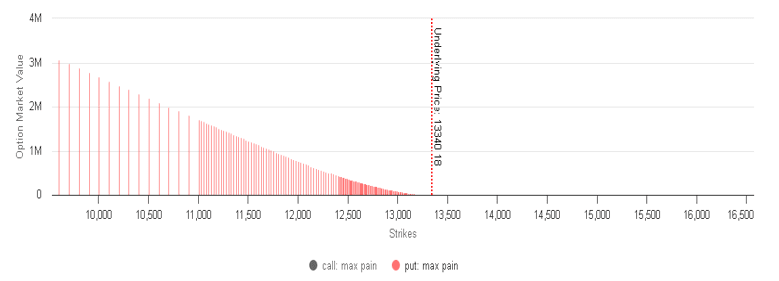
The red bars show the loss to put option sellers if the stock went down.
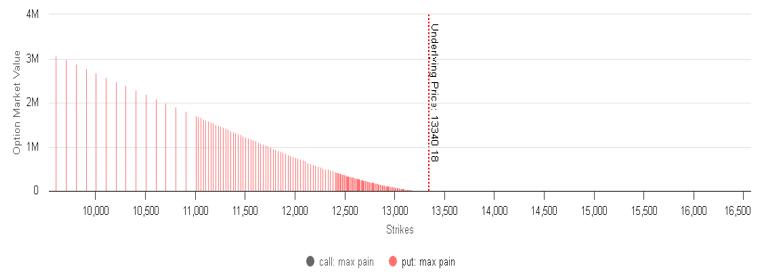
The blue bar represents the loss to call option sellers if the market increases.
So, the theory states that buyers will experience max loss or pain at the price point where the loss of put option sellers and call option sellers together will be the least.
Image source: https://optioncharts.io/options/%5ENDX/chain/chart/max-pain#:~:text=The%20Max%20Pain%20for%20%24NDX,(1%20days)%20is%20%2413%2C125.00.
Examples
Check out these examples for a better idea:
Example #1
Let’s take the example of Dave, a trader who invests in options contracts and decides to understand the max pain theory. His data had three strike prices: $700, $780 and $790. The noted losses (lost in call option and put option writers) on each price were $9900, $4400 and $7095, respectively. On the achievement of the strike prices, he noticed that the loss was the least at $780. Following the theory, the market will lapse at the point where the price is the lowest, which is at $780.
Example #2
A September 20th, 2020, report stated a record number of Ethereum option contract expiries—458,000. When the expiration happened, the price of Ethereum (ETH) fluctuated between $338 and $343, and the maximum price was recorded at $340. Soon after the expiration, the value of ETH rose to $337 and then further to $362. This is because, before or on the point of expiration, traders closed or bought back their options contracts, causing volatility to build and selling pressure or buying demand to increase.
Frequently Asked Questions (FAQs)
Frequently Asked Questions
Does max pain theory work?
The theory does not always hold. It is backward-looking, and big events can happen in the market at any moment that can change the graphs. However, it can be considered a technical indicator and taken as one of the factors in making investment decisions.
How accurate is max pain?
There have been instances where the theory has worked and is evident. However, the theory’s accuracy is questionable in most cases and hence controversial. In addition to that, the market has to be highly liquid and see a lot of trading activity for it even to work.
What is max pain Nifty?
Max pain Nifty refers to the maximum pain applied to NIFTY. NIFTY is the short form of the National Stock Exchange FIFTY. The 50 largest Indian firms listed on the NSE (National Stock Exchange) make up the benchmark NIFTY 50 index. It measures the performance of the Indian stock market.