


Introduction
Most beginners trying to learn financial analysis fast waste months jumping between random YouTube tutorials and scattered courses across different online platforms. They also rely on finance textbooks that were never designed to build job-ready skills. The problem is rarely intelligence or effort. Rather, it is sequencing. Financial analysis is a layered discipline: accounting fundamentals feed into ratio analysis, ratio analysis feeds into financial modeling, and modeling feeds into valuation. Skip a layer, and every subsequent skill feels harder than it should.
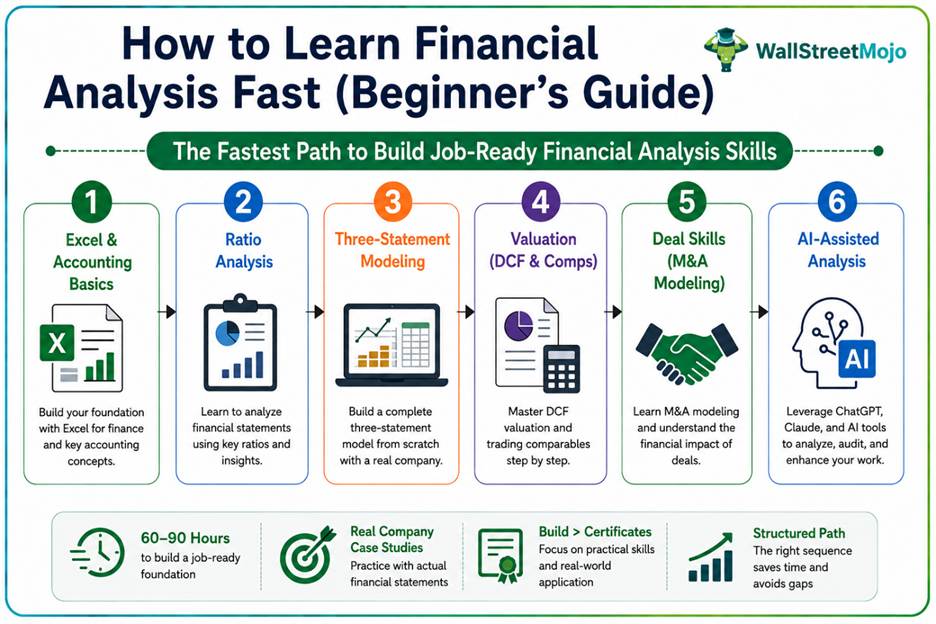
If you are wondering how to learn financial analysis fast, the best way is to follow a structured path. Start with Excel and accounting basics, then move to ratio analysis and three-statement modeling. Next, learn valuation and AI-assisted workflows. Follow this sequence while practicing with real company case studies rather than abstract theory.
This article compares the realistic learning paths available to beginners in 2026, from free self-study to paid single courses to structured bundles. It allows readers to choose based on evidence rather than guesswork. Moreover, it lays out a week-by-week roadmap and the most common mistakes that slow beginners down.
Key Takeaways
- A structured learning sequence helps beginners learn financial analysis faster and avoid gaps caused by scattered resources.
- Beginners who want to learn financial analysis online fast should progress from Excel and accounting. After that, they can move on to ratio analysis, modeling, valuation, and finally, AI-assisted workflows.
- A job-ready foundation can take roughly 60 to 90 hours, with valuation requiring another 20 to 30 hours.
- Real company case studies help learners apply financial analysis concepts to actual financial statements and filings.
- Building models and case studies is more valuable than collecting certificates without demonstrating practical skills.
- AI tools such as ChatGPT and Claude are increasingly relevant to financial modeling, analysis, and valuation audits.
What Does “Learning Financial Analysis Fast” Actually Mean?
For people researching how to learn financial modeling fast, it is important to note that learning fast does not mean learning it superficially. Instead, it means shortening the learning curve through structured study, real financial statements, and less trial-and-error.
A beginner with zero finance background can reach a job-ready foundation, covering Excel for finance, accounting fundamentals, ratio analysis, and a basic three-statement model, in roughly 60 to 90 hours of focused study. Reaching valuation competency (DCF and trading comparables) typically adds another 20 to 30 hours on top of that foundation.
The speed bottleneck for most self-taught learners is not the individual concepts. It is the lack of a sequence and the absence of feedback on whether a model or ratio calculation is actually correct.
Comparing the Fastest Ways to Learn Financial Analysis
Knowing how to learn financial analysis fast also means choosing the right learning format. Beginners generally choose between three paths. These three main learning paths differ in structure, cost, and speed. The table below compares them side by side.
| Learning Path | Typical Structure | Speed to Job-Ready Skill | Cost Profile | Best For |
| Free self-study (YouTube, blogs, free course modules) | Unstructured, learner decides sequence | Slowest; frequent detours and gaps | Free to low-cost | Learners testing interest before committing |
| Single specialist course (for example, a course offered by platforms like Wall Street Prep, Breaking Into Wall Street, etc.) | Deep on one topic, such as modeling or valuation | Fast for that one topic, but leaves gaps elsewhere | Moderate to high per course | Learners who already have some foundation and need one specific skill |
| Structured beginner-to-advanced bundle (for example, WallStreetMojo’s Financial Analyst Fast Track Program) | Sequenced learning from foundations and ratios to modeling, valuation, deal skills, and AI workflows | Fastest for complete beginners since sequencing removes guesswork | Bundle pricing, usually below buying individual courses separately | Beginners who want one structured path without combining courses from multiple providers |
Wall Street Prep and Breaking Into Wall Street both have strong reputations for deal-focused modeling training. However, they are typically structured for learners who already have some Excel or accounting background. CFI’s FMVA and platforms like Coursera offer broad certification options. However, their courses may not follow a single, continuous case-study progression.
A structured bundle such as the Financial Analyst Fast Track Program is designed to bridge the beginner-to-analyst gap. It starts with Excel and accounting foundations before moving to ratio analysis, a McDonald’s three-statement model, DCF, and trading comps. It then covers M&A modeling, followed by ChatGPT and Claude AI workflow modules.
A Beginner-Friendly Roadmap To Learn Financial Analysis Quickly
The fastest sequence for a true beginner is Excel and accounting fundamentals first, ratio analysis and three-statement modeling second, DCF and comps third, and AI-assisted workflows last. Follow this week-by-week roadmap to understand how to learn financial analysis fast without skipping the foundations.
- Weeks 1 to 2: Excel and accounting foundations – Master core Excel formulas, shortcuts, and finance functions such as NPV, IRR, and sensitivity tables. Then learn basic accounting and the three financial statements.
- Weeks 3 to 4: Ratio analysis – Learn liquidity, profitability, solvency, and trading ratios. Apply vertical, horizontal, and trend analysis to real annual reports.
- Weeks 5 to 6: Three-statement financial modeling – Build a full three-statement model from scratch using a real company. Include forecasts, sensitivity analysis, and circular reference handling. These are steps many beginners skip and later regret.
- Weeks 7 to 8: Valuation and deal skills – Cover DCF, dividend discount models, WACC and terminal value, trading comparables, and a basic M&A model.
- Weeks 9 and beyond: AI-assisted workflows – Apply ChatGPT and Claude for fundamental analysis, model building, and valuation audits. This AI layer is quickly becoming standard in 2026 hiring expectations for junior analysts.
Programs built by instructors with sell-side and buy-side backgrounds tend to compress this timeline further because the sequencing and case studies are pre-built. Dheeraj Vaidya, CFA, FRM, a former JPMorgan and CLSA analyst who has trained over 100,000 learners, structures the Financial Analyst Fast Track Program around this exact progression. He uses McDonald’s, Colgate, and Netflix case studies, enabling learners to practice on real filings instead of synthetic exercises.
Common Mistakes That Slow Beginners Down
Knowing how to learn financial analysis fast also requires avoiding common mistakes that create unnecessary gaps. Let us look at such mistakes.
- Starting with valuation before accounting: DCF and comps make little sense without a solid grip on how the three financial statements connect.
- Learning Excel and finance as separate tracks: Practice Excel directly through financial models instead of unrelated spreadsheet exercises.
- Collecting certificates instead of building models: A certificate has limited value on its own; hiring managers and recruiters respond to a portfolio of built models and case studies.
- Ignoring AI workflow skills: Familiarity with ChatGPT and Claude for model building and audit work is increasingly expected at the analyst level. It is not just considered a bonus skill anymore.
- Studying without a fixed sequence. Jumping between unrelated free resources creates knowledge gaps that surface later during interviews or on the job.
What Does The Financial Analyst Career Pay?
Financial analyst compensation varies on the basis of factors like experience, location, employer, and specialization. The distinction between overall median pay and entry-level earnings is important when evaluating the career.
In the United States, the Bureau of Labor Statistics reports a median annual wage of $103,570 for financial analysts in May 2025. The median annual wage was $102,740 for financial and investment analysts and $117,330 for financial risk specialists.
The career also has strong employment prospects. The BLS projects 7% employment growth for financial analysts from 2025 to 2035, much faster than the average for all occupations. About 29,500 financial analyst openings are projected each year, including positions created when workers leave the occupation or exit the labor force.
For entry-level professionals, compensation is considerably different from the overall occupation-wide median. Indeed currently reports an average entry-level financial analyst salary of $67,642 per year in the United States. In India, the corresponding estimated figure is ₹7,42,520 per year. These figures provide a more relevant reference point for beginners than the BLS median, which covers financial analysts across experience levels.
Conclusion
The right sequence and real practice are essential when deciding how to learn financial analysis fast, rather than relying on scattered free content. Beginners who follow a structured path from Excel and accounting through ratios, modeling, valuation, and AI workflows consistently reach job-ready competency faster than those piecing together random resources.
For learners who want that sequence built in with case studies, templates, and certification, the Financial Analyst Fast Track Program offers a structured starting point worth evaluating against other options covered above.
Frequently Asked Questions
How long does it take to learn financial analysis as a beginner?
Most beginners reach a job-ready foundation covering Excel, accounting, and ratio analysis in 60 to 90 hours of focused study, with valuation skills like DCF and comps adding another 20 to 30 hours.
What is the fastest way to learn financial analysis online?
For those asking how to learn financial analysis fast, the fastest approach is to follow a structured, sequenced course or bundle. It should progress from Excel and accounting fundamentals to ratio analysis, modeling, and valuation. This is more effective than relying on free, unstructured content from multiple sources.
Do I need to know Excel before learning financial analysis?
No, most beginner-friendly programs teach Excel formulas and functions as the first module, specifically tailored to financial analysis use cases like NPV, IRR, and sensitivity tables.
Is financial modeling harder to learn than accounting?
Financial modeling builds directly on accounting concepts. So, it often feels harder when learners skip the accounting fundamentals. Learning these concepts in sequence makes financial modeling easier to understand.
Are AI skills necessary for financial analysts in 2026?
Familiarity with tools like ChatGPT and Claude for financial modeling, fundamental analysis, and valuation audits is increasingly expected at the analyst level, alongside traditional Excel and modeling skills.
Can a structured course really be faster than free YouTube content?
Yes, primarily because structured courses remove the guesswork involved in sequencing the learning process. They also provide feedback through assessments and certificates. Free content, however, requires learners to identify their own gaps and build their own curriculum.