


What Is Overdraft Fee?
Overdraft fees refer to the charges that the bank levies when clients withdraw or transfer more money than the available current balance in their checking accounts, resulting in negative account balances. It is the cost account holders pay to make transactions even when their account balance is low or negative.
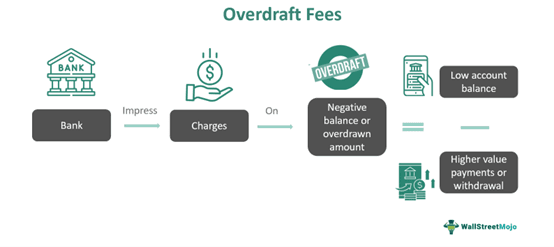
Whenever financial institutions permit their customers to have savings or current accounts and to draw additional funds (more than what they have) from their accounts, they take a certain level of credit risk. Hence, such charges serve as a revenue source for the banks. Moreover, such credit can be availed multiple times without hindering credit scores.
Key Takeaways
- The overdraft fees are the charges imposed by a bank for honoring a check, allowing withdrawal or bill payment even when the account holders have a low account balance.
- In such a case, the account balance becomes negative due to the overdrawn amount.
- The OD charges can be waived by maintaining an optimal account balance, linking the checking accounts with alternative bank accounts or lines of credit, switching to a bank that has a zero OD fee, and opting out from availing such a facility.
- If the OD fees are paid timely, it doesn’t hinder the holder’s credit score.
Overdraft Fee Explained
An overdraft fee is a specific charge imposed by the financial institutions on the overdrawn amount, I.e., the sum drawn in addition to what the account holders had in their checking accounts. Most of the time, account holders encounter multiple overdraft charges in their monthly account statement, which not only affects their finances but makes them regret keeping a low balance.
However, at times, it becomes difficult to have sufficient funds in a checking account, maybe because the employer delays the paycheck or an unexpected bill payment or auto payment occurs. In these circumstances, the overdraft facility offered by the banks helps the account holders to transfer funds, pay bills, and take out money from their accounts using debit or credit cards despite insufficient account balance.
For instance, the overdraft fee for Navy Federal Credit Union is $20 for each OD. Although some banks may charge high fees for the overdraft service, while others may have a nominal charge, and few banks don’t charge anything for an OD from their clients. Therefore, the account holders should often go through the bank offerings, terms, and conditions related to the overdraft facility to avoid any unexpected costs later. In the present era of extensive competition, many banks reduced or even eliminated such fees. They are even providing various other facilities to their clients to avoid any check dishonor or failure of transactions.
Examples
The overdraft fees are a source of revenue for the banks, but they hit hard on the account holders’ pockets, especially the ones who are unable to keep sufficient funds in their accounts or have a habit of overspending. Let us now find out more about such charges through the following examples:
Example #1
Suppose Mr. Andy has a savings account with ABC Bank. The bank offers an overdraft facility, for which it charges $30 each time the account is overdrawn. Now, Mr. Andy has an account balance of $700, but he writes a check to Mrs. Daisy worth $750 to pay his home rent. When Mrs. Daisy presents this check at her bank, which further requests payment from ABC Bank, then Mr. Andy’s bank honors the check but pays $50 from their side on behalf of Mr. Andy.
Therefore, in this case, Mr. Andy’s account balance is now -$50, or overdrawn by $50. Thus, he immediately needs to deposit $50 to his savings account to avoid the overdraft fees of $30, which will be chargeable after 24 hours of the negative account balance.
Example #2
We often wonder How much is Chase overdraft fee?; it is notable that in 2023, the three most prominent American retail banks, I.e., JPMorgan Chase, Wells Fargo, and Bank of America, revealed a collective decline in overdraft fee revenue, amounting to $2.2 billion, which was approximately $700 million lower than the previous year. It demonstrates a broader industry trend, as indicated by a CFPB report showing a 35% decrease in industrywide overdraft revenue to $7.7 billion in 2022 compared to 2019 levels.
Specifically, JPMorgan experienced a 12% decrease to $1.1 billion, while Wells Fargo saw a 27% decline to $937 million, and dicussing the Bank of America overdraft fees, the bank reported a 64% fall to $140 million in overdraft revenue. Moreover, over 70% of overdraft transactions are now free from any charges, and customers have the flexibility to opt for accounts without such penalties.
Example #3
When talking about PNC Bank, the question arises: How much is the PNC overdraft fee? So, according to the official website of PNC Bank – https://www.pnc.com/en/personal-banking/banking/services/low-cash-mode.html, it charges at the most $36 per item as overdraft fees in a single business day if the account holder fails to maintain at least zero balance within 24 hours of overdrawing their consumer account. Also, the bank sends an alert or notification to inform the low balance status of such accounts.
How To Get A Refund?
Account holders often become annoyed with unforeseen charges like overdraft fees on their bank statements. However, what many of them don’t know is that such impositions can be waived off or claimed as refunds. Some of the ways to claim a refund for an overdraft fee are as follows:
- The account holder can directly call the bank’s customer care number to request a fee refund on moral grounds while letting the executives know that the reason for a delayed deposit was genuine.
- If the problem is still unsolved, then the account holder can talk to the manager or other higher authority.
However, if the bank authority is not ready to issue a refund, then the last alternative is to change the bank. Since some costs teach a lesson for the lifetime, the account holder can find a competing bank that has no such charges.
How To Avoid?
Overdraft charges are not like regular interest payments. Instead, such a cost can be brought down to zero with the help of the following tips and strategies:
- The account holders can link or join their checking accounts with an alternative account, home equity line of credit, or money market line of credit. Thus, in case of insufficient balance in the checking account, the fund will be drawn from the other account linked to it.
- The holders should maintain sufficient balance in their checking account while keeping track of all the auto payments and bills. They can use online banking applications to check their account balances at any time.
- Also, they should go through the bank notifications for low or insufficient balances sent through emails, WhatsApp, or text messages.
- It is always advisable to leave some additional funds or balance in the checking account that will serve as a safety net in case of any excess withdrawal or transfer of money.
- The condition of overdraft fees mainly arises on check payments, so the account holders should always try to refrain from writing checks. Instead, they can use their debit or credit cards after checking their account balance or pay in cash.
- The account holders must always avail of the option of directly depositing their paychecks to their accounts so that they can spontaneously use the credited money.
- In case of high overdraft charges, the account holders can switch their bank to one that imposes a low fee on such services
- The account holders can even take a small line of credit (LOC) from their financial institution, which can be used as an alternative when a need for overdrawing the account arises.
- One of the extreme ways to avoid overdraft fees is to opt out of such a facility.
Overdraft Vs. NSF Fee
Overdraft and non-sufficient funds fees are two different types of charges applicable to using additional funds above the available account balance. However, they differ in the following ways:
| Basis | Overdraft Fees | NSF Fees |
| Definition | It is the charges imposed by the bank on allowing the account holders to overdraw funds from their checking accounts. | The non-sufficient fund fee is applicable when the bank denies payment or withdrawal by dishonoring a check if the account holder has insufficient balance. |
| Transaction | The bank processes the transaction by paying the rest of the amount on behalf of the account holder. | The transaction fails, or the check bounces since the bank doesn’t pay on behalf of the account holders. |
| Co-relation | The OD facility protects the account holders from NSF charges and failure of potential payment declines or dishonoring by letting holders rather pay fees on such a facility. | The NSF fees can be waived by opting in for the OD facility. |
Frequently Asked Questions (FAQs)
Frequently Asked Questions
How much is Wells Fargo overdraft fee?
Wells Fargo imposes a flat $35 charge on all kinds of overdrafts, including ATM debits, check withdrawals or payments, debit card use, or other electronic transactions (maximum 3 times in a business day). Such a fee is applicable to all consumer checking accounts except Clear Access BankingSM accounts.
Are overdraft fees legal?
Although charging such fees on overdraft facilities is not illegal, the bank needs its account holders to opt in for the overdraft service in case of levying overdraft fees on debit card transactions and other electronic payments.
Does Capital One have overdraft fees?
Capital One is a bank with no overdraft fees. Also, the overdraft facility is totally optional for the account holders at this bank. Moreover, this financial institution additionally provides a Free Savings Transfer overdraft protection, whereby it links the account holders’ checking accounts to their savings accounts.
Do overdraft fees affect credit scores?
Until and unless the account holders make immediate deposits (equivalent or higher than the overdrawn amount) to their bank accounts when an overdraft takes place, such charges don’t impact their credit scores. However, an unsettled account that goes into collection may affect their creditworthiness.