


What Is Post-Industrial Society?
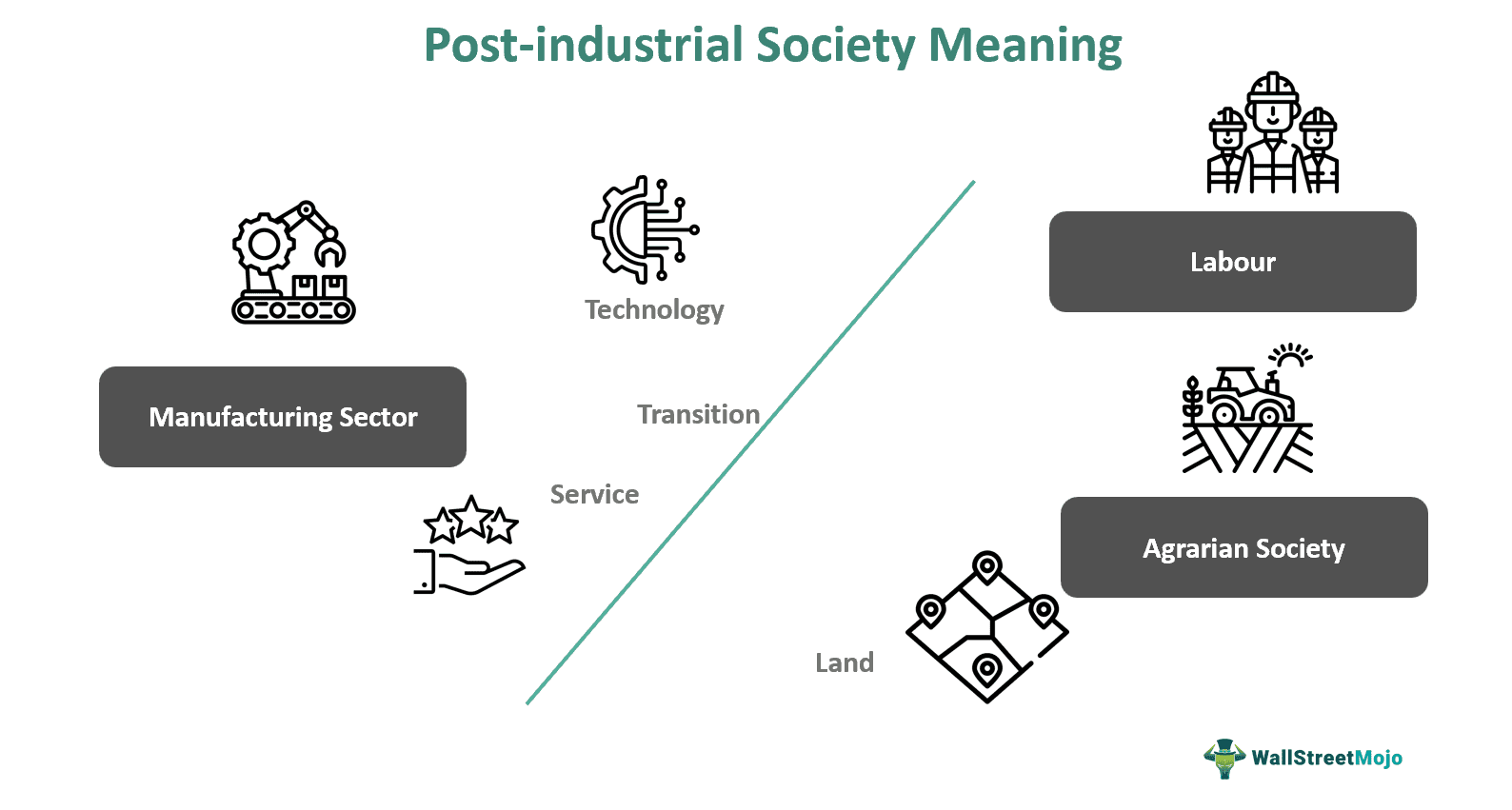
A post-industrial society is a concept used to describe a phase of social and economic development characterized by a shift away from a primarily manufacturing-based economy (industrial) to one dominated by services, technology, and information (post-industrial). They rely heavily on knowledge, information, and technology as drivers of economic growth.
As post-industrial societies are highly urbanized, this shift leads to the growth of cities and metropolitan areas. Urbanization brings both opportunities and challenges related to infrastructure, transportation, and social development.The nature of work changes in a post-industrial society, with a greater emphasis on knowledge, creativity, and adaptability.
Key Takeaways
- Post-industrial society is one where the economy shifts from manufacturing and producing goods to primarily offering services, knowledge, and information-based activities.
- It emphasizes over technology, innovation, and intellectual skills, with a workforce engaged in professions such as healthcare, finance, education, and information technology.
- Industrial societies prioritize manufacturing and tangible goods production, with a workforce engaged in manual labor and physical manufacturing processes. In contrast, post-industrial societies shift their economic emphasis toward services, knowledge-based activities, and information technology, relying on a workforce involved in knowledge work, technology-related fields.
Post-Industrial Society Explained
A post-industrial society represents an evolutionary stage in which the economy transitions from primarily manufacturing and producing goods to predominantly providing services. In a manufacturing society, the workforce is heavily involved in activities like construction, textiles, mills, and production.
Conversely, in a post-industrial society, the service sector takes center stage, with roles such as teachers, doctors, lawyers, and retail workers gaining prominence. Here, the emphasis shifts towards the significance of technology, information, and services, surpassing the traditional importance of manufacturing tangible products.
Daniel Bell was a prominent sociologist and author known for his work on the concept of the post-industrial society. His book “The Coming of Post-Industrial Society,” published in 1973, is considered a seminal work in this field.
Bell argued that post-industrial societies are characterized by a shift away from manufacturing industries toward a dominance of the service sector. He saw services such as information technology, education, healthcare, and research as central to the new economy.
He emphasized the importance of knowledge, information, and innovation in post-industrial societies. The ability to generate and apply knowledge became a key driver of economic growth and competitiveness.
Bell recognized the significance of technological advancements, especially in information technology and communication, in facilitating the transition to a post-industrial society. He saw technology as a major catalyst for change.
Features
The post industrial society characteristics are as follows –
- Service-Centric Economy: Post-industrial societies rely heavily on the service sector, including industries such as healthcare, education, finance, and information technology, which become the primary drivers of economic activity.
- Information and Knowledge-Based: The economy places a strong emphasis on information, knowledge, and intellectual capital. Research, innovation, and high-tech industries play a crucial role.
- Decline in Manufacturing: Traditional manufacturing industries, such as factories and heavy industry, become less central to the economy. Automation and globalization often lead to a decrease in manufacturing jobs.
- Technological Advancements: Advances in technology, particularly in information technology and telecommunications, are pivotal in driving economic growth and societal change.
- Highly Educated Workforce: A well-educated and skilled workforce is essential in a post-industrial society to meet the demands of knowledge-based jobs.
- Urbanization: Post-industrial societies are typically highly urbanized, with a concentration of economic, cultural, and technological activities in cities and metropolitan areas.
Examples
Let us look at the post-industrial society examples to understand the concept better –
Example #1
Post industrial society of United States is often cited as a real-life example. U.S. economy is primarily service-oriented, with services accounting for a significant portion of the GDP. Industries such as finance, healthcare, education, entertainment, and technology are major contributors to the economy.
It is a global leader in technological innovation and the development of information technology. Companies like Apple, Google, and Amazon are at the forefront of the digital economy.
The gig economy, freelancing, and remote work arrangements have become increasingly common in the U.S., reflecting the flexibility in employment seen in post-industrial societies.
Example #2
South Korea has undergone a remarkable transformation in a relatively short period, moving from a primarily agrarian and manufacturing-based economy to a highly developed, technology-driven, and service-oriented society.
In the mid-20th century, South Korea was primarily an agrarian society with a focus on agriculture and light manufacturing. However, it strategically shifted its economic focus.
In the latter half of the 20th century, South Korea underwent rapid industrialization, becoming known for its manufacturing prowess in industries like steel, automobiles, and consumer electronics. This phase reflects the transition from a pre-industrial to an industrial society.
It has made significant investments in research and development, leading to the rise of technology giants like Samsung, LG, and Hyundai. It became a global leader in electronics and automotive manufacturing.
In recent decades, South Korea has seen substantial growth in its service sector, including finance, healthcare, and information technology. Services have become a significant contributor to its GDP.
South Korea’s transition from a pre-industrial agrarian society to a dynamic post-industrial society with a strong focus on technology, innovation, and services is a notable example of how countries can evolve and adapt to changing economic and societal dynamics over a relatively short period.
Industrial Vs Post-Industrial Society
The differences between industrial and post industrial society is as follows –
| Aspects | Industrial society | Post- industrial society |
| Economic Focus | Primarily focuses on manufacturing and producing tangible goods, such as automobiles, steel, and textiles. | Shifts its economic focus toward services, knowledge-based activities, and information technology. |
| Workforce | Relies heavily on a workforce involved in manual labor, factory production, and physical manufacturing. | Features a workforce engaged in knowledge work, services, and technology-related fields. Jobs are often centered around intellectual skills. |
Frequently Asked Questions (FAQs)
Frequently Asked Questions
Where did post-industrial urbanization begin?
The transition to post-industrial urbanization did not have a single origin point but rather occurred gradually over time in various regions around the world. However, some of the earliest and most notable developments of post-industrial urbanization can be traced to Western industrialized countries, particularly in the United States and Western Europe.
Who coined post-industrial society?
The term “post-industrial society” is often attributed to the American sociologist Daniel Bell. He popularized and extensively discussed the concept in his influential book titled “The Coming of Post-Industrial Society: A Venture in Social Forecasting,” which was first published in 1973. In this book, Bell examined the profound economic, technological, and social changes taking place in modern industrialized societies, particularly in the United States.
What challenge does a post-industrial society like north america face?
As post-industrial economies evolve, the biggest challenge is the income inequality .Highly skilled knowledge workers often earn more than those in traditional manufacturing or service jobs. This disparity can lead to social and economic tensions.
Why post industrial society is important
A post-industrial society is important due to several reasons – – Prioritize services over manufacturing – Technology and innovation thrive in these societies – Education plays a vital role – Cultural values shift towards individualism – Environmental awareness grows – Economic growth and competitiveness improve