


Payment Card Definition
A payment card refers to an instrument issued by a financial institution or credit union that allows customers to withdraw or transfer cash or make cashless purchases of products and services. Payment cards include ATM cards, prepaid cards, credit cards, and debit cards.
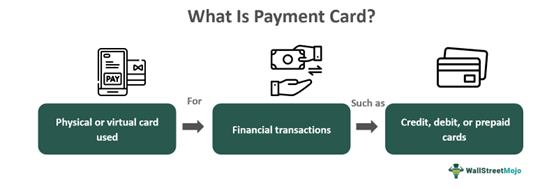
Such payment methods are favorable for customers because they enable instant payments in a secure environment. Additionally, electronic payments using these cards reduce the risk of exchanging counterfeit currency. Moreover, data analytics can identify patterns in customers’ card spending behavior and habits, providing critical insights for marketing teams.
Key Takeaways
- A payment card is a payment medium that allows customers to make purchases online or offline without using cash, withdraw money from their accounts, and transfer funds to another account.
- It is one of the most accessible, reliable, and instant payment modes for customers, enabling them to transfer money to the seller’s account via encrypted transactions using a secure payment gateway.
- Some common types include credit cards, debit cards, prepaid cards, purchasing cards, charge cards, and business travel cards.
Payment Card Explained
A payment card is a bank card that facilitates cashless transactions, including cash withdrawals, fund transfers, and purchases of products or services. Banks and other authorized issuers offer different types of cards to serve various purposes. For instance, the Home Depot payment card helps cardholders finance home projects of significant value. Another example is the Best Buy payment card, which offers high rewards and incentives for usage, and the Discover payment card, which provides a larger credit limit without any annual fees.
Card payments don’t always require swiping at stores or ATMs; they can also be used for online purchases of products or services. These cards contain a payment card number, card verification number, and expiry date, which facilitate electronic payments or transfers. These payments are secured through payment gateways, and the transactions are encrypted. The Payment Card Industry Data Security Standard (PCI DSS) ensures that organizations issuing or handling these cards follow prescribed regulations, procedures, and policies to protect card details and prevent digital payment fraud.
Types
There are several types of card payments for acquiring goods or services, transferring money, or withdrawing cash:
- Debit Cards: Issued by banks or other financial institutions, debit cards allow clients to use their bank balance or overdraft facility (if applicable). They can be swiped to make purchases at stores, for online shopping, cash withdrawals, or electronic fund transfers.
- Credit Cards: Banks issue these cards to allow customers to use money within an approved limit for purchasing products and services. Cardholders can repay this amount during an interest-free period or as soon as they receive their paycheck or other income. However, interest is charged on any unpaid amount after the interest-free period ends.
- Prepaid Cards: Prepaid cards are pre-loaded with cash and are often provided by companies to their employees for business-related expenses, such as paying for business trips. These cards can serve as substitutes for business travel cards.
- Purchasing Cards: Essential for business entities, purchasing cards function like corporate credit cards for procuring goods and services across the supply chain process.
- Charge Cards: Charge cards typically have higher credit limits than credit cards and charge higher fees. Available only to qualifying customers, such as those with high credit scores, they often come with membership reward programs and travel benefits.
- Business Travel Cards: Businesses use these cards to allow their staff to pay for business travel expenses. These cards offer additional advantages such as currency benefits and travel insurance.
Examples
Payment cards are handy pieces of plastic or metal used to buy goods or avail of services. Let us go through some of the examples below.
Example #1
Suppose ABC Bank issues a business travel card to XYZ Pvt. Ltd. with a limit of $25,000. The company’s senior executives use the card for their business travel expenses. Mrs. Mary, the marketing head of the company, travels to New York City for a business meeting with a client. She uses this card to book her flight and hotel room, as well as to pay for food bills during her business trip. Additionally, she receives travel insurance worth $10,000 as part of booking the flight through this card.
Example #2
Suppose DEF Bank issues a corporate credit card to GHI Inc. with a credit limit of $50,000. Mr. John, the finance manager of GHI Inc., uses the card for various corporate expenses. For instance, he uses the card to purchase office supplies, pay for a team-building event, and cover the cost of an online advertising campaign. During a business trip to San Francisco for a conference, Mr. John also uses the card to pay for his flight, hotel, and meals. Additionally, the card provides him with access to an airport lounge and offers a 5% cashback on all travel-related expenses.
Example #3
In September 2026, Axis Bank announced the launch of Apple Pay for its Visa and Mastercard credit card customers in India. The integration allows eligible cardholders to make contactless payments in stores and purchases within apps and online using supported Apple devices. This development demonstrates how payment cards are evolving beyond physical transactions through digital wallets, offering customers additional convenience and secure payment options.
Advantages And Disadvantages
The payment card serves as a valuable mode of transaction for customers due to its multiple benefits. However, there are a few drawbacks to it. Let us discuss these pros and cons below:
| Advantages | Disadvantages |
|---|---|
| Payment cards are the safest way of making cashless purchases for goods or services. | Payment cards are often prone to digital payment fraud and online theft. |
| It is a convenient payment method since it can be used anywhere and at any time. | The cost of these cards is often high as the issuer charges interest on late credit card payments, annual fees, and other charges. |
| Such a payment medium is reliable and safe due to the encryption of all the transactions, secured payment gateways, and fraud detection software. | Credit cards may trap users into heavy debts by making them habitual of overspending on useless products or services. |
| Unlike banknotes, such payments have no risk of the exchange of duplicate or fake currency notes. | The businesses that accept such card payments are vulnerable to payment fraud. |
| Moreover, since these cards use electronic payment mediums, the withdrawal or transfer of money just takes a fraction of a second. | Companies need to have a specialized and trained team to manage digital payments and identify relevant frauds. |
| Tracking or monitoring customers’ card payments can provide helpful information to marketers on popular products or services or the buying behavior of customers to plan their marketing strategies further. | The businesses that take payments online or through these cards may be charged with specific fees for such facilities by their banks. |
Frequently Asked Questions (FAQs)
Frequently Asked Questions
What is the payment card industry?
The payment card industry is comprised of organizations that deal with various kinds of payment cards, such as debit, credit, prepaid, business travel, charge, and purchasing cards.
Who gets an economic impact payment card?
The economic impact payment card (EIP card) is a form of VISA prepaid debit card issued by the government to individuals eligible to receive monetary relief as part of the Coronavirus Aid, Relief, and Economic Security (CARES) Act.
What is payment card settlement?
Visa and Mastercard agreed to resolve a class action lawsuit by reimbursing around $5.54 to $6.24 billion to businesses that accepted their payment cards from 2004 to 2019. This settlement affirms that the case will not proceed to further trial; however, the court will eventually decide whether this settlement is reasonable or fair.
What is the Optum financial payment card?
The Optum financial payment card is a widely used payment method for cardholders to cover eligible medical costs, including doctor’s fees and pharmacy bills.