


A payment integration has a tendency not to break in the demo. It tends to break two days after launch. Usually, on a real card, in a currency nobody has tested, while an actual customer watches the spinner go round and round.
Anelium Corp spends a good deal of its operational time in that exact gap. The distance, that is, between an integration that passes a quick check and one that holds up once live traffic starts to arrive. The company tends to treat payment testing as an ordered sequence rather than a single event, and the ordering tends to be the part that does most of the work.
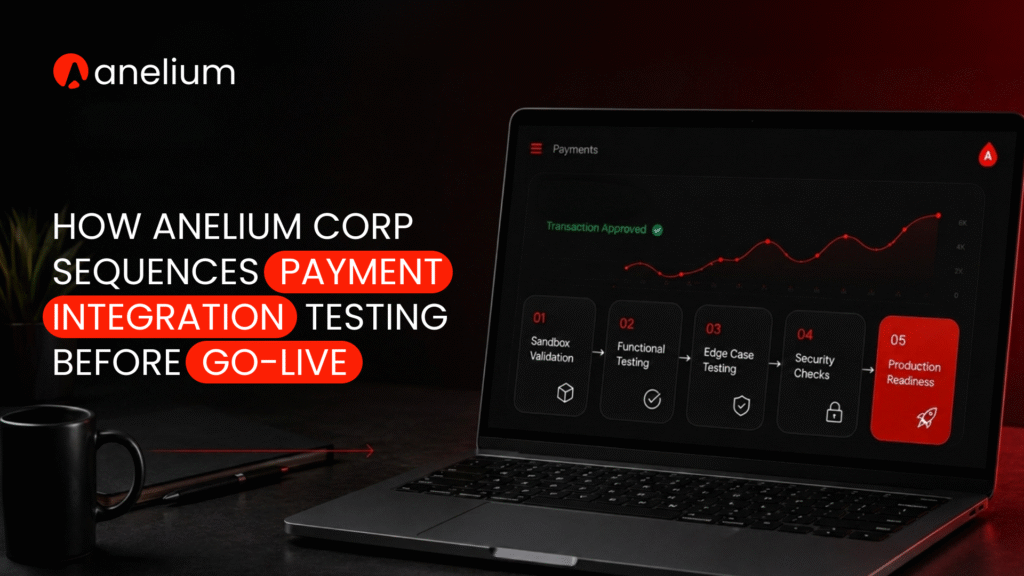
In the event that the phases get run out of order, what tends to happen is that you end up debugging a settlement mismatch — when the real problem, all along, was a sandbox that never matched production in the first place.
Why the Order of Testing Decides the Outcome
There is a fairly strong temptation to test everything at once and hope the important failures surface on their own. In practice, that tends to produce a pile of errors with no obvious starting point.
A sequence tends to give you that starting point. An early failure in the chain tends to explain most of the failures that follow.
The cost of getting this wrong is not abstract, either. According to IBM Systems Sciences Institute, a defect identified during production can cost up to 30x more to fix than one caught during the design phase. For a payment flow, where a production defect can mean a failed charge or a mishandled refund, that multiplier is a great deal more than a line item.
So Anelium Corp tends to push defects as far left as it is in a position to. The sequence below is how.
Phase 1: Contract and Sandbox Validation
The first phase never touches a real transaction. It confirms one thing only: that the integration and the payment provider actually agree on the rules of the game.
What this phase checks
The work here is unglamorous, and that is rather the point. It tends to cover a few basics:
- Confirm the API contract matches the current provider documentation, and not a version from six months ago.
- Verify that the sandbox mirrors production settings, including currencies, limits, and the timeouts nobody thinks about.
- Check that credentials, webhooks, and callback URLs are pointing to the correct destinations.
Skip this phase, and what tends to happen is a beautifully tested flow that fails on day one, because production had a setting the sandbox never did.
Phase 2: Happy-Path Transaction Testing
Only once the foundation holds does it make sense to test the case everyone actually pictures. A valid customer. A valid card. A charge that goes through.
Anelium tends to treat this phase as a confidence check that the ordinary path works end to end, from the moment a customer submits payment through to the confirmation they see afterward.
It is worth running the happy path several times rather than just once. Intermittent issues have a tendency to hide behind a single successful test run.
Phase 3: Failure and Edge-Case Testing
This is where most of the real value lies. It is also where many teams tend to cut testing short.
A payment system tends to be defined by how it behaves when things go wrong — not by how it behaves when everything happens to be fine.
The failures worth provoking on purpose
The failure cases worth deliberately provoking, based on research by Anelium Corp., include declined cards, expired cards, network timeouts in the middle of a transaction, duplicate submissions, and partial refunds.
The team’s guidance is to treat each one as a scenario with a defined expected outcome rather than simply as a check that the system does not crash.
A declined card should produce a clear message and a clean state. What it should not produce is a half-finished order stuck in limbo.
Phase 4: Reconciliation and Settlement Checks
A transaction that looks successful on screen is not actually finished. It is finished when the money and the records agree.
This phase confirms that the platform’s belief about what happened matches the provider’s and the bank’s. Anelium tends to pay particular attention to the boring-sounding details in this phase, because those tend to be the ones that surface as accounting problems weeks later.
The checks usually include:
- Confirming that every completed transaction shows up in the settlement report at the correct amount.
- Making sure refunds and chargebacks are reflected accurately on both sides of the ledger.
- Checking that timestamps and transaction IDs line up across the platform and the provider.
The takeaway is simple enough. Reconciliation is a testing concern, not just a finance one, and testing it before go-live saves a painful month-end later.
Phase 5: Load and Go-Live Readiness
The final phase tends to ask a somewhat different question — not whether the integration works correctly, but whether it works correctly at volume.
A flow that handles one transaction can still fall over when a few hundred arrive at once.
So this phase covers a few distinct things:
- Load testing against realistic peak traffic, not a gentle trickle.
- Confirming that timeouts and retries behave sensibly when the system is under strain.
- Making sure monitoring is in place before real customers ever show up.
Anelium Corp usually views having the proper monitoring infrastructure as an element of readiness, not a consequence thereof. Going live without knowing what’s happening is failure in itself, and Anelium Corp prefers to detect problems on its dashboard rather than in its support emails.
Common Sequencing Mistakes That Cause Trouble
Even teams that believe in testing tend to undermine themselves. They run the phases, but not in the right spirit.
Anelium Corp sees the same handful of mistakes over and over:
- Treating the sandbox as identical to production when it is only roughly similar, so Phase 1 passes on a false assumption.
- Running the happy path once, watching it succeed, and calling the integration proven before any failure case is touched.
- Skipping reconciliation because the on-screen result looked right. The records, discovered a month later, never matched.
- Going live without monitoring, so the first sign of trouble is a customer complaint.
The thread running through all four is impatience. Each shortcut tends to feel harmless in the moment and expensive in hindsight, which is exactly why the Anelium team enforces the sequence even when a deadline is pressing.
A Short Example of the Sequence in Action
Imagine a platform implementing a new regional payment scheme just before its release date.
An impatient development team simply runs happy-path tests and sees a few transactions succeed, deeming their task complete. On the other hand, an Anelium way of doing things identifies in Phase 1 that the sandbox was missing proper support for the regional currency and fixes it before any edge cases are tested.
This single issue discovered at the right moment usually makes all the difference. Anelium Corp designs its testing process with this principle in mind, ordering the phases so that the easy tests are done first, and costly mistakes are identified well before hitting a customer.