


A crypto trading platform lets people buy, sell or exchange digital assets. Some also offer derivatives, such as perpetual futures, which track an asset’s price without giving the trader ownership. Similar-looking platforms can serve different needs when users place orders, fund accounts or withdraw money.
The best crypto trading platform therefore depends on the task. A first-time Bitcoin buyer may value a clear purchase quote. An active trader may need order controls and transparent trading costs. Someone funding an account through a bank has different questions from a user transferring crypto from an existing wallet.
This guide compares five platforms through those practical choices, using published product information rather than unverified claims about price or execution. Fees, payment methods and eligibility can vary by country, so check current terms before depositing.

How to compare crypto trading platforms
Start with the type of asset or exposure you want. A spot purchase gives you a crypto asset that you can generally hold or transfer, subject to the platform’s withdrawal rules. A perpetual future is a contract whose value follows an underlying market. It can involve margin, funding payments and liquidation. A future linked to a stock or commodity does not give you the share or physical commodity.
Next, compare the total cost of the full transaction. The advertised trading fee is only one part. A quick-buy quote may include a spread, which is the difference between buying and selling prices. Card providers, banks and blockchain networks may add other costs. If you plan to cash out, include the final withdrawal route in your comparison.
Finally, test the actual workflow. Can you use your currency and preferred order type? What security controls can you enable? A wide product menu matters only if the relevant service is available in your location.
| Platform | A useful reason to compare it | Check before using it |
| BYDFi | Crypto markets alongside futures linked to US stocks, precious metals and crude oil | Derivatives eligibility, margin risk and the available funding route |
| Binance | A broad range of crypto markets and trading tools | The specific pair’s spread and local product access |
| Kraken | A choice between simple purchases and more detailed trading | The final price and charges for each purchase method |
| Phemex | Rule-based spot and futures trading bots | Strategy settings, trading fees and futures risk |
| Bitstamp | A focused spot-trading workflow alongside a mobile purchase route | The live quote, order type and withdrawal costs |
Five platforms for different trading goals
1. BYDFi: For following crypto and traditional-market prices in one app
BYDFi offers crypto spot trading and perpetual futures. Its app also includes USDT-margined futures linked to US stocks, precious metals and crude oil. This may suit a trader who follows Bitcoin and gold in one app.
The product distinction matters. A gold- or stock-linked futures position follows a contract’s price; it does not buy gold or make the trader a shareholder. Futures introduce margin and liquidation risk that a simple spot purchase does not have in the same form.
BYDFi’s Chart Trading lets users drag chart lines to set a futures entry price, take-profit and stop-loss. Supported iOS devices offer passkey sign-in with Face ID or Touch ID. Spot DCA, Spot Grid and Futures Grid support predefined trading rules, but cannot prevent losses or guarantee a fill at the intended price.
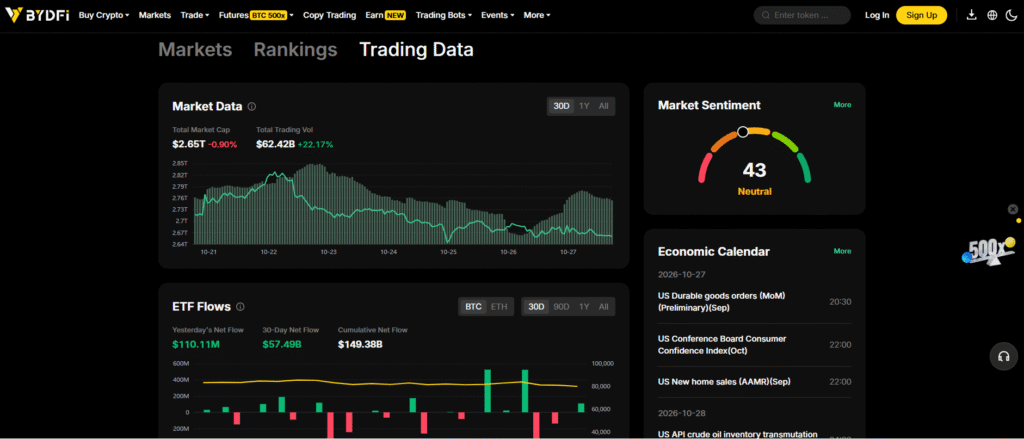
Best fit: Users who want to compare crypto trading with futures linked to traditional markets and value chart-based order controls. Check first: Which products are available in your jurisdiction, how margin works and what the complete funding and withdrawal route costs.
2. Binance: For a wide crypto market selection
Binance is a starting point for users who want many crypto markets within one exchange. Its offering covers spot trading, derivatives and other trading tools. This breadth can help users following several coins or trading styles.
However, market breadth should not replace a check of the exact trading pair. A heavily traded Bitcoin pair and a newly listed token can have different order-book depth. The latter may show a wider spread or greater slippage, meaning an order executes at a worse average price than the price first visible on screen. This matters especially for a larger market order.
Compare the bid, ask, available order-book depth and order types for the pair you want. Check deposit and withdrawal routes too; providers and supported products differ by country.
Best fit: Users who value a broad crypto trading ecosystem. Check first: Liquidity in the specific pair, total transaction costs and local product restrictions.
3. Kraken: For moving from simple buying to order-based trading
Kraken offers different ways to enter a position. A user can make a straightforward purchase or set up recurring buys, while Kraken Pro provides a more detailed trading interface for placing orders. This gives a beginner a simple route to start with and a way to compare more deliberate order placement later.
For a monthly Bitcoin buyer, recurring purchases may simplify the routine. Someone who wants to buy only below a chosen price may prefer an order-based interface. Neither method ensures a better outcome.
The cost may also differ between routes. Compare the final asset quantity shown in a quick-buy quote with the fees and expected execution on the trading screen. Funding currencies, payment methods and bank charges can change the effective price for an international user.
Best fit: Users who want a simple purchase flow with the option to use more detailed trading tools. Check first: The full quote for the selected payment method and whether the chosen service is supported locally.
4. Phemex: For traders who want predefined automation rules
Phemex is worth examining if the main question is how to execute a repeated trading plan. Its bot tools include Spot Grid and Futures Grid. A grid strategy places orders at preset price intervals, so the user does not have to enter each trade manually. The spot and futures versions have different risk profiles because a futures strategy can use margin.
Automation does not make the underlying idea profitable. A spot grid may accumulate an asset that keeps falling in price. A futures grid can face liquidation if adverse price moves overwhelm the available margin. Each executed order can also incur trading costs, so a strategy that triggers many small trades needs to clear those costs before it makes a net gain.
Before using a bot, examine its price range, order spacing, committed amount and stopping rule. A small trial may clarify the mechanics but cannot prove future performance.
Best fit: Traders who already have a defined plan and want to automate its execution. Check first: Bot settings, transaction costs and the additional risks of any futures position.
5. Bitstamp: For a focused spot-trading workflow
Bitstamp, now branded Bitstamp by Robinhood, is another option for users who want to concentrate on buying and selling crypto in the spot market. Its mobile app offers a purchase route, while Tradeview presents a trading interface. Rather than count every product an exchange offers, a spot trader can use these two routes to examine how an immediate purchase differs from an order placed on a market.
For example, a market order buys against available sell orders and may fill at several prices if the order book is thin. A limit order sets the maximum purchase price, but it may not fill at all. Neither order type solves the separate question of how much it costs to deposit funds or withdraw crypto afterward.
Compare the final asset amount in any quick-buy quote with the estimated cost of placing an order for the same amount. Then check the supported withdrawal networks and the current fee schedule. Availability of payment methods and products varies by location.
Best fit: Users who want to compare a simple purchase with a more deliberate spot order. Check first: Country eligibility, the live quote, trading fees and withdrawal networks.
What can a lower headline fee miss?
Consider an illustrative $1,000 crypto purchase. Platform A shows a 0.1% trading fee, a 0.4% difference between the reference market price and the purchase quote, and a $5 withdrawal charge. Those three items add up to about $10 before any price movement. Platform B has a higher 0.2% trading fee but a 0.2% price difference and a $2 withdrawal charge: about $6 in this simplified example. These are hypothetical figures, not quoted rates for any exchange above.
Compare the asset quantity received for the same payment, then add the cost of moving or cashing out. For futures, review funding, margin requirements and liquidation risk. A stop-loss order does not eliminate execution risk in a fast market.
Conclusion
The best crypto exchange is the one whose available products, costs and funding routes fit a specific task. BYDFi brings crypto and traditional-market-linked futures into one app. Binance offers a broad crypto market menu. Kraken gives users different purchase and order workflows. Phemex focuses on automated strategies, while Bitstamp gives spot traders another purchase and order interface to compare.
Use the same asset, transaction size and withdrawal destination when comparing quotes. Confirm local eligibility and security settings before depositing, and treat leveraged products as a separate risk decision from buying crypto on the spot market.