


What Are Genetic Algorithms?
Genetic algorithms are an optimization technique used on both constrained and unconstrained problems. The whole process evolved from natural selection, which also denotes biological evolution. Hence the best possible solution to a problem is derived by these algorithms using natural selection. It is a heuristic approach to arrive at solutions.
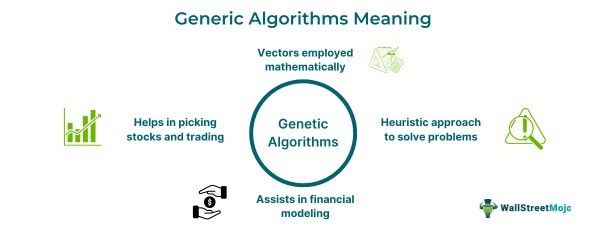
The method is useful in finance to determine the best combination of trading rule parameter values that assists in building artificial neural network models alongside computation and mathematics. These models are then further used to identify stocks and determine the suitable entry and exit points in trading.
Key Takeaways
- Genetic algorithms are a heuristic technique to derive optimal solutions for both constrained and unconstrained problems using mathematical computation.
- The technique is used in finance to identify stocks, trade, and build new investing and market strategies, along with predicting future security prices.
- Competitive corporate traders commonly use it, but ordinary traders can also employ it. These solutions typically come as standalone software packages inclined toward financial markets to offer in-depth analysis and market examination.
- When using genetic algorithms in financial markets and trading, backtesting helps in defining the accuracy, dependability and consistency of the trading strategy and employed algorithms.
How Do Genetic Algorithms Work?
Genetic algorithms are a heuristic approach to optimize problems and provide the best optimal solutions for problems. Ideally, the term and context belong to biological evolution. They are based on Charles Darwin’s theory of natural selection. Still, with modernization and compelling studies, it has been adopted in machine learning, science and different fields of finance and statistical research. These algorithms are mathematically developed using vectors. Vectors are quantities that also have a direction and magnitude.
Now, each trading rule’s variable can be treated as a one-dimensional vector and then natural selection is implemented. Here, the vectors are observed as a chromosome and each parameter is taken as genes.
For instance, a trading rule may have a MACD or exponential moving average, with the assistance of genetic algorithm values entered into these variables to increase the overall profit. After that, minor adjustments are made from time to time, and the variables with positive results are taken further.
The key advantage of genetic algorithms in financial markets is their ability to enhance the precision and accuracy of traders’ decisions in active markets. This, in turn, reduces the risk of missing out on investment opportunities. Moreover, these algorithms enable traders to analyze market statistics more effectively, leading to improved risk management. Additionally, algorithmic trading, driven by genetic algorithms, provides better trading liquidity and contributes to the swift execution and conduct of global financial markets.
Using Genetic Algorithms to Forecast Financial Markets
When it comes to using genetic algorithms for optimization trading rules and forecasting financial markets, the trading rules are optimized when it comes to parameter selection for a particular stock. By employing the right values the change in the underlying securities price can be anticipated. With a dire need for efficient and successful trading tactics, algorithmic trading has boosted exponentially in the past few years. It allows a trader to –
- Build trading systems and deduce the right trading strategy.
- Predict the future stock price movement.
- Make better financial decisions and identify the right stocks to invest in.
- The genetic algorithm helps traders pinpoint suitable entry and exit points in a market trade.
- With backtesting, risk management is increased, and operating costs are reduced.
- It has majorly impacted the finance sector, having a positive influence on trading administration, performance and investment executions.
- Choosing the right fit and correct parameter can elevate a trader’s profit in the market.
Trading with Genetic Algorithms
The corporate quantitative dealers are the primary users of genetic algorithms. Moreover ordinary traders also employ it to take advantage in trading. The normal traders involved in genetic algorithms have a certain risk when it comes to curve fitting or building a trading strategy based on past historical data compared to identifying repetition in patterns. Genetic algorithms must be forward-tested on paper before they are implemented live. One of the critical steps is parameter selection. Traders using genetic algorithms must look for correlated factors and multiple signals to determine significant market shifts.
Genetic algorithm applications in trading have a huge impact on how traders cultivate market results. It can be done using a combination of genetic algorithms with Python. Since the process of natural selection inspires it, the optimal solutions are gained by repetition. GAs help in optimizing trading parameters to arrive at better results.
When using genetic algorithms with Python, a trader requires –
- Initial population – An initial population is created from potential trading strategies.
- Fitness function – The fitness function defines the credibility of a trading strategy based on several factors such as risk, profit, market trends, price movements and so on.
- Selection – The best performing strategies are identified from the current population based on their fitness scores.
- Crossover – The selected strategies together form a new population and are combined to create new strategies.
- Mutation – It refers to small changes introduced to regulate trading parameters.
- Repeat – The entire process from selection, crossover and mutation is repeated until the best and optimal trading strategy is found.
When it comes to algorithmic trading, backtesting plays a crucial role. It helps traders verify their trading algorithms using primary data. It uses previous market data to test the performance of a trading system which assists traders in checking how their trading strategy would have executed and hence make necessary adjustments rather than taking a financial risk. Hence, reliability is assured.
Examples
Below are two examples of genetic algorithms –
Example #1
Suppose David is an advanced trader and investor; he is particularly eyeing an IT stock; he employs genetic algorithms to predict the future stock price movement of the security and, at the same time, is thinking of building a trading strategy for it.
By using curve fitting, David designs a trading system by identifying repeatable behavior. He ensures that before going into live trading, he forward tests the strategy on paper. David uses different technical indicators to see if any of its outcomes correlate with major market shifts. The most challenging part for David was the parameter selection and seeking price changes of the stock.
It is a straightforward example showcasing the use of genetic algorithms in trading. However, in the real world, it is highly time-consuming, complex and filled with many limitations.
Example #2
For the second example, there is a particular paper that signifies a hybrid stock selection model that is created using genetic algorithms and support vector regression. Stock market data is highly complex and noisy. It often happens that the approaches become inconsistent and give inaccurate results with unpredictable performance. Most of the time it is because of the nonlinear and non-stationary time series process.
Given the complications, stock selection has always been a challenging task. This paper highlights how using both genetics algorithms and support vector regression models an important stock selection problem was solved. Firstly, the hybrid model was validated statistically, and the empirical results reflected that when the proposed methodology was employed, it outperformed the benchmark return. At the same time, it is expected to advance the research in finance.
Frequently Asked Questions (FAQs)
Frequently Asked Questions
What are the applications of genetic algorithms?
The genetic algorithms applications have a wide scope in multiple fields, such as: – In machine learning for optimization – In finance, build an ANN model to pick stocks and create new trading strategies. – Typically employed for scheduling, parameter tuning and routing. – Image and signal processing, evolutionary robotics and data modeling.
Who is the father of genetic algorithms?
John Henry Holland is considered the father of genetic algorithms. He is an American scientist and psychology professor with a degree in computer science and electrical engineering from Michigan University. He, along with his collaborators, designed the model of abstraction of biological evolution from the 1960s to the 1970s. The model was based on Charles Darwin’s theory of natural selection.
What are the limitations of genetic algorithms?
The limitations of genetic algorithms are – – Time-taking process with a slow convergence rate – With higher complexity, arriving at an optimal solution is challenging – The whole method is based on random search techniques – Premature convergence refers to early solutions with full exploration – The whole process is computationally expensive and tiring – Genetic algorithms face troubles with a high degree of epistasis in problems