


Part of our Business Operations guide
What Is CEO Succession?
CEO succession refers to the systematic process of identifying, selecting and nurturing a successor to the existing CEO to ensure an easy leadership transition in a company. It aims to achieve business continuity, organizational stability, long-term success and reduced operational risk and business disruptions.
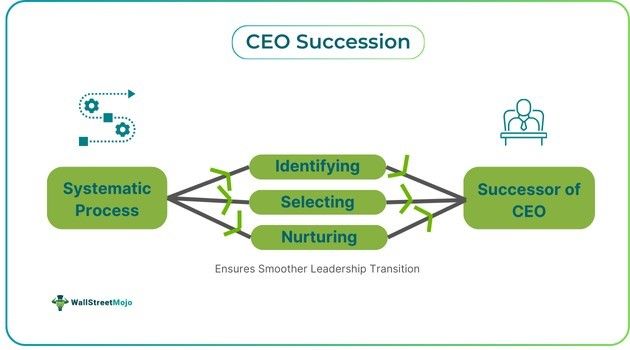
It instills investor confidence and fosters internal and external talent of potential CEO candidates. It helps in corporate governance, risk management, and organizational growth by readying it for leadership change. It helps stakeholders learn about the succession process and familiarize themselves with the future CEO. It also effectively oversees the onboarding of the new CEO.
Key Takeaways
- CEO succession is crucial for maintaining business continuity, stability, and long-term success, ensuring a smooth transition, and reducing operational risk and disruptions.
- It involves establishing criteria, identifying candidates, evaluating them, developing a leadership pipeline, emergency succession planning, selecting and transitioning the CEO, and reviewing the annual succession plan.
- It is important as it ensures continuity of leadership, risk management, talent development, strategic alignment, shareholder value, preservation of institutional knowledge, and board accountability.
- The company’s familiarity with the internal CEO succession is high, while the external CEO succession has a low level of familiarity as an outsider.
CEO Succession Planning Explained
CEO Succession Planning is an ongoing procedure undertaken by the board of directors to make their organization transition from current CEO to incumbent CEO while retaining the excellence in leadership. It is crucial for any organization in any industry for sustainable growth, continuity, and stability of a company. It involves steps like potential successor identification, grooming and development, planning for transition, and review of succession planning and update.
A well-implemented CEO succession plan may benefit the business in a number of ways, including:
- Continuity: A seamless transfer helps keep the business moving forward and prevents any changes to its strategic course.
- Talent retention: Organizations can recruit and retain top talent and lower the risk of losing important leaders to rivals by cultivating and preparing prospective successors.
- Adaptability: A well-thought-out succession plan may assist the firm in adjusting to alterations in the business environment, such as modifications in the state of the market or advances in technology.
Furthermore, planning for the CEO transition may be advantageous for the business as well as the successor. It may assist the business in ensuring a seamless transition, maintaining continuity, and adjusting for evolving conditions. It can allow the person to embark on an entirely novel task, acquire more responsibility, and even land a more powerful position within the company.
Moreover, CEO succession planning is an essential procedure for businesses to maintain their success and continuity. By identifying, developing, and facilitating a seamless transition, firms may effectively sustain their strategic orientation, adjust to evolving conditions, and ultimately secure sustained success.
Planning Process
A number of vital actions are included in the ongoing process of CEO succession planning, which guarantees a seamless and efficient handoff of power. The primary phases in the CEO succession planning process are as follows:
- Criteria Establishment: Board members define the criteria like leadership style, qualifications, competencies, and experience for the future CEO.
- Candidate Identification: Then identification of suitable candidates from within an external organization takes place.
- Internal Candidate Evaluation: Internally, potential candidates with high leadership potential are selected and groomed for more than two years using development and evaluation plans.
- External Landscape Assessment: Recruiters, job boards and external organizations in the same or other industries are accessed and monitored to select the right candidate for the future CEO position.
- Candidate Development: Internal or external candidates identified as fit for the future CEO are given adequate exposure, made to experience the role, and trained for the role. They are also made familiarized with businesses’ operations, values, and culture to adapt and work accordingly.
- Leadership Pipeline Development: Avenues are opened for these selected future CEOs to get groomed, mentored, trained, and assigned assignments that will familiarize them with all operational aspects.
- Emergency Succession Planning: The Board also prepares short-term options for getting into the CEO role to control the business in sudden deaths, resignations, or departures of current CEOs.
- CEO Selection and Transition: Finally, the board selects one suitable candidate as the company CEO who has imparted full knowledge transfer and their transition into the role after the current CEO has ended their tenure.
- Annual Succession Plan Review: Moreover, the selected and future CEO-designated candidate is evaluated internally and externally to ensure that they fulfill the company’s ever-changing leadership needs.
- Besides these, nonprofit CEO succession planning is critical to organizational management. The Harvard Business Review’s CEO succession planning offers valuable insights into CEO succession best practices. Utilizing a CEO succession plan template can streamline the process and ensure smooth leadership transitions in nonprofit organizations.
Examples
Let us look at a few examples to understand the topic.
Example #1
Tim Cook, the CEO of Apple, stated in a BuzzFeed News interview on October 24, 2017, that he plans to train a number of people to take over as CEO one day. Cook clarified that the board makes the ultimate decision and that his job is to train as many candidates as possible for the role. Apple’s retail chief, Angela Ahrendts, denied reports that Cook preferred her to take the position.
Cook also spoke about Apple’s position on politics, stressing that the business talks policies but stays out of fights centered on individual personalities. Ahead of the much-awaited release of the iPhone X, Cook discussed the company’s determination to manufacture the maximum number of handsets during the interview.
Example #2
Suppose a succession tale plays out at the corporate headquarters of TechiCorpi, a major technological firm located in the vibrant city of Innovia. On November 8, 2022, the CEO at the moment, Robert G. Anderson, declared his retirement following a fruitful term. The search for a new CEO is started by the board of directors under the direction of Chairperson Emily dicky Johnson.
The two internal candidates that stand out as front-runners are Michael K. Thompson, the charming chief operating officer, and Sarah P. Roberts, the creative chief technology officer. TechiCorpi’s existence is in jeopardy as the corporation gets ready for an important board meeting at the opulent Graandi Toweri Hotel. Tensions are high, and alliances are forming.
Importance
A crucial component of organizational management and corporate governance is CEO succession planning. Hence, let us know some of the major importance as listed below:
- Continuity of leadership: It helps maintain stability, employee morale and productivity as it ensures a smooth leadership transition leading to uninterrupted business operations.
- Risk management: It decreases the risk associated with vacant leadership arising out of the death, retirement, or resignation of the current CEO, allowing a firm to respond efficiently to these challenges.
- Talent development: It selects and grooms the right internal candidates for leadership roles in a structured manner, promoting staff engagement, retention, and motivation to perform well.
- Strategic alignment: It imparts necessary personal traits, skills and experience to the new candidate who can align with the company’s strategic vision, mission, and values.
- Shareholder value: Shareholders and stakeholders gain confidence in the company because succession planning makes them feel that the company is ready to face and overcome any challenge to grow.
- Preservation of institutional knowledge: A structured and planned succession helps preserve the company’s culture, strategy, operations, and relationships among partners and clients.
- Board accountability: It signals that the board is accountable regarding its choice and action on the selection of a new CEO in a timely manner to propel the company in a high growth direction.
Internal Vs. External CEO Succession
Both the CEO succession process has benefits and drawbacks for internal and external candidates. Moreover, they have certain differences, as shown in the table below:
Frequently Asked Questions (FAQs)
Who is CEO succession?
Moving from one Chief Executive Officer (CEO) to another is called CEO succession within a business. It entails choosing and grooming a successor to guarantee a seamless transfer of leadership.
What are the four models of CEO succession?
Insider succession, outsider succession, hybrid succession, and emergency succession are the four types of CEO succession plans. Whereas outer succession involves recruiting a CEO from outside the company, insider succession entails elevating a member of the staff. Insider and outsider succession are combined in hybrid succession, and emergency succession involves appointing an interim CEO in the event of an unexpected departure.
CEO succession: what we know and where to go?
A crucial component of organizational continuity and planning is the succession of CEOs. It entails locating possible heirs, enhancing their qualifications, and ensuring the smooth leadership transition. To achieve long-term success, organizations must have a comprehensive grasp of the tenure and performance of their present CEO and a well-defined plan for choosing and developing the future CEO.
Recommended Articles
For more on Business Operations, explore these related articles from our Business Operations guide.