


Part of our Fintech Basics guide
What Is A Chief Privacy Officer (CPO)?
The Chief Privacy Officer (CPO) is the senior executive in charge of creating, overseeing, and implementing data privacy guidelines and regulations to safeguard data from unwanted access. It also monitors and processes the collection and maintenance of customer information in accordance with a firm’s data rules and policies.
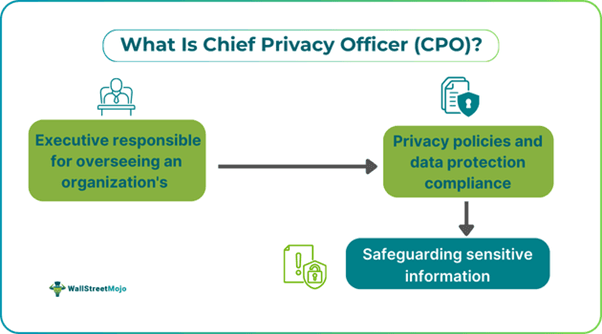
The CPO acts as the nodal point for enhancing a firm’s data safety and making appropriate decisions concerning its data privacy. It has to uphold current and detailed knowledge of privacy laws and corporate operations. It also disseminates an organization’s privacy policy to its customers and staff. Actually, CPOs act as a one-stop solution for all public inquiries related to an organization’s privacy policy and related matters.
Key Takeaways
- A CPO is a management person in charge of creating and enforcing data privacy regulations that frustrate attempts to obtain employee and customer information illegally.
- It serves the purpose of monitoring and processing, collecting and maintaining customer information in accordance with a firm’s data rules and policies, and paying the most experienced CPOs around 100,000 dollars.
- Its primary roles and Responsibilities include – helping businesses subjectively navigate the information ocean and defining, maintaining,
- and implementing privacy policies plus processes by developing a strategic privacy policy.
- Its main duty is to develop an organization’s privacy policy and ensure its efficiency,
- whereas the Data Protection Officer’s main duty is to oversee an organization’s compliance with various privacy regulations, such as LGPD, GDPR, and CCPA, among others.
Chief Privacy Officer Explained
A Chief Privacy Officer (CPO) is a member of management who is responsible for establishing and executing data privacy policies that thwart any attempt to illegally access an organization’s staff and customer data. In other words, they act as corporate legal advisers for a firm. The CPO serves as a leader for all privacy-related compliance. They also design and execute detailed privacy policies and strategies throughout the organization concerning information security and data protection.
They have a legal obligation to provide guidance on regulatory and legal aspects of privacy compliance and resolve issues related to the organization’s strategic privacy policies as and when required. They report to either the Chief Operating Officer or the Chief Compliance Officer as per the company’s policy. The CPO position is at the C-level in an organization. Their primary responsibility is to ensure that their organization is following international laws on standards and compliance with privacy practices.
Above all, CPOs are entrusted with the welfare of a firm on a priority basis. Their primary duty is building trust among customers plus enhancing a firm’s reputation as one that complies with all data safety rules and presents as a privacy-conscious entity. Other tasks include being the main communication channel of a firm in the privacy-related domain. Furthermore, the CPO also has to mitigate all public fallout due to any security breach or incident in the privacy of the firm.
Roles And Responsibilities
Let us discuss the role of CPO first, which has been listed below:
- Increase the existing privacy of information throughout the organization
- Utilizing personal information to increase the revenue opportunities of a firm
- More importantly, they help businesses subjectively navigate the information ocean.
- Liasoning with government departments
- Monitor privacy impact evaluations.
- Managing controls of compliance
- Establishing procedures and privacy policies for businesses.
Now let us move on to know the responsibilities of a CPO as follows:
- To define, maintain, and implement privacy policies plus processes by developing a strategic privacy policy
- Increase the confidentiality of data.
- To ensure that an organization’s privacy policy complies with the government’s existing laws, regulations, and privacy standards.
- Coordinate with the senior executives, compliance officers, and security officers of a business.
- To monitor the rights of the customer concerning access, examination, and amendment of information by them
- To organization training classes for all and new employees of a firm to make them aware of data safety policies and abiding them
- To prepare and act as a guide to deal with all security-related complaints.
- To preserve and execute the firm’s accreditation standards along with state and federal privacy laws.
CIGNA chief privacy officer, apple chief privacy officer, or Twitter chief privacy officer has more or less the same responsibilities and duties.
Salary
The average Chief Product Officer (CPO) in the US earns approximately $223,953 annually, with an additional average bonus of $37,992, which constitutes about 20.43% of their total compensation. Nearly half of CPOs receive bonuses each year. CPOs in San Jose, CA, command the highest salaries, averaging $442,169 annually, significantly above the national average. Overall, CPO salaries across the US range from $57,931 to $1,798,389, with a median of $190,000.
Regarding taxes, CPOs in this income bracket face an average federal tax rate of around 35%, impacting their take-home pay from the reported salary figures.
Chief Privacy Officer Vs. Data Protection Officer
Let us understand the differences between the two using the table below:
| Chief Privacy Officer | Data Protection Officer |
|---|---|
| The chief privacy officer’s job is to build the privacy policy of an organization and ensure its efficiency. | Its main duty is to oversee an organization’s compliance with various privacy regulations such as LGPD, GDPR, and CCPA, among others. |
| It has a vast and ambiguous role in an organization’s data privacy policy and compliance. | It has a well-defined role. |
| It dies to represent the interest of the whole organization. | It has professional and expert knowledge of data protection |
| It may have responsibilities conflicting with the role of DPO. | It plays a centralized role. |
| It is exempt from fulfilling the requirements of GDPR art 37(1 ) | It never gets into the decision-making procedure concerning data processing activities. |
| Their function gets aligned with the strategic data policy of the business. | It alone never represents the whole organization’s business interest |
| They play an active role in compliance, privacy policy management, and governance. | It never conflicts with the role of the CPO |
| They have decision-making ability, unlike DPOs. | It has only an advisory role and only police over the security aspects. |
| They only require good communication skills besides technological expertise. | They tend to have legal and technological backgrounds. |
Frequently Asked Questions (FAQs)
What does a chief privacy officer do?
They are mainly concerned with data privacy policies and increasing and maintaining a firm’s data security.
How much does a chief privacy officer make?
According to salary.com, the salary of a CPO in the United States was $234,200 as of January 2023. However, on average, a CPO’s salary falls between $205,400 and $273,640. Nevertheless, one can expect to get a different salary offer depending on one’s certification, education, additional skills, and years of experience.
How to become a chief privacy officer?
To become a CPO, one needs to follow the route map, which includes hard work, skills, and experience, as well as proper educational qualifications. However, one has to follow the steps below:
- Defining the career plan
- Obtaining the relevant degree
- Getting professionally certified
- Searching for job
- Improving one’s skillset
Who should the chief privacy officer report to?
Every firm has a different structure for reporting CPO. However, for those firms which have more focus on operations, the CPO reports to the following:
- The Head of Compliance
- The General Counsel, or
- The CEO or Corporate Affairs Officer
Recommended Articles
For more on Fintech Basics, explore these related articles from our Fintech Basics guide.