


What Is Elder Law?
Elder law, also referred to as older adult law, is a legal provision that primarily focuses on the practical and legal issues of citizens over the age of 65 years. While the law takes care of the older population, it also is for their caretakers, friends, and family.
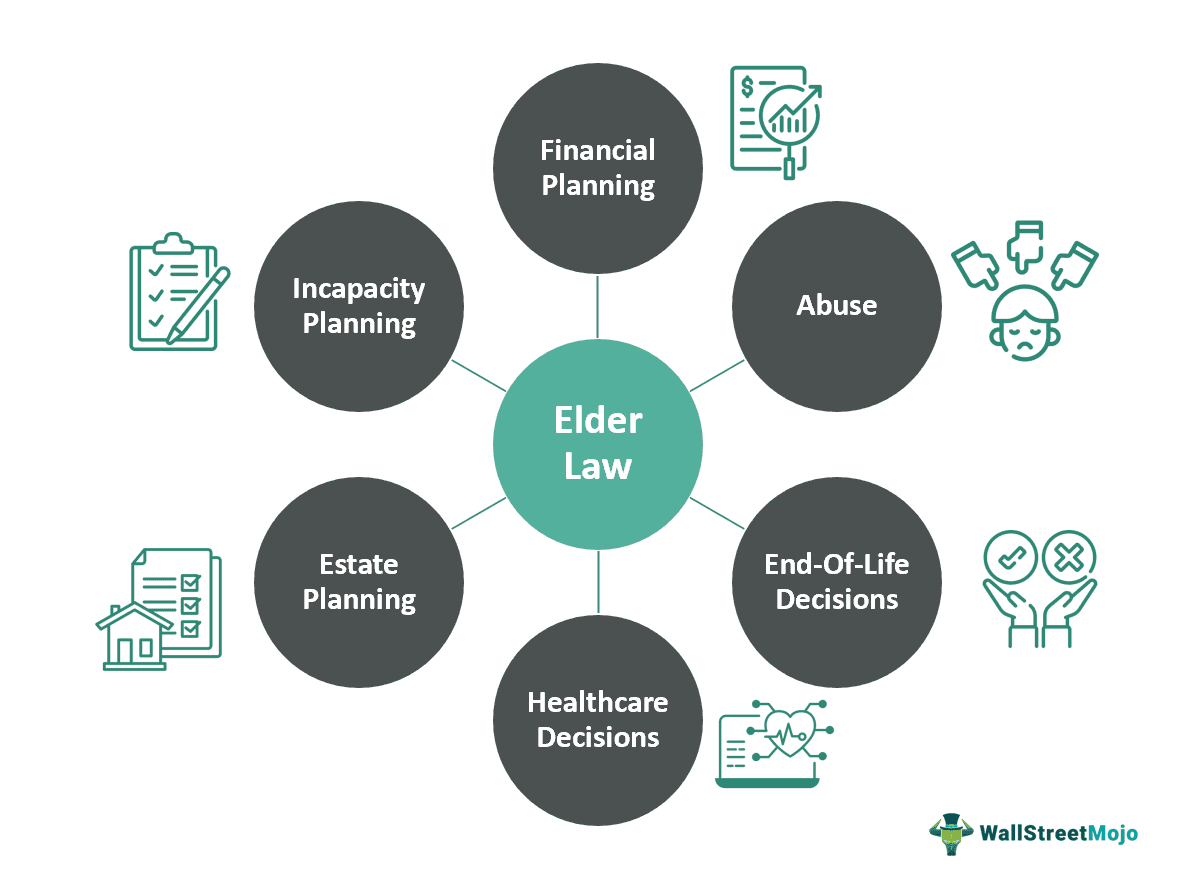
The common issues resolved by elder law firms include healthcare decisions, abuse, estate and financial planning, and end-of-life decisions. The National Elder Law Foundation (NELF) certifies attorneys as Certified Elder Law Attorneys (CELA). These practitioners choose a specific area and practice around that specialization to ensure their clients are promised financial stability, dignity, and overall well-being.
Key Takeaways
- Elder law is a stream of legal practice that has its primary focus on protecting the financial, social, mental, physical, and sexual rights of individuals above the age of 65.
- The National Elder Law Foundation certifies practitioners as Certified Elder Law Attorneys (CELA). These lawyers usually practice a specific sub-set within these sets of laws.
- The primary areas of work for older adults concerning healthcare, end-of-life decisions, incapacity planning, estate planning, and abuse.
- These laws help individuals prepare for a tricky situation in the future if planned efficiently before the need arises.
Elder Law Explained
Elder law, or older adult law, is a separate area of legal practice that places impetus on the challenges and needs of senior citizens or the older population. It includes an extensive range of issues such as long-term care, estate planning, healthcare, retirement, protection against abuse, and guardianship.
One of the most common areas of practice for elder law attorneys is estate planning. Under this specific area within the older adult law, these attorneys create wills, powers of attorney, and trusts as per the requirement of the individual. These steps make sure that the individual’s assets and other items in their estate are passed on according to their wish.
The reason special laws for older adults came into being was because of medical advancements. Because of these advancements, the lifespan of human beings in general increased, and there came a need for laws, financial management, and caregiving.
As an individual keeps growing old, the list of things they are unable to perform keeps increasing every day. Therefore, it is essential to make sure that critical decisions regarding healthcare, estate planning, and guardianship, among others, are taken while they can do so.
Issues And Problems That Might Need Legal Assistance
While there are a variety of problems that might need the legal assistance of a professional, the points below cover the most common ones.
- ·Estate Planning: It refers to the preparation for what would happen to the assets of an individual after they pass away. It is a common misconception among people that estate planning is for the older generations. However, it can be done at any age. Moreover, it is not just for the wealthy section of the society. Anyone who is getting older and does not have a plan in place to pass on their assets can draft one.
- Benefits From Social Security: These benefits can come in handy for older adults. However, it is essential to note that these benefits can be claimed anytime between the age of 62 and 70. Nonetheless, early withdrawal or delayed withdrawal can reduce the benefits significantly.
- Medicare Planning: One of the significant expenses linked to old age is medical expenses. Therefore, it is critical to enroll for Medicare at 65. Otherwise, the individual might have to pay significantly higher premiums for coverage later. An attorney specializing in this area can help find the best option that fits the individual’s unique needs.
- Abuse: Elders who are unfortunately subject to abuse physically, emotionally, financially, or sexually can file a claim with the help of an older adult attorney. They can file claims and compensate for the emotional distress, medical bills, loss of income, if any, and physical pain endured.
- Incapacity Planning: An individual is considered incapable of making decisions due to a mental or physical condition that prevents them from taking care of their own daily chores or hygiene activities. Therefore, a lawyer can curate an incapacity plan to ensure nothing is left to chance.
How To Find An Elder Law Attorney?
Under the ambit of an elder law firm, different legal issues are dealt with. Therefore, making sure that the right lawyer is found as per the individual’s requirement can take time and effort.
It is tricky not just because the nature of the legal issue is slightly different than ordinary cases but also because of the remuneration structure. For instance, lawyers who handle cases related to abuse of older adults do not charge on an hourly basis. They get a percentage of the claim recovered, and they are paid only if they win the case.
However, if the individual requires assistance with incapacity or estate planning, these attorneys charge on an hourly basis. Some attorneys also charge a set fee for a specific service.
To find a lawyer who specializes in the specific legal issue, an individual can search from the following websites:
- National Elder Law Foundation
- National Academy of Elder Law Attorneys Database
Examples
Now that the basics and the related factors of the concept are out of the way, the examples shall help with understanding the concept in further depth.
Example #1
Shane is 57 years old and is set to retire in 3 years. He was also diagnosed with diabetes and needed assistance with most things due to his medical condition and age-related issues. He met with his attorney, who also specializes in elder law abuse and incapacity planning, who advised him to set out instructions while he still could.
Therefore, Shane drafted a document that said that the medical expenses that would be covered through his extensive Medicare and any decisions regarding his medical treatment that needed consent or end-of-life decisions would be made by his wife, Georgia.
Shane also created a trust where his wife and children would get a share of his assets, and the remaining would be transferred to a charity of his choice.
Example #2
A daughter-father duo from a rural hometown in Kentucky faced multiple issues due to not having sufficient preparation for healthcare. The father had assigned his daughter as his medical surrogate; however, due to the unavailability of Medicare advantage insurance.
He was diagnosed with dementia and needed assistance around the clock. Moreover, amid a pandemic, he was also diagnosed with Alzheimer’s in 2020. The cost of long-term memory care would bring in a bill of $9,000 every month, and the daughter, despite having a power of attorney, could not make decisions as he was incapacitated due to his Alzheimer’s.
Despite the daughter having the POA, she needed to work on efficiently getting things done due to the incapacity of planning needing to be made available.
Importance
Even though the importance of an elder law attorney is explained in bits and pieces throughout the article, there are specific points that prove their significance in the point below.
- With old age, there is usually a requirement for additional care in the form of assisted living or even a nursing home for more specialized care. Therefore, older adult law can help individuals plan things carefully amidst hundreds of options and hundreds of pricing plans.
- In a world with constant upgradation in terms of technology, the older generation tends to understand little of these technologies. Hence, they are susceptible to financial fraud, which can be highly damaging. The damage can be limited with protection against such frauds with the help of a professional.
- Individuals who have or have not amassed a bunch of assets would want to pass them on according to their wishes. Therefore, estate planning could require them to draft a will or form a trust to channel these transfers. Older adult law helps with creating these transfers with ease.
- As individuals age, their capacity to make decisions also diminishes due to a physical or mental ailment. As a result, incapacity planning is essential to make sure someone the individual trusts calls the shots when they cannot due to their circumstances.
- Social security is one of the most enormous benefits for the older population. However, the rules and withdrawal systems are complicated. A professional’s help with the intricacies of the process can help with the optimal use of the advantage.
Elder Law vs. Estate Planning
The differences between the services of an elder law firm and estate planning professionals are discussed below.
Elder Law
- A separate avenue of legal issues that concern the older citizens of a country. The significant issues that are protected under the law are regarding abuse, long-term care, guardianship, and healthcare.
- It deals with the issues that arise due to medical or age-related issues faced by older adults.
- The legal system provides them with the shield to ensure they are not abused or taken advantage of physically, mentally, financially, or sexually.
- The system also makes sure that after the individual passes away, their assets and other forms of wealth are passed on according to their wishes.
- An attorney practicing law in this area is certified by the National Elder Law Foundation.
Estate Planning
- Estate planning is a subset of older adult law. Its primary focus is to manage and distribute the assets of an individual according to their wishes after their death.
- The assets can be passed on by drafting a will or forming a trust based on the individual’s discretion.
- They can also assign a family member or a friend to make decisions regarding financial or medical matters if they are incapable of making those decisions.
- A plan concerning the transfer of assets after one’s death can also attract taxes. Therefore, sufficient planning could lead to a seamless transfer and keeping the wishes of the individual at the forefront of things.
Frequently Asked Questions (FAQ)
Frequently Asked Questions
When should I hire an elder law attorney?
The general perception that an elder law attorney is needed only when an individual reaches a certain age is the root cause of most problems in terms of finances and healthcare with older adults. Therefore, an older adult attorney must be hired before the need arises to make sure there is a compartmentalized preparation sorted before it is too late.
How to become an elder law attorney?
To be a certified elder law attorney, an individual must be licensed and be in good standing with the respective state bars in which they practice. Additionally, their affiliation with the National Elder Law Foundation also gives them the additional pass to practice this specific stream of law.
How much do elder law attorneys make?
Different lawyers charge different fees based on their experience, the nature of the case, and urgency. Some lawyers charge a percentage of claims made, while others have a fixed hourly charge of typically $350-650 an hour. On average, older adult law layers make about $108,160 a year.