

Sending out one email message to customers worldwide may seem like a breeze until you try it. Things can get confusing with languages, cultures, currencies, dates, and expectations of customers. Success in one market can be totally different in another market. That’s where email localization at scale comes in handy.
Why Email Localization Matters for Global Brands
Now, customers in more markets than ever are reached by global brands. The internet was used by 6.12 billion people in the world by the beginning of April 2026. It gives businesses a large audience on a global level, but effectively reaching them needs more than just translation.
- Creates a More Relevant Customer Experience
A familiar email is easier to understand. However, a marketing team can find it time-consuming to do email localization at scale and produce a new design for each market. A drag-and-drop email template builder can solve this issue.
Teams can adapt layouts to suit their needs rapidly and maintain their branding. This helps to pinpoint language, currency, dates, and cultural information for targeted audiences.
- Builds Trust Across Markets
Customers need to know what a brand has to offer before they do anything. So, it becomes crucial that you make personalized emails when you are doing email marketing.
So, emails that are tailored to a specific area eliminate pricing, offers, delivery, and other information confusion. They also indicate that your business is aware of the market rather than just sending translated content.
- Supports Better Engagement
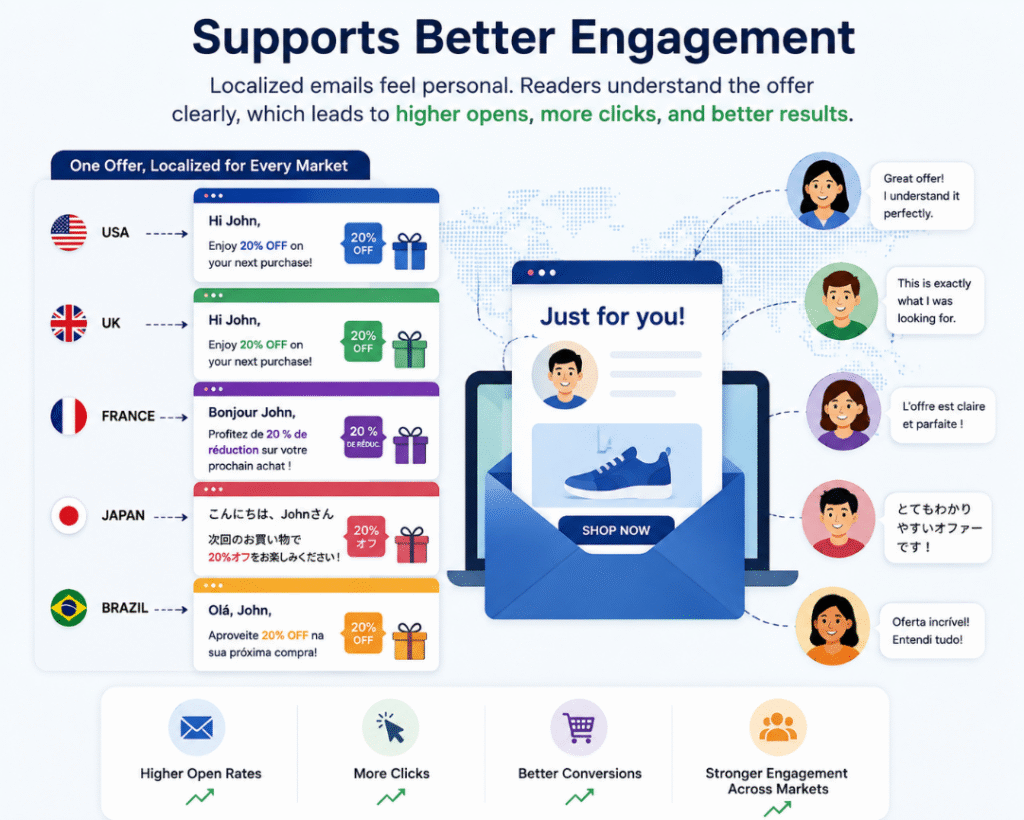
It is possible to make a localized email more personal than a generic one sent worldwide. The reader is able to comprehend the offer that you are giving.
In fact, they must understand it without having to convert the information in his/her mind. This might lead to increased open rates, clicks, and so on from customers across various markets.
- Protects Your Brand Image
Even professionals can appear careless when they have been poorly translated. Words can carry different meanings across languages.
With the right and advanced AI email localization, you can uphold your brand tone. Plus, you can adjust your message to the local language and cultural norms.
- Helps Global Growth
You can adopt the approach of the glocalization technique as it becomes more important as your business enters new markets. You can repeat this approach in your campaigns.
Plus, you can communicate to various audiences without having to build new campaigns each time. With this, localization of emails becomes more feasible at scale as you add more subscribers.
Key Elements to Localize in Email Campaigns
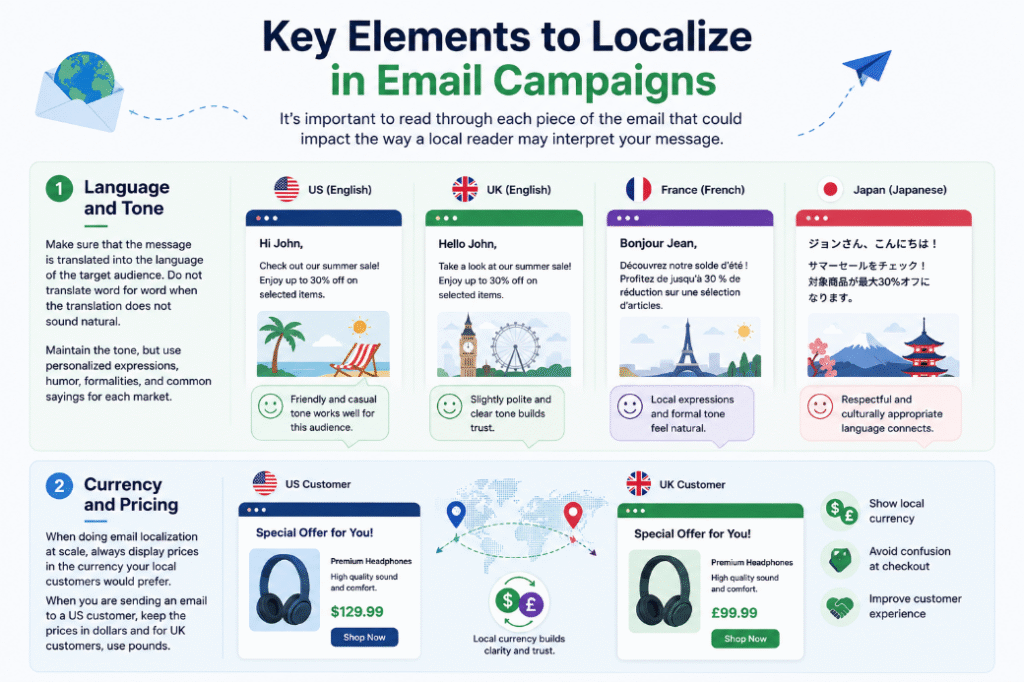
It’s important to read through each piece of the email that could impact the way a local reader may interpret your message. Using an infographic maker can help teams present localization guidelines, language considerations, and market specific information in a clear visual format.
- Language and Tone
Make sure that the message is translated into the language of the target audience. Do not translate word for word when the translation does not sound natural. Maintain the tone, but use personalized expressions, humor, formalities, and common sayings for each market.
- Currency and Pricing
When doing email localization at scale, always display prices in the currency your local customers would prefer. When you are sending an email to a US customer, keep the prices in dollars, and for UK customers, use pounds.
How to Localize Emails at Scale?
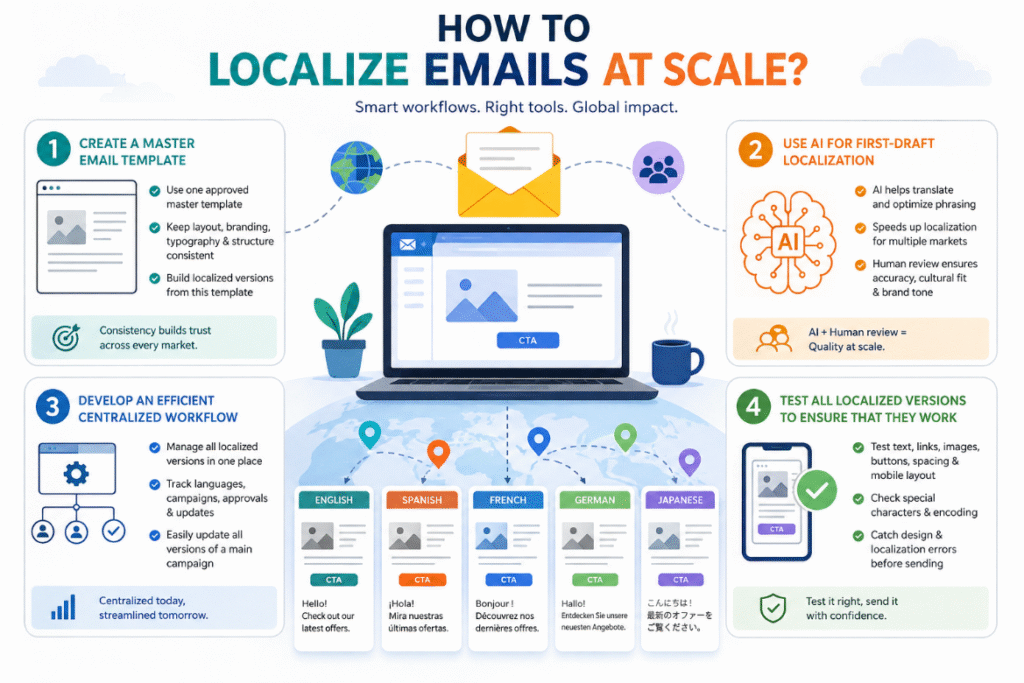
It begins to get difficult when you’re dealing with hundreds of campaigns and multiple markets. Now you may ask, how to localize emails at scale? Well, the workflows must be clear to prevent redoing work in your digital marketing through email for your business.
- Create a Master Email Template
Use only one approved master template. Consistency has to be there in layout, branding, typography, and core structure. Then make localized versions from this template. This will minimize repetitive design efforts and provide a common launching point for each market.
- Use AI for First-Draft Localization
AI email localization can help accelerate the initial step. AI can assist in translating content and optimizing phrasing and generate localized versions for different markets. But it is not enough to rely on machine translation. Human review is crucial to ensure accurate cultural and brand tone.
- Develop an Efficient Centralized Workflow
Have all localized versions managed in a single workflow. This helps to follow the languages, campaigns, approvals, and updates. If there is a main campaign, then your team can easily see which localized campaigns need to be updated as well.
- Run All Localized Versions to Ensure That They Work
Don’t assume that an email translated will look right. Test text, links, images, buttons, spacing, and mobile layout. Check the appearance of special characters as well. Testing can detect design and localization mistakes that are not yet in the hands of customers.
Conclusion
Email localization at scale aids a global brand in talking to its customers in a relevant language. The process becomes more difficult with the number of markets and languages. So, scale efficiently using templates, automation, AI, and human review to ensure consistency in campaigns.