


Europe had a leading role in designing the international trading system, and is now trying to defend it. The single market and the network of trade agreements and trade on the basis of rules offered more opportunities to European companies and lower prices for consumers.
Openness caused a demand for global supply chains and a shift of production to lower-cost countries as well. Europe wasn’t the only region that contributed to globalization and de-industrialization; there are several reasons for it. European politicians and corporations followed a model that has its costs, which are not so easy to ignore anymore.
It is not as simple as claiming that manufacturing has moved overseas. A report by the European Commission found that the extent to which manufacturing’s share of total EU output had fallen was exaggerated, once inflation was taken into account, because high-tech manufacturing was actually rising in real terms. It also found the EU had been losing global market share in some areas, notably textiles and electronics.
In its latest communication on the future of industrial policy, the Commission indicated that during the last two years the EU had been losing, on average, 27,000 manufacturing jobs each month. Yes, Europe is suffering from an industrial retreat, but that retreat is uneven and it is subject to both low cost domestic and foreign competition.
It’s also worth noting that China now has many more unicorns than Europe. Europe has about 324, compared to 452 in China. Furthermore, European unicorns are often in the services, wellness, or fintech sectors — such as the neobank Revolut, which has attracted considerable attention amid discussions surrounding a potential Revolut IPO — and are not necessarily involved in the export of goods.
Last year the EU sold €199.6 billion worth of goods to China and brought in €559.4 billion, leaving a trade deficit of €359.8 billion.
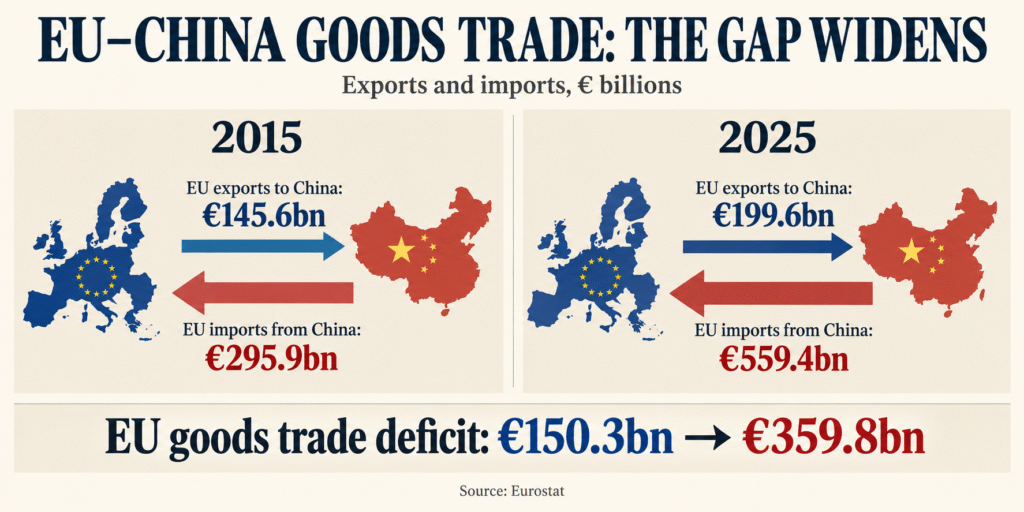
The existence of a discrepancy alone does not necessarily prove that trade is unfair, as it also depends on what Europe is importing, what it is exporting, and how its economy is structured. Nonetheless, it adds political clout to European protests over subsidies, overproduction, and market distortions.
Currency moves matter too: exchange rate fluctuations, including movements in EURUSD, can affect how competitive European exports are and how costly imports become.
On 5 October, France and Germany proposed a quicker EU response mechanism enabling the single market to be closed off if a member state created systemic distortions. They also called for measures to diversify essential supplies, prepare for retaliation, and conduct rapid and comprehensive trade defense investigations.
It is designed for use in relation to any country, even though China is obviously the main target. It is still just a proposal and would still have to be agreed upon by EU governments and the European Parliament.
Europe is now trying to save the furniture after helping to fix the room. This phrase captures a turning point in politics, but not a full explanation of why the industry declined. There are other explanations in the Draghi report, including weaker productivity growth, higher energy prices, dispersed investment, and the difficulty Europe has in managing its industrial policy.
Furthermore, the report warns that trade measures may raise prices for consumers and firms in Europe, especially if tariffs are imposed on the inputs used by European manufacturers.
The danger is that a defensive strategy may simply replace the pursuit of competitiveness: tariffs may buy some time or confer a bargaining advantage, but they cannot, by themselves, bring cheaper energy, foster more innovation, or make European firms more productive.
The bigger challenge lies in establishing believable rules against concerted distortions, and aligning investments, skills, and energy to create a more integrated single market. Europe’s traditional approach to trade, as recent experience suggests, has left it exposed when open, without built-in resilience.