


What Is Batch Size?
Batch size in inventory management refers to the volume of an item produced or ordered in a single lot. Such a decision is often based on demand, production, supply chain efficiency, and storage capacity. It significantly influences the production costs and order fulfillment ability of an organization.
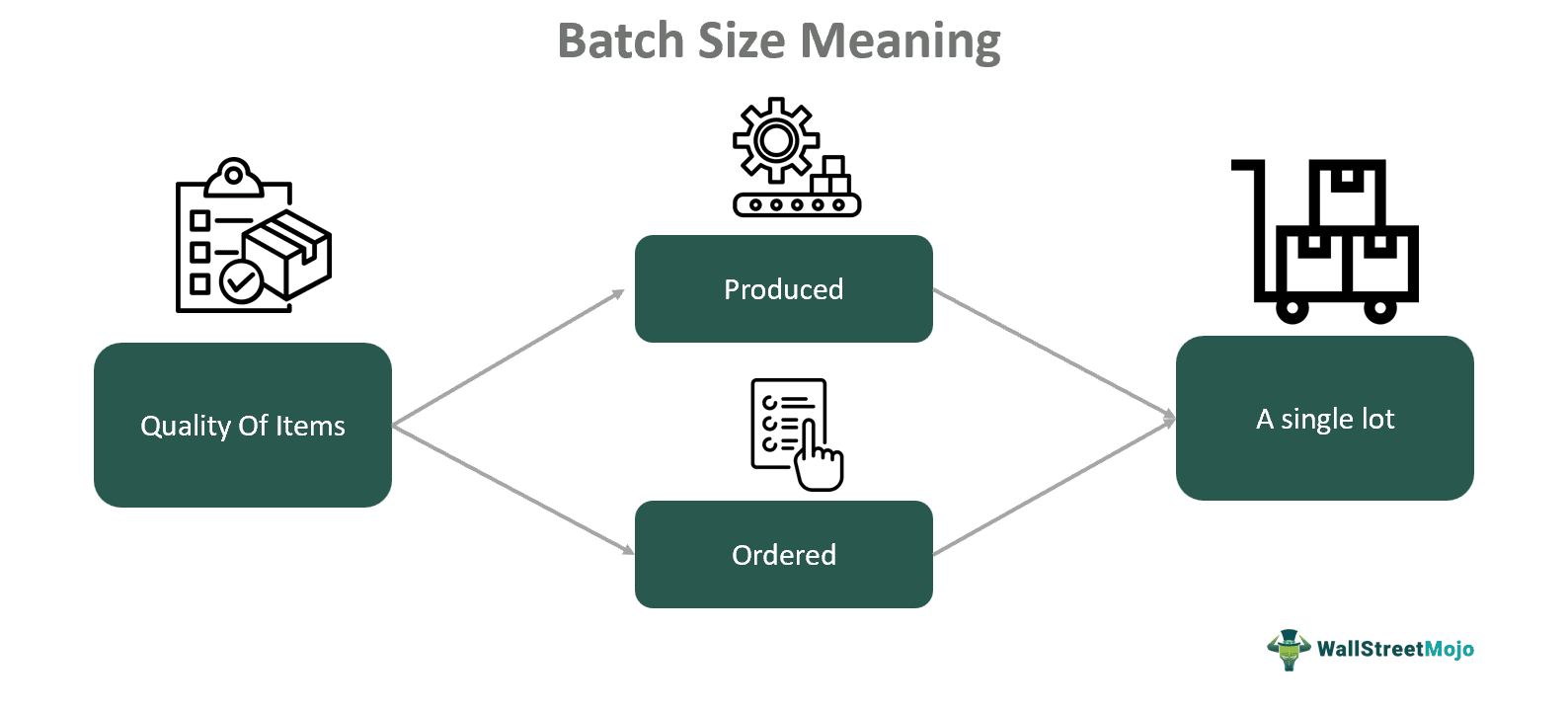
Determining an optimal batch size is crucial for attaining sustainable business goals. However, it requires careful planning. Opting for a larger batch size can lower per-unit production or ordering costs but may result in increased holding costs and the potential for obsolescence. On the other hand, smaller batches provide more flexibility but may incur higher setup or ordering expenses.
Key Takeaways
- The batch size is the quantity of items ordered or produced together in a single order or production run. It is essential for efficient inventory management practices.
- A large size of the batch helps the business gain economies of scale and reduce the per unit fixed cost of production. However, it may lead to limited flexibility due to tied-up capital, high holding costs on insurance, storage, and depreciation, inventory obsolescence risk, and inability to rapidly adjust to transforming market trends or demands.
- While a small size of the batch ensures greater flexibility, it also increases the firm’s production or ordering costs.
Batch Size in Inventory Management Explained
Batch size is a critical decision in inventory management that relies upon a business’s production capacity, storage facility, and demand forecast. The adjustment of batches facilitates the shaping of inventory levels, production processes, and overall supply chain management. It helps optimize production quantity, curtail holding costs, and maintain a balanced inventory. The appropriate size of the batch is the one that achieves an equilibrium between the economies of scale in production and the expenses associated with holding surplus inventory. Hence, batch-size manufacturing is crucial in production sectors.
However, organizations should sensibly decide on the size of the batch, as a too-large or too-small production or order volume would lead to operational inefficiencies. Larger batch sizes undesirably heap inventory levels, leading to elevated holding expenses on storage, insurance, and depreciation. Stocking items in bulk batches for extended periods intensifies the risk of obsolescence due to changing market demand or trends.
Moreover, when most of the capital is blocked in surplus inventory, the organization needs more funds for other essential business operations and opportunities. As customers’ demand or market conditions change, businesses with large batches of inventory would need more time to respond to such trends, reducing their overall flexibility.
How To Determine?
Deciding the size of the batch in inventory management involves considering factors such as demand variability, storage capacity, and production constraints.
Given below are the various factors that shape the decision of optimum size:
- Demand and Sales Estimate: It considers the market demand and sales trend analysis for inventory management.
- Lead Time: It is the average time required to restock inventory, like the time from initiating an order to receive the goods; large batches increase lead time and vice versa.
- Material Cost: It involves the bulk purchase discounts and low cost of material for production.
- Inventory Cost: The cost of the available stocks is another critical constraint in inventory planning.
- Production Capacity: The available space, equipment efficiency, and maximum production capacity must be considered.
- Minimal Wastage: Planning the batches efficiently ensures no minimum wastage or obsolescence of material.
- Setup Cost: The other expenses affecting the manufacturing are labor, equipment setup, and tools requirement.
One of the best approaches in planning the size of the batch is to utilize the Economic Order Quantity (EOQ) formula, factoring in the costs associated with ordering and holding inventory. It’s also important to analyze historical demand patterns to adapt batch sizes for seasonal fluctuations or shifts in demand. Some of the other evaluation techniques include production time-based, lead time-based, and material cost-based methods. Determining the batch volume based on the availability of labor, and production capacity is facilitated through constraints optimization mathematical measures.
Examples
It is essential to ascertain the right size of the batch that has a balanced approach to minimize costs while effectively meeting customer demand. Let us find out some of the examples to interpret the concept better:
Example #1
Suppose a bike showroom manager faces the challenge of determining the optimal size for replenishing stock of a particular model. Opting for a larger batch, let’s say 50 units, might bring down the per-unit cost but potentially tie up more capital and storage space. While a smaller batch, such as ten units, may decrease storage costs but elevate the cost per unit. Hence, he found an optimal size of 30 units, which would curtail the cost per unit to a certain extent and would not require additional storage space while ensuring sufficient flexibility of capital.
Example #2
Let’s consider managing inventory for a cosmetic store. To determine the Economic Order Quantity (EOQ) for a specific lotion, factors such as demand rate, ordering cost, and carrying cost are taken into account.
Given below are the key inputs:
- Annual demand for the lotion: 10,000 units
- Cost to place an order: $50
- Carrying cost per unit per year: $2
EOQ = √[(2 x Demand x Ordering Cost) / Carrying Cost] = √[(2 x 10,000 x $50) / $2] = 707 units.
Hence, the optimal batch size for every order is 707 units.
Benefits
Selecting an optimal batch size formula necessitates maintaining a balanced volume of goods produced or ordered such that the organization benefits from the scaling and only stocks a little inventory at the same time. Let us find out its various advantages below:
- Attain Economies of Scale: Opting for larger batches can lower the production costs per unit, as fixed costs are distributed over a more significant number of items.
- Curtail Ordering Costs: Enlarging the size of the batch can lower the frequency of orders, thus minimizing administrative and transaction costs associated with order placements.
- Bulk Discounts: Suppliers often provide discounts for larger orders, facilitating overall cost savings in the procurement of raw materials or inventory.
- Maintains Flow: Optimal batch size formula contributes to a more stable production and operational environment by reducing the frequency of changes in production levels.
- Limited Wastage: With careful planning, businesses can reduce the chances of obsolescence of stock, minimizing the wastage of outdated or expired items.
- Flexibility: As the firm maintains a balanced size, it can ensure flexibility of capital, which would otherwise be tied up in unnecessary stockpiling.
Frequently Asked Questions (FAQ)
Frequently Asked Questions
Does batch size matter?
The selection of an appropriate batch size plays a pivotal role in influencing inventory holding costs, order fulfillment efficiency, and production procedures.
Does batch size affect accuracy?
When the business entities carefully consider various factors such as demand variability, production capabilities, storage costs, and business strategies to determine a suitable size of the batch, it improves the accuracy of inventory forecast and management.
What is EOQ and batch size?
The economic order quantity (EOQ) serves as an optimal batch size, aiming to minimize overall inventory costs. This approach helps businesses attain a balance between holding and ordering costs, ensuring efficient inventory management.
What is the difference between MOQ and batch size?
Minimum Order Quantity (MOQ) focuses on the smallest volume of a particular item that a customer must order, as specified by the supplier, to maintain an economically viable production process. On the contrary, the batch size relates to the quantity of an item ordered or produced in a single order or manufacturing run based on constraints like production efficiency, equipment capacity, and demand forecasts.