


Legal Compliance Meaning
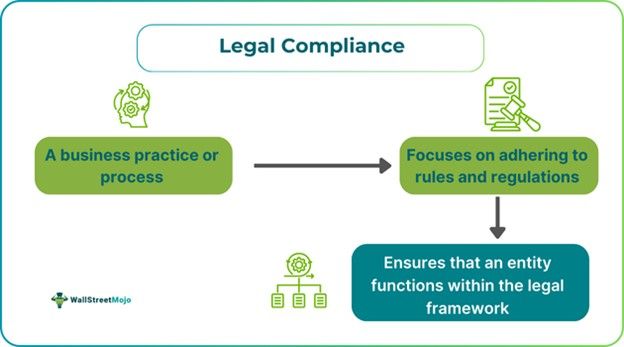
Legal compliance is a set of practices or processes in an organization that focus on adhering to the laws and regulations that govern a particular business or industry. It ensures that an entity performs all its operations and activities while staying within the legal framework that is applicable to it.
You are free to use this image on your website, templates, etc.
Legal compliance includes ensuring that all procedures, protocols, and activities are carried out in accordance with necessary local, state, federal, and international laws, as well as corporate policies and industry-specific rules. Being legally in accordance with the rules, regulations, and guidelines helps optimize the business and can help businesses avoid severe penalties and fines.
Key Takeaways
- Legal compliance is an extensive set of regulations or procedures within a company that focus on following the rules and regulations that apply to a specific company or the business sector.
- It ensures that an organization carries out all of its business activities and initiatives while conforming to the relevant legal structure.
- Compliance with the law is crucial since it promotes ethics, safeguards rights, and encourages responsible behavior.
- It is significant for different aspects of the financial system, society as a whole, and business administration.
Legal Compliance Explained
Legal compliance is a structure developed by government agencies to regulate organizations within which businesses must operate. The exact meaning of legal is “according to the law,” while compliance is “adherence to.” Ensuring compliance with the law is more than an obligation for businesses. It serves a significant role in improving their daily operations.
Regular audits of businesses can simplify compliance maintenance while keeping up with legal developments that may affect various divisions. Compliance with the law is essential, as it protects rights, upholds morality, and encourages responsible behavior. It is crucial for several areas of the economy, society, and administration. Compliance is more than just a legal responsibility. It serves as the basis of reliability and confidence in any business entity.
Legal Requirements Of Compliance
The legal compliance requirements include the following:
- Labor regulations: It involves reviewing employment policies, agreements, and contracts. It ensures that labor contracts, minimum pay regulations, and working hour regulations are followed. Moreover, it helps verify that safety precautions at work are implemented and followed according to applicable labor legislation.
- Safety and Health: This is an essential issue to consider while performing audits in an organization. Since companies must abide by various environmental, health, and safety regulations, the legal manager may use a checklist to cover every requirement and effectively handle any possible risks.
- Businesses Governance: This includes examining record-keeping, board meetings, and corporate governance procedures. It also aids in verifying adherence to corporate governance guidelines and rules.
- Information Security: This involves analyzing privacy and data protection policies and procedures.
- It helps ensure that all data protection regulations are followed, especially those associated with information safety and breach reporting.
Steps For Evaluating Legal Compliance
The steps for evaluating legal compliance are:
- The initial step is to determine what indicators best demonstrate compliance. Compliance managers usually employ several kinds of measures because it is challenging to evaluate compliance with just one metric.
- The next step is to track the metrics chosen to assess compliance. Compliance managers assemble the information from all sources and begin tracking the results against specific key performance indicators.
- Then, they must conduct an internal audit at regular intervals, often once a year. This will help assess the condition of compliance throughout the organization, including all different divisions, considering that compliance standards vary by jurisdiction.
- Compliance managers must determine the problem and take the necessary measures to resolve it if the review and evaluation reveal any concerns. These corrective measures and their implementation must be checked and evaluated on a regular basis to ensure favorable progress toward compliance at the following assessment.
Examples
Let us go through the following examples to understand legal compliance:
Example #1
Suppose People’s Trust Bank is a financial institution that manages the funds of individuals and organizations. Due to its work requirements, the bank needs to store enormous amounts of sensitive data from the public. According to the industry’s regulatory requirements, the bank must ensure that all customers’ private and confidential information stays protected. In order to maintain compliance with the law, the bank takes excellent measures to protect the data privacy of its customers. This is an example of legal compliance
Example #2
EY and ServiceNow have extended their strategic collaboration to provide comprehensive solutions for generative AI (GenAI) compliance, governance, and risk management. The extended partnership, initially focusing on the digital evolution of tax and financial services, intends to improve AI administration and compliance while helping businesses comply with regulations. The companies will work closely together to provide a set of products comprising AI discovery, inventory control, regulation enforcement, risk categorization, and automated surveillance. This is another example of legal compliance.
Importance
The importance of legal compliance is as follows:
- Breaking laws and regulations can lead to legal repercussions, including penalties, fines, litigation, and criminal charges. To prevent such unfavorable consequences, individuals and organizations must follow the law.
- Compliance management safeguards an individual or organization’s legal rights and interests. This can cover a wide range of issues, such as contractual rights, property rights, and the right to pursue legal recourse if required.
- Laws and regulations offer a structure for preserving stability and social harmony. Following such rules reduces the chances of social unrest, conflicts, and clashes.
- Following the law is usually linked to acting ethically and responsibly. Abiding by the law is an essential element of ethical behavior. It encourages transparency and confidence in various kinds of interactions and exchanges.
Legal Compliance vs. Regulatory Compliance
The differences are as follows:
Legal Compliance
- It is the process of conforming to all applicable laws, rules, and guidelines that control an individual, company, or business sector.
- This compliance is the process of ensuring that one’s actions, rules, and instructions comply with the requirements and standards that have been set.
- It is crucial for a number of reasons, including upholding ethical business conduct, maintaining individual rights and safety, and preventing legal repercussions like penalties, fines, or legal action.
Regulatory Compliance
- Regulatory compliance refers to an organization’s conformity to regulations, rules, norms, and specifications that apply to its business processes.
- Regulatory compliance violations usually lead to legal consequences, such as federal penalties.
- Organizations might seek directions from regulatory compliance methods and approaches to achieve their business objectives. Compliance-proving audit reports help businesses market themselves to customers.
Frequently Asked Questions (FAQ)
Frequently Asked Questions
What is a legal compliance officer?
A Compliance Officer is in charge of ensuring that a business complies with all applicable government rules and regulations. They work with the company’s management to determine possible risks, establish policies and processes that comply with the law, and monitor the business’s compliance with those policies and procedures.
What is legal compliance in safety?
Safety compliance refers to the continuous process of adhering to the health and safety regulations established by regulatory authorities and legislatures. Stringent safety laws may be particular to a sector based on the type of job or industry. In most instances, failing to comply with health and safety standards may lead to criminal charges or severe penalties for companies.
What is a legal compliance certificate?
A certificate of compliance is a contractual document that verifies that particular criteria have been met. It is an official statement confirming that an individual or business has fulfilled some specific requirements. Certificates of compliance are issued for several reasons, and based on the subject, official bodies usually draft and sign them.