


What Is Market Surveillance?
Market surveillance is the practice of seeking, investigating, and preventing any form of unlawful activities, including abusive, malicious, and illegal trading practices in the stock market. It is observed as a watchdog that makes sure that no market participant is becoming a victim of fraud and stock market scams.
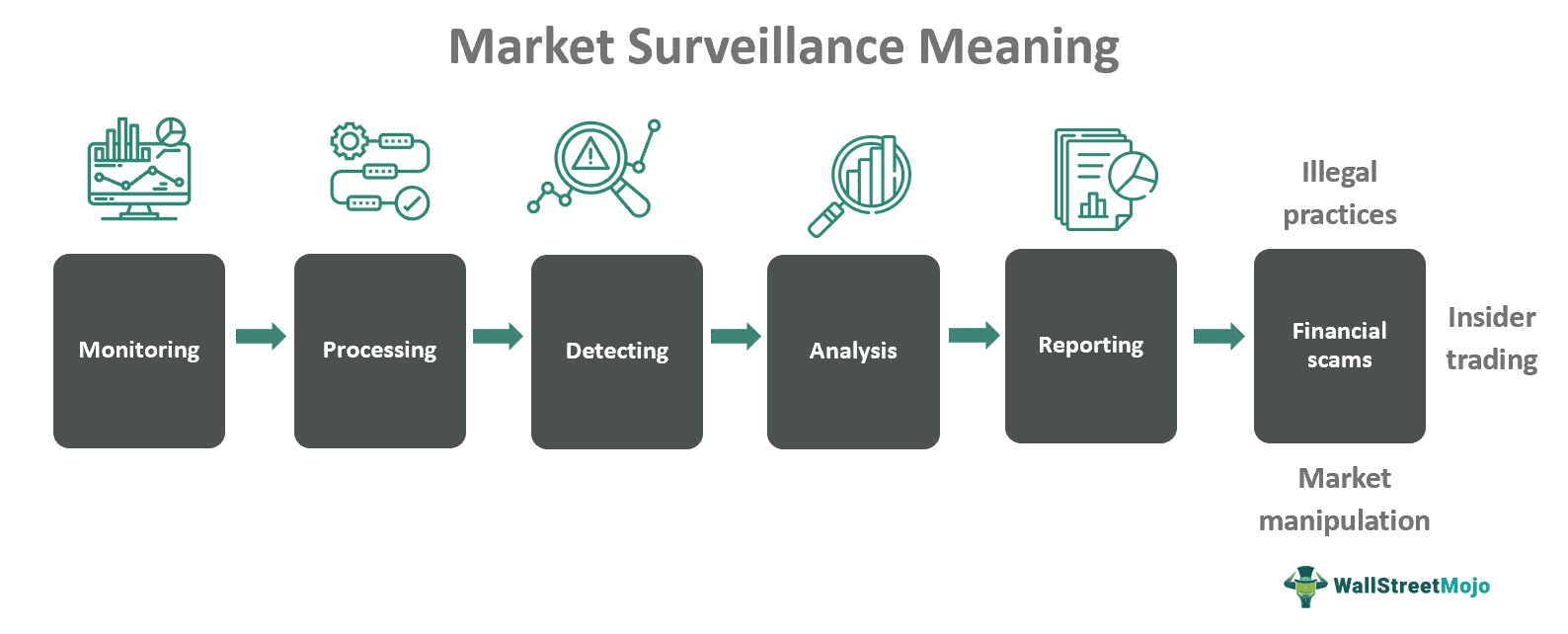
The whole process of this surveillance exists to maintain market integrity. Without such surveillance, many traders and investors can become victims of insider trading, misconduct, market manipulation, and illegal and unethical activities. If this happens, people will eventually lose confidence in the securities market and avoid participating in it, leading to a disturbance in economic growth.
Key Takeaways
- Market surveillance refers to seeking, identifying, analyzing, and reporting any form of abusive, unethical, unfair, illegal, and suspicious trading practices and market manipulation activities.
- Both the public and private sectors can provide it. Nasdaq offers a surveillance product called SMARTS for it. Additionally, there is a regulatory standard from the SEC as well.
- Without these surveillance regulations, there will be no order in the securities market and authority to take legal action against the culprits and protect traders.
- As long as the market exists, there will be individuals perpetuating it by finding loopholes and inducing illegal activities for their gain and interests. Yet, the framework is trying to bring new models and strategies to catch them.
Market Surveillance in Trading Explained
Market surveillance in trading is the framework that ensures that no unethical practices or abusive and illegal activities in the securities market can happen. Every market has its regulations, and likewise, every market has its perpetrators who try to make a profit by involving or applying tactics and illegal, unethical market practices. It is heavily observed in the securities market, especially with trading activities. Therefore, to monitor, detect, report, and catch any form of market misconduct, insider trading, stock price manipulation, and illegal practices, market surveillance exists.
The market surveillance regulations exist parallel to the SEC laws, which offer an additional layer of safety and protection. Many market participants opt for private-sector surveillance as well. Nasdaq offers a market surveillance product called SMARTS, which is used for multiple services like monitoring trading activities and evaluation of different asset classes. Moreover, there are third-party software platforms.
As for the federal government market surveillance authority, apart from the SEC, multiple offices such as the National Futures Association and Commodity Futures Trading Commission timely conduct market surveillance. Unethical market practices are a harsh truth of the securities market; despite strict laws and actions, illegal trading occurs in a significant form. At the same time, the authorities aim for a long-term vision of becoming ace in the real-time detection of financial fraud.
Examples
Below are two examples of the concept:
Example #1
Suppose a brokerage firm is accused of insider trading. The market authorities and the Securities and Exchange Commission come forward to take matters into their own hands and study the firm’s last nine month’s trading records and charts upon studying, analyzing, detecting, and reporting. The SEC finds that there is only one analyst of the firm who is involved in insider trading.
All the suspicious trades went ahead and were primarily escalated from his table only. Upon discovery, the SEC takes in the analyst, and he finally accepts to have practiced insider trading for an external bribe offered to him. This way, market surveillance catches the culprit and brings fair treatment and order to the stock market.
Example #2
In July 2023, the chairman of the US Securities and Exchange Commission expressed his positive views towards the use of artificial intelligence in market surveillance and enforcement. Although he definitely has many doubts regarding the concerns linked to AI. The SEC chairman, Gary Gensler, shared his thoughts on the challenges surrounding this surveillance with the National Press Club.
He elaborated on how AI may also make it difficult to induce fairness. The outcomes of its predictive algorithms may show historical biases. The chairman also covered the various risks that artificial intelligence will bring to the financial stability of the country. Given that there is a small possibility of AI platforms dominating raising issues.
Benefits
Various benefits are as follows:
- Helps keep the market orderly and ensure fair treatment of investors, traders, and other market participants.
- Alerts, protects and makes people aware of malicious activities, insider trading, stock price manipulation, unregulated schemes, and any form of market misconduct and illegal practices.
- The entire process operates like a market watchdog and sets regulatory standards and compliance for every market participant to follow.
- It keeps the trading grounds clean, keeps the market integrity alive, and does not let traders and investors lose their confidence.
- Without such surveillance, the market can become a breeding ground for unethical and illegal financial practices and evoke many frauds and scams.
- It promotes and safeguards the interests and rightful behavior of people who are willing to learn from the market, participate, and make a profit.
Challenges
The challenges are as follows:
- Stock markets have active trading sessions during which hundreds of thousands of investors and traders participate simultaneously, which leads to high data volume. This data becomes a concerning challenge, especially as it requires processing time, let alone detecting any anomalies and patterns.
- The second challenge faced in the process of this surveillance is the real-time detection of suspicious trading activities. If the misconduct is not detected on time, it can lead to a bigger scam and financial fraud. Trading patterns are required to be identified in time to maintain market integrity.
- During the entire surveillance of the market, it is essential to follow and adopt the right form of regulatory compliance and track the culprits or scams by staying within the boundaries of laws and bylaws.
- Lastly, the market perpetrators often come across new and more sneaky, secretive ways to practice unethical behavior and develop more and more tactics to get involved in abusive and illegal market practices, which is challenging to detect in this surveillance all the time.
Frequently Asked Questions (FAQs)
Frequently Asked Questions
What are the objectives of market surveillance?
The main objectives are as follows: – Ensure the safety and protection of every market participant from unethical and illegal market practices. – To enforce standard regulations for fair market practices and maintain the market integrity and participants’ confidence in it. – Process large amounts of data to detect, analyze, report, and catch any form of market misconduct allegedly occurring in the financial markets.
What is market surveillance in banking?
When it comes to banking, it takes help from various established acts and federal policies that strictly focus on tracking money laundering, financial scams, identity theft, and market scams. All financial institutions comply with multiple acts and regulations, such as Know Your Customer (KYC), the Dodd-Frank Act, and anti-money laundering compliance.
How do you improve market surveillance?
The most crucial ways to improve this surveillance are as follows: – Explore and adopt higher analytical dimensions that are not present in the international capital markets. – Set high regulatory standards and compliance control systems. – Have a behavior analysis approach to detect suspicious activities. – Introduce cross-market surveillance – Real-time reporting and actions.