


What Is Market Impact?
Market impact refers to the effects of factors like trading activity, news, and regulations on financial markets. Its primary purpose is to help investors and institutions make informed decisions and manage risks effectively in dynamic market conditions.
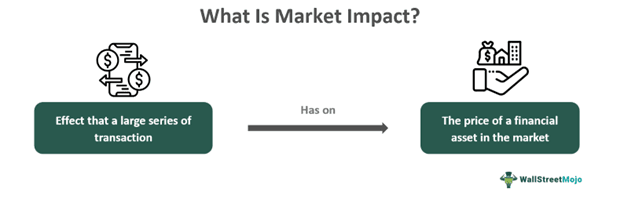
It is the most essential tool for large traders as it can significantly impact trade profitability. High market impact may move asset prices unfavorably, diminishing trade profits. So, it becomes necessary to understand and mitigate market impact through strategic approaches that can yield profitable trades, & optimize trading outcomes for traders.
Key Takeaways
- Market impact refers to how buying and selling in financial markets affect prices and trading conditions.
- Traders assess it through methods like volume-weighted average price (VWAP) analysis and implementation shortfall, which consider additional costs.
- Price slippage evaluates trade execution, while market impact models predict trading effects on prices and liquidity, aiding trade decisions.
- Market impact measures how trades influence market conditions overall. Slippage calculates the difference between planned and actual trade prices.
Market Impact Explained
Market impact refers to the price alteration of an asset due to its trading activity. So, purchasing an asset appreciates its price, while selling it lowers it. The degree of price shift reflects the asset’s liquidity: higher liquidity dampens the impact of individual trades. Additionally, trading an asset can influence the prices of other assets, which is termed cross-impact.
There are several factors involved in studying it, like trade size, asset liquidity, and timing, that contribute to its complexity. For instance, a large trade in a highly liquid asset may have less impact than in a less liquid one. Similarly, trading during high market volatility may amplify the impact compared to low volatility periods.
Various metrics are used to gauge the market impact, such as the percentage of price change from the trade, trade volume relative to average daily volume, and time for market recovery. These metrics help estimate the impact and plan overhead mitigation strategies.
How To Measure?
Market impact is one of the vital aspects for traders to assess and can be evaluated through various methods.
- One such method is the volume-weighted average price (VWAP) analysis. This approach calculates the average price at which a security is traded over a specific time frame, generally before and after a trade. VWAP provides insights into how trade influences the average price of the security, helping traders gauge the extent of market impact.
- Another method to measure market impact is through implementation shortfall. This metric compares the actual execution price of a trade with the expected price at which it was anticipated to be executed. Implementation shortfall uses not only the impact on market prices but also factors in other costs such as commissions and fees. By taking into account these additional expenses, traders gain a comprehensive understanding of the total cost associated with executing a trade beyond just the direct impact on market prices.
- Price slippage measures how much the actual price of a trade differs from what was planned. It shows how market changes affect trade execution and helps evaluate trading strategies.
- Market impact models and algorithms use math and stats to predict how trading will affect prices and liquidity. They consider things like trade size, volume, and market conditions to improve trade outcomes.
Examples
Let us look at the market impact examples to understand the concept better-
Example #1
Imagine a trader who wishes to purchase a significant number of shares of a particular company’s stock. This trader decides to execute a large buy order all at once without considering the potential market impact.
As soon as the buy order is executed, the sudden surge in demand for the stock causes its price to increase rapidly. This price hike attracts other market participants, including algorithmic traders and institutional investors, who start buying the stock as well, further driving up its price.
However, as the price continues to rise rapidly, it starts to attract profit-taking from other traders who had previously held the stock. They begin selling their shares, causing the price to fluctuate even more. Additionally, some investors may become concerned about the sudden spike in price, fearing it may not be sustainable, and decide to sell their shares as well.
Eventually, the market stabilizes, but not before experiencing volatility due to the initial large buy order. The trader who initiated the buy order may have ended up paying a higher average price for the shares than they initially anticipated, thus experiencing a negative market impact on their trade.
This example explains how the execution of a large trade without considering market impact can lead to price movements and volatility in the market, which has an overall outcome on trading.
Example #2
In a report by WNS and HFS Research, the challenges and opportunities in the Travel and Hospitality industry were highlighted. The report, based on a survey of over 300 industry leaders, found that education costs are rising, driven by factors such as increasing tuition fees and living expenses. It showed that 50% of firms prioritize cost containment and efficiency, while a significant portion focuses on innovation. The report also revealed that 36% of firms see meeting customer expectations as their biggest challenge amidst digital disruption. These insights are crucial for industry leaders as they balance modernization, cost control, and customer experience to build resilient, future-ready enterprises.
Importance
Market impact is a vital aspect that shapes how financial markets behave. It comprises various factors, like how easily assets can be bought or sold, how prices are affected, and the rules that govern trading. An understanding of market impact helps investors and traders make better decisions and manage risks, which is crucial in today’s complex financial world.
By grasping and handling market impact effectively, people involved in finance can make trades that work out well, reduce the chances of losses, and improve how their investments perform. Following rules and ethical standards also ensures that markets are fair and trustworthy, which is essential for everyone involved and for the economy as a whole.
As financial markets keep changing and rules evolve, knowing about market impact remains essential. It helps investors achieve their goals and deal with the ups and downs of markets more effectively.
Market Impact Vs. Slippage
The differences between market impact and slippage are as follows-
| Market Impact | Slippage |
|---|---|
| When a trade is executed, it can affect the supply and demand dynamics of the market, leading to changes in prices. This influence on market conditions is known as market impact. | Slippage occurs when there’s a difference between the expected price of a trade and the actual price at which it is executed. This can happen due to various reasons, including market volatility, delays in order execution, and changes in supply and demand. |
| For example, a large buy order can increase demand for an asset, causing its price to rise, while a large sell order can increase supply and drive prices down. Market impact can vary depending on factors such as trade size, asset liquidity, and market sentiment. | For instance, if a trader places a market order to buy a stock at a certain price, but the actual execution price is higher due to sudden price movements, slippage occurs. Slippage can lead to unexpected costs and may result in losses for traders. |
Frequently Asked Questions (FAQs)
How does the financial market impact the economy?
The financial market impacts the economy by allocating capital to businesses and governments, providing funding for investments and projects. It determines asset prices through supply and demand, influencing consumer confidence and spending. Financial market indicators serve as early signals of economic health, guiding policymakers and businesses. Overall, the financial market plays a vital role in driving economic growth and stability.
How does the stock market impact the economy?
Market volatility, driven by fluctuations in stock prices, impacts businesses and consumers. In a bull market, rising stock prices boost confidence, leading to increased consumer spending and economic growth. More investors entering the market can further drive prices up, contributing to economic development, though this is only sometimes consistent.
Can market impact be mitigated?
Yes, market impact can be mitigated through strategic trade execution, such as breaking up large orders into smaller ones, using algorithmic trading strategies, and trading during periods of higher liquidity to minimize price movements.