


Introduction
Most beginners who try to learn merger and acquisition modeling struggle because they follow a scattered learning approach. They jump between YouTube tutorials, outdated PDFs, and theory-heavy textbooks without ever building a complete model in Excel. The result is a learner who can define accretion/dilution in an interview but freezes when asked to build the actual schedule.
Merger and acquisition modeling is the process of building a financial model that combines two companies’ financial statements to evaluate the economics, financing, and shareholder impact of a deal. When built correctly, it helps an acquirer determine whether a transaction creates or destroys shareholder value.
This article compares the realistic paths beginners take to learn merger and acquisition modeling fast, shows what separates a fast learner from a slow one, and lays out a sequence that mirrors how analysts build these models on the job. It also flags where a structured, case-study-driven program shortens the timeline meaningfully compared to piecing the skill together for free.
Key Takeaways
- Master financial statements before valuation, synergies, and purchase accounting.
- Build one complete deal model instead of practicing isolated Excel exercises.
- Purchase accounting and pro forma financials form the foundation for accurate deal analysis.
- Merger and acquisition modeling opens opportunities in investment banking, private equity, corporate development, and equity research.
- A structured, case-study-based approach helps beginners become job-ready faster than scattered self-study.
Why Most Beginners Waste Time Learning M&A Modeling
The biggest reason beginners struggle with merger and acquisition modeling is that they learn concepts in the wrong order. Many beginners jump straight to accretion/dilution formulas before mastering enterprise value. Some individuals also memorize purchase accounting rules without applying them to a pro forma balance sheet.
In the absence of a structured sequence, every new concept feels isolated instead of building on the last one. Another time-waster is relying on isolated practice exercises instead of building a complete deal model through a case study. The difference becomes clear when you look at how M&A analysts work in practice. They are expected to build complete transaction models, not isolated Excel exercises.
Global M&A activity hit roughly $5 trillion across an estimated 50,810 transactions in 2025, the most active year on record by both deal count and value, and deals valued at $1 billion or more generated 56.6% of all global M&A value that year. Analysts working on transactions of that scale are not asked to model a two-tab spreadsheet. Rather, they need to gather real financials, calculate sources and uses, and model synergies. In addition, they must produce a proforma income statement and balance sheet in one connected workbook.
Comparing The Realistic Learning Paths
There are several ways to learn merger and acquisition modeling, but not all are equally effective. The table below compares the most common learning paths based on structure, hands-on practice, certification, and the time typically required to become competent.
| Learning Path | Structure | Case Study Practice | Certification | Realistic Time to Competency |
| Free YouTube + blog patchwork | None; scattered topics | Rarely a full deal, mostly isolated formulas | No | 4–6 months, often incomplete |
| University corporate finance course | Academic, theory-first | Conceptual case studies, limited Excel | Sometimes | 3–4 months, weak on Excel mechanics |
| Structured online merger and acquisition modeling course | Sequenced: statements → valuation → deal mechanics → recommendation | Full deal case study (for example, a two-company merger, plus real precedents like the Kraft Heinz merger) | Yes | 3–5 weeks with consistent practice |
The comparison highlights a clear pattern: structured learning paired with a complete case study consistently shortens the path to competency more than consuming large amounts of disconnected free content. A learner who watches 40 hours of disconnected YouTube videos is not necessarily closer to a finished model than one who works through 6 focused hours built around a single deal.
WallStreetMojo’s Mergers and Acquisitions Modeling Course follows the structured, case study-based approach. It walks learners through an AlphaTech and Beta Electronics acquisition case study covering financial statement analysis, synergies, purchase accounting, proforma financials, and a final deal recommendation. This mirrors the actual workflow an M&A analyst follows on a live transaction.
What A Beginner Actually Needs To Learn, In Order
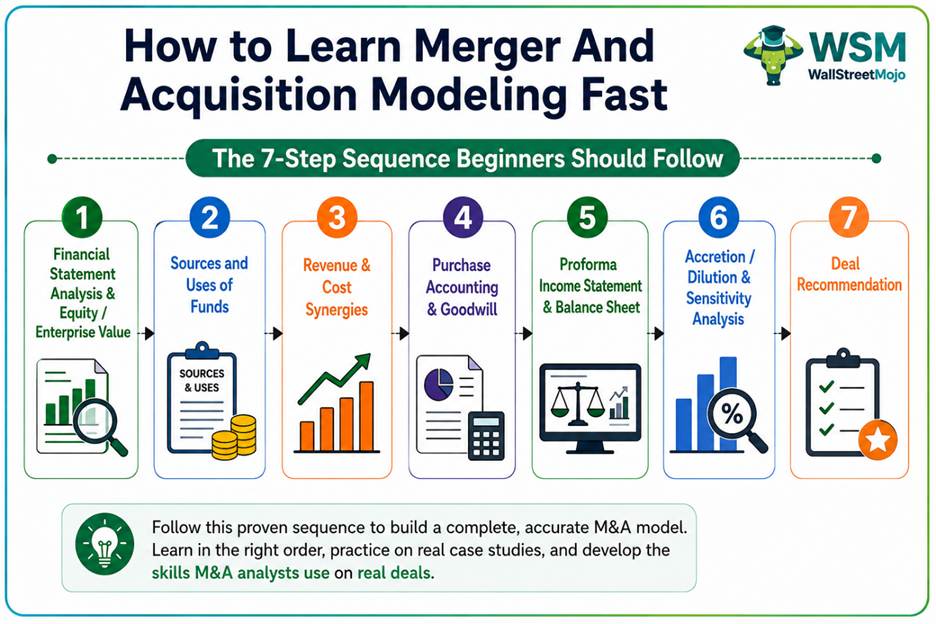
Speed comes from learning components in the sequence a real deal requires, not the order a textbook happens to present them. The table below outlines the sequence that reflects how analysts build M&A models in practice.
| Stage | Core Skill | Why It Comes at This Point |
| 1 | Financial statement analysis and equity/enterprise value | Every valuation input depends on clean historicals |
| 2 | Sources and uses of funds | Establishes how the deal is financed before modeling impact |
| 3 | Revenue and cost synergies | Determines the deal’s incremental economics |
| 4 | Purchase accounting and goodwill | Required to build an accurate proforma balance sheet |
| 5 | Proforma income statement and balance sheet | Combines both companies into one post-deal entity |
| 6 | Accretion/dilution and sensitivity analysis | Answers whether the deal helps or hurts EPS |
| 7 | Deal recommendation | Synthesizes every prior step into a decision |
Skipping ahead to accretion/dilution before mastering purchase accounting is the single most common reason beginners produce models that look right but calculate wrong. A goodwill or deferred tax liability error early in the model quietly breaks every downstream schedule.
Common Mistakes That Slow Beginners Down
Three mistakes consistently extend the learning timeline. Let us look at them.
- First, learners treat merger and acquisition modeling as a standalone skill rather than an extension of financial modeling and valuation. As a result, gaps in DCF or comparable company analysis resurface mid-model.
- Second, many skip building sensitivity tables for EPS and Debt/EBITDA, which are standard deliverables in real deal memos.
- Third, beginners rarely practice the recommendation step, the part of the job that actually gets presented to a client or investment committee.
Avoiding these three mistakes, more than any single resource choice, is what separates learners who finish a working model in weeks from those still troubleshooting circular references months later.
Where This Skill Leads
Merger and acquisition modeling is a highly transferable skill that opens doors to multiple finance careers. Professionals who master it often move into investment banking, private equity, equity research, corporate development, and financial analyst roles. This is because these functions rely on many of the same valuation and transaction modeling techniques.
The table below highlights some of the most common career paths and how the skill is applied in each role.
| Career Path | How M&A Modeling Applies |
| Investment Banking | Supports acquisition, merger, and advisory models for live transactions |
| Private Equity | Evaluates acquisition targets, buyouts, and portfolio investments |
| Equity Research | Supports valuation, forecasting, and company analysis |
| Corporate Development | Assesses acquisitions, divestitures, and strategic investments |
| Financial Analyst | Applies financial modeling and valuation to business planning and investment decisions |
Job prospects for finance professionals also remain positive. The U.S. Bureau of Labor Statistics expects employment of financial analysts to increase by 6% between 2024 and 2034, outpacing the average growth rate across all occupations and creating approximately 29,900 job openings each year. Because merger and acquisition modeling is a specialized skill used in many of these roles, it serves as a valuable foundation for pursuing a broad range of finance careers.
Conclusion
Beginners rarely fail at merger and acquisition modeling because the concepts are too advanced. They fail because they learn the pieces out of order and never practice on a complete deal.
Following the sequence outlined here, from financial statements through a final recommendation, and practicing on one complete case study rather than dozens of fragments, is what actually compresses the learning curve.
For learners who want that sequence pre-built, the Mergers and Acquisitions Modeling Course walks through an entire acquisition case study, from data gathering and valuation to purchase accounting, pro forma financial statements, and a final deal recommendation.
Frequently Asked Questions
How long does it take to learn merger and acquisition modeling?
With a structured, case-study-based merger and acquisition course, most beginners with basic Excel and accounting knowledge can build a complete M&A model in 3 to 5 weeks of consistent practice. Self-taught, unstructured learning typically takes 4 to 6 months and often leaves gaps.
Do I need investment banking experience to learn M&A modeling?
No, prior investment banking experience helps but is not mandatory. That said, learners need a working understanding of the three financial statements and basic Excel before starting.
What is the difference between financial modeling and M&A modeling?
Financial modeling covers forecasting and valuing a single company. Merger and acquisition modeling extends those principles to combine two companies’ financials into a single model. It also incorporates synergy modeling, financing, and earnings per share (EPS) analysis to evaluate the impact of a transaction.
Can I learn M&A modeling for free?
Free resources can teach individual concepts, but they rarely provide a sequenced, full-deal case study. That practical, end-to-end experience is what helps beginners become competent faster.
What Excel skills are required before starting?
Comfort with formulas, cell referencing, and basic financial statement linking is sufficient. Advanced VBA or macros are not required for standard M&A modeling.
Is merger and acquisition modeling only useful for investment banking careers?
No, mergers and acquisitions modeling is also valuable for careers in equity research, private equity, corporate development, and FP&A, where professionals regularly evaluate acquisitions, divestitures, and strategic investments.