


What Is A Stop Run?
A stop run is a financial market scenario in which a large volume of stop loss orders are executed simultaneously, inducing a sharp price movement. Such scenarios are deliberately created as many market participants try to push and manipulate a stock’s price to a level where most investors have set their stop loss.
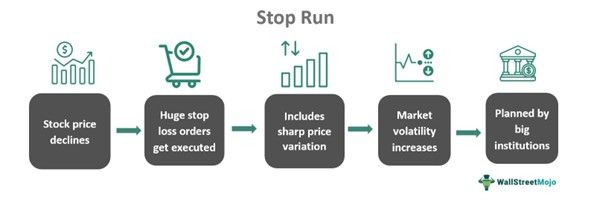
When a stop run is triggered, it causes rapid price fluctuations, which can benefit or harm other traders. The market volatility increases, and it presents trading opportunities in the form of open trades, and a long cascade of buying and selling is initiated. The market participants that are involved in doing so also call this process stop loss hunting.
Key Takeaways
- Stop run is a deliberate price manipulation and pushing by certain market participants to induce the execution of large volumes of stop loss orders simultaneously. It is also called stop-loss hunting.
- It gets triggered due to the accumulation of stop loss orders, the market’s mindset, general fear of loss, panic selling and intentional pushing of prices by large market participants.
- Investors can avoid it by observing the market, setting stop losses at less obvious points, using manual stop loss, not following market psychology, and avoiding panic selling.
- Big institutions and large market participants do it to remove the positions of early buyers before them to take a better position. In contrast, amateur investors hate the concept.
Stop Run Explained
Stop run is a well-planned scenario orchestrated by big and influential market participants to drive the price of the assets to such a level where usually most stop loss orders are placed by investors and traded to avoid financial loss. When the price falls below it, bulk stop loss orders get executed, which means a cascade of stock selling is induced automatically, increasing the market volatility. This phenomenon can be observed in multiple financial markets such as futures, stock and Forex.
The foremost factor is the market’s mindset. Most traders and investors tend to put stop loss at easily recognizable price points. For instance, using a round figure value or at highs or lows. So, when the price reaches around this price range, a cluster of stop loss orders gets executed, allowing institutions to manipulate prices. Many market participants and experts phrase it as a clear battle between the market’s influencing professionals and amateurs. Big institutions and banks adopt it as an easy way to make a profit, but the amateurs primarily hate the concept.
Stop run is also known as stop loss hunting. For big banks and institutions, taking a short position is a short-term sacrifice for long-term gain, offering a favorable risk-to-reward ratio. The strategy is based on the fundamental rule of trading-buy low, sell high. Institutions use stop runs to eliminate the positions of early buyers, allowing them to be the first to buy. As more buyers enter the market, the price of the stock, currency, or futures is pushed higher. The earlier the position they take, the more buyers are likely to follow, driving the market up.
What Triggers Stop The Run?
The main stop-run triggering factors are –
- General fear of loss among investors and traders.
- Usual, common and easily recognizable price points at which traders and investors typically place their stop loss.
- The market’s mindset and psychology manifest in panic selling to mitigate risks, leading to high-volume selling around usual price points.
- Large banks, hedge funds and institutional investors deliberately drive the prices to a certain level in the first place to induce a stop run.
- The most important factor market whales and big players have is the strong capital backing through which they can influence the market to trigger stop runs.
Examples
Here are two simple examples of stop runs in the stock market –
Example #1
Suppose a company launches its IPO, and the stock lists at the market price of $99. Many investors were excited about its listing, and hence, many of them bought it and put a stop loss at $90. If the price drops below $90, a large volume of stop-loss orders will get executed, and due to continued selling, the price will fall even lower.
Now, for instance, if there is a bank, financial institution or hedge fund that has the power to estimate where the stop losses are placed usually and can influence the market direction, they can sell a large quantity of the shares, drive the price down to the likely stop losses and earn profit from this downward market.
It is a simple example; such stop runs are basically orchestrated by large institutions capable of influencing the market direction.
Example #2
In a similar hypothetical scenario, suppose James is a wise investor. He is aware that many large institutions and hedge funds try to drive and manipulate prices to levels that are commonly used as stop-loss price points to orchestrate a stop run. Hence, he never usually sets stop losses at obvious price points and, moreover, always tries to handle trading operations manually. James also observes market trends, learning about new technical indicators and their interpretation.
When the price drops below the usual stop-loss threshold, James never panics or operates as per market psychology. In fact, he reinvests more and more in the falling stocks as he seeks investment opportunities in the price falling. This way, James avoids falling for the stop-run scenario and makes the most of it.
How To Benefit From It?
Although it should be avoided, an investor intending to take benefits from a stop run can –
- By recognizing early potential stop runs by analyzing price patterns and market trends.
- Identifying a major swing, either high or low, and seeking a retrace of it.
- An investor with the knowledge of candlestick interpretation can look for a reversal candlestick pattern created at high or low swing.
- The stock prices can bounce back after the stop run, an investor can use the price decline as a good opportunity to buy more and more at a lower price.
How To Avoid?
In order to avoid stop run, an investor can take the following steps –
- Gaining knowledge of market behavior and observing its dynamics from time to time.
- Implementing defensive strategies, for example, investors opting for manual stops.
- Try to set stop-loss orders at less obvious price points.
- Using logic and operating rationally during a price decline in the market rather emotionally.
- Traders can also use risk management tools, careful positioning and employing a variety of trading strategies.
Frequently Asked Questions (FAQs)
Frequently Asked Questions
How does stop run work in crypto?
Stop run is the same in crypto as it is in the equities market. Primarily, stop run was associated with the stock market and Forex. However, in crypto, it particularly happens with small-cap cryptocurrencies. Institutional traders hunt the easy targets, mainly focusing on common stop loss levels. It is highly frustrating for new retail traders, but in reality they lack knowledge, and by not implying the right strategies, they are making themselves easy targets.
Why does one need to be aware of stop runs?
One should be aware of stop runs in different financial markets because – – Lack of knowledge will never work in their favor as they become easy targets for institutional traders. – It is a market exploitation and professional approach to manipulating asset prices, and hence, one should know either to avoid it or to benefit from it. – New and retail traders become easy targets in such situations, which is highly frustrating for them and can discourage them from participating in the markets.
How do stop runs are executed?
Irrespective of the different financial markets, there is definitely the presence of big institutions, hedge funds, big brokers and market whales that prey on retail and amateur traders. Such big banks and financial institutions have access to information from the market makers and, more importantly, have a huge capital ready. Now, the hunters place huge sell orders to force the securities to decline and come to a level where major stop losses are placed. Eventually, stop losses get triggered, causing the price to drop suddenly.