


What Is Tier 1 Capital?
Tier 1 capital refers to the readily available core funds a bank maintains in the form of paid-up capital, retained earnings, statutory reserves, and other liquid assets for executing its regular business operations. It serves as a safety net for the banks by always ensuring capital sufficiency.
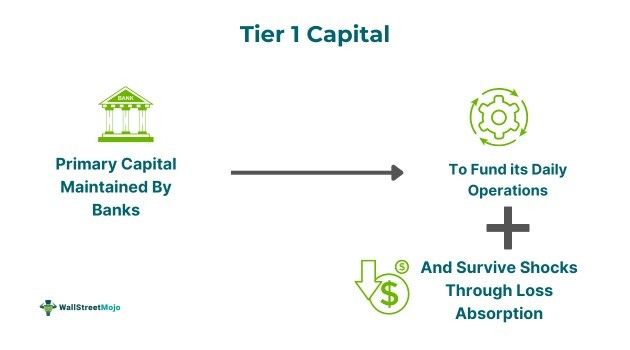
According to the Basel Committee of Banking Supervision (BCBS), tier 1 capital is the highest-quality grade of capital reserved by banks as a backup to handle sudden losses or repayments. It demonstrates their financial strength to survive the banking crisis and other shocks. Moreover, such funds are essential for a bank’s sustainability and stability in the long run.
Key Takeaways
- Tier 1 capital is a bank’s primary fund, which it utilizes to commence day-to-day business operations and cope with losses in case of a banking crisis.
- It includes paid-in capital and all disclosed reserves, including retained earnings and statutory reserves.
- The Basel III Accord, established by the Basel Committee of Banking Supervision (BCBS) in 2010, fixes a minimum required tier 1 capital limit, which is 10.5% of the total risk-weighted assets of a bank.
- It differs from tier 2 capital, which is the secondary, less reliable, and less liquid funds a bank maintains in the form of reserves.
Tier 1 Capital Explained
Tier 1 capital refers to a parameter in gauging a bank’s capital adequacy to maintain funds for its daily business activities and for surviving the banking or economic shocks through loss absorption. The banking systems of different nations adopt the Basel Accords set by the Basel Committee of Banking Supervision (BCBS) to maintain a particular tier 1 capital ratio for long-term sustainability and stability. This type of capital is of the highest quality grade, and Basel III requires the banks to maintain at least 10.5% of total risk-weighted assets as tier 1 capital.
The various components of Basel III tier 1 capital can be categorized as follows:
- Common Equity Tier 1 Capital: While CET1 comprises retained earnings, common stocks, and other comprehensive income, it excludes intangible assets. The higher the CET 1 ratio, the stronger the bank’s capitalization.
- Additional Tier 1 Capital: The AT1 includes components like perpetual tier 1 bonds and non-cumulative preferred stocks.
Perpetual bonds or AT1 bonds are capital instruments for banks where the investors never receive their principal sum but are eligible for a lifetime dividend payout. Also, these are considered as core capital along with the common equity tier 1 capital. Nevertheless, the capital adequacy analysis is essential for regulators, investors, and depositors to identify the financial soundness and stability of the banks in a changing economic scenario.
Examples
Let us now look at a few examples for a better understanding of Tier 1 capital, or core capital of a bank:
Example #1
Suppose XYZ Bank has Tier 1 Capital as follows:
- Common Equity Tier 1 Capital:
- Common Shares: $10 billion
- Retained Earnings: $3.7 billion
- Other Comprehensive Income: $2.3 billion
- Additional Tier 1 Capital:
- Non-Cumulative Preferred Stock: $1.9 billion
- Perpetual Tier 1 Bond: $0.8 billion
Determine the core capital. Also, find out if it passes the capital adequacy ratio test when the bank’s risk-weighted assets account for $200 billion.
Solution:
Core Capital = CET1 Capital + AT1 Capital
- = ($10 billion + $3.7 billion + $2.3 billion) + ($1.9 billion + $0.8 billion)
- = $18.7 billion
Required core capital of the bank = 10.5% of risk-weighted assets = 10.5% of $200 billion = $21 billion
However, with $18.7 billion of core capital, which is lower than the required rate of 10.5 %, XYZ Bank fails the CAR test. This makes it incapable of absorbing losses in case of banking crises or shocks and makes it difficult to execute its everyday business activities.
Example #2
On June 28, 2024, the major U.S. banks announced a rise in investor payouts after successfully clearing the Federal Reserve’s annual stress test. This test was conducted on 31 banks with assets worth a minimum of $100 billion to assess their capital adequacy. The results showed that the banks have a common equity tier 1 capital ratio of 9.9% in a severe economic scenario, which is impressively higher than the desired threshold of 4.5%.
Therefore, these renowned US banks made the following announcements after the core capital test results:
- JPMorgan Chase – Rise in quarterly dividend from $1.15 to $1.25, and stock repurchase plan worth $30 billion;
- Morgan Stanley – Surge in the quarterly dividend from $0.85 to $0.925 and a $20 billion stock repurchase program;
- Bank of America – Increase in quarterly dividends from $0.24 to $0.26;
- Citigroup – Surge in quarterly dividends from $0.53 to $0.56;
- Wells Fargo – Rise in quarterly dividend from $0.35 to $0.40; and
- Goldman Sachs – Increase in quarterly dividend from $2.75 to $3.00.
However, policymakers and economists are still unconvinced by the Federal Reserve’s models and call for higher public scrutiny due to the potential volatility in the banking scenario.
Tier 1 Capital vs Tier 2 Capital
While Basel III has stated regulatory requirements for capital adequacy, the same can be categorized into different tiers based on their roles and components, i.e., Tier 1, Tier 2, and Tier 3 Capital. Let us discuss the various dissimilarities between Tier 1 Capital and Tier 2 Capital below:
| Basis | Tier 1 Capital | Tier 2 Capital |
| Definition | It is the core funds that the bank keeps to fulfill its everyday business operations and as financial protection for absorbing losses in times of crisis. | It is an alternative source of funds for the banks that comprises less reliable and liquid assets. |
| Funding Source | Primary | Supplementary |
| Purpose | It aims to maintain the bank’s continuity and stability by facilitating day-to-day banking operations and ensuring the availability of immediate finances at the time of shocks to absorb losses effectively. | It serves as a secondary or additional cover for the banks to sustain losses; however, these funds are not meant for operational use. |
| Components | Disclosed reserves like statutory reserves and retained earnings, and paid-up capital | Undisclosed funds, hybrid capital instruments, revalued reserves, general loan reserves, and subordinated term debts |
| Regulatory Requirements as per Basel III | A minimum of 10.5% of the bank’s risk-weighted assets | Atleast 2% contribution to the total of 12.9% required capital adequacy ratio (CAR) |
| Calculation of Related Ratios | (Tier 1 Capital/Total Risk-Weighted Assets)*100 | (Tier 2 Capital/Total Risk-Weighted Assets)*100 |
| Reliability | High | Comparatively lower |
| Liquidity | High | Comparatively lower |
Frequently Asked Questions (FAQs)
Frequently Asked Questions
Do credit unions have tier 1 capital?
The Generally Accepted Accounting Principles (GAAP) state the net worth of credit unions’ retained earnings. These financial institutions maintain tier 1 capital in the form of equity capital.
Does tier 1 capital include unrealized gains and losses?
The BCBS Basel Accord allows the deduction of unrealized losses from tier 1 capital while considering unrealized gains; both are included in the Accumulated Other Comprehensive Income (AOCI).
How to increase tier 1 capital?
The banks need to have a higher tier 1 capital ratio to ensure a stable and sustainable position even in a challenging economic scenario. Therefore, the banks should maintain an optimal level of retained earnings, limit their risk-weighted assets, </p><p>Issue new stocks, enhance asset quality, and convert poor-quality capital.
What is unrestricted tier 1 capital?
The unrestricted tier 1 capital accounts for 80% of the overall tier 1, comprising paid-in subordinated liabilities and paid-in subordinated members contributions or preference shares.