


Part of our Data Science & Machine Learning guide
What Is Knowledge Engineering?
Knowledge Engineering is a field within artificial intelligence (AI) that focuses on designing and building knowledge-based systems. These systems aim to capture and represent human expertise, domain-specific knowledge, and problem-solving capabilities in a formal and structured manner so that computers can understand and utilize this knowledge to make intelligent decisions or solve complex problems.
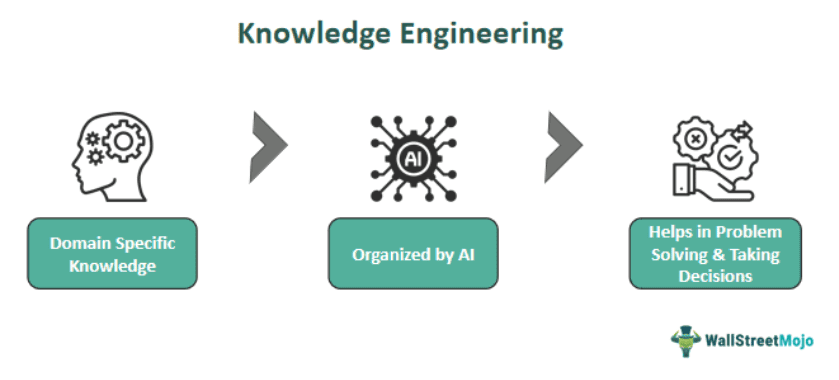
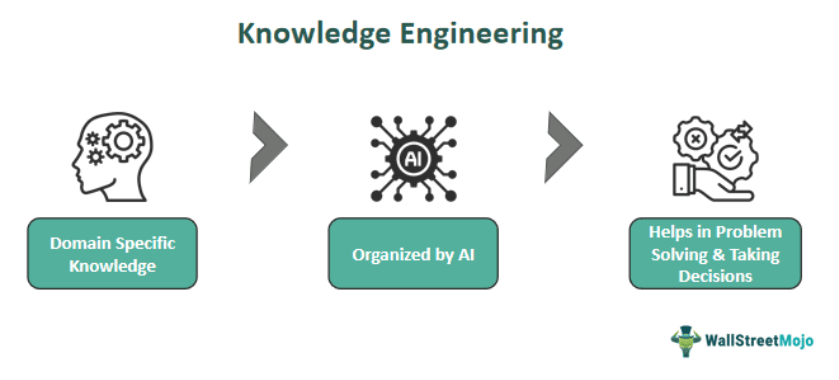
Converting acquired knowledge into a format that computers can understand and process. This involves choosing appropriate formalisms and languages to represent various types of knowledge, such as ontologies, semantic networks, frames, rules, and more, and organizing and structuring the knowledge to reflect the relationships between different pieces of information.
Key Takeaways
- Knowledge Engineering enables computers to use human expertise and domain-specific knowledge to make informed decisions and solve complex problems.
- It involves converting acquired knowledge into a structured and formalized format that computers can understand, like rules, facts, and relationships.
- Knowledge Engineering systems use logical inference and reasoning mechanisms to deduce conclusions and make decisions. It provides recommendations based on the captured knowledge.
- It finds applications in various fields, including medicine, law, finance, and industry, where expert knowledge is crucial for accurate decision-making.
Knowledge Engineering Explained
Knowledge Engineering is like teaching computers to be competent in a specific area, just like teaching someone to become an expert. It’s all about capturing what experts know and how they solve problems.
The origin of knowledge engineering traces back to the early days of artificial intelligence (AI) research in the 1960s and 1970s. During this period, researchers wanted to create systems that could exhibit intelligent behavior and solve complex problems like humans. However, they realized that capturing and representing human knowledge formally was crucial for achieving these goals.
As more expert systems were developed and the methodologies for capturing and representing knowledge matured, knowledge engineering emerged as a distinct discipline within AI. It involved the technical aspects of knowledge representation and the collaborative process of working with domain experts to extract and formalize their expertise.
While expert systems showed promise in specific domains, they often struggled with handling uncertainty, real-world complexity, and the need for constant knowledge maintenance. As AI research evolved, approaches like machine learning gained prominence, shifting focus from hand-crafted knowledge to data-driven approaches.
Examples
Let us understand it better with the help of examples:
Example #1
Suppose the “Smart Gardening Advisor” is a fictional knowledge-engineered system that assists gardeners in maintaining healthy gardens. This AI-powered application captures gardening expertise by interviewing experienced gardeners and organizing their insights into a knowledge database. It uses rules connecting factors like plant type, weather conditions, and soil characteristics to suggest personalized recommendations.
Gardeners input their garden details, and the system offers advice on watering schedules, plant care, and pest control. Validation by gardening experts ensures the advice’s accuracy. The system is implemented as a user-friendly app, where users interact with it by inputting garden information, and the app provides tailored guidance. Regular updates keep the app current with evolving gardening practices and challenges, making it a valuable tool for novice and experienced gardeners.
Example #2
A paper of 2015 introduced a cutting-edge spacecraft design approach rooted in knowledge engineering principles, a facet of artificial intelligence. This novel technique enhances the spacecraft’s overall design efficiency, quality, and automation. The study focuses on tackling knowledge representation, evaluation, acquisition, and inference challenges within spacecraft design.
Diverging from conventional methodologies, the research leverages ontology technology to establish a compact yet powerful spacecraft overall design knowledge base. By integrating this approach, the study simulates the designed power subsystem, validating the method’s efficacy and reliability in shaping spacecraft design.
This innovative study not only paves the way for transformative advancements in spacecraft design but also underscores the significant role of knowledge engineering in propelling the field of space technology forward. The successful simulation outcomes provide tangible evidence of the potential impact of knowledge-based spacecraft design methodologies.
Benefits
Knowledge Engineering offers several benefits in various fields by enabling computers to capture, represent, and utilize human expertise and domain-specific knowledge. Some of the key benefits include:
- Efficient Decision-Making: Knowledge-based systems can process vast amounts of information quickly and accurately. This leads to more informed and efficient decision-making in complex scenarios, such as medical diagnosis, financial analysis, and industrial processes.
- Consistency and Accuracy: Once expert knowledge is captured and formalized, knowledge-based systems apply rules and logic without being influenced by emotions or biases, leading to accurate and consistent results.
- Expertise Sharing: Knowledge engineering allows experts to share their insights and experiences with a broader audience. This is especially valuable when experts are scarce or located in remote areas.
- 24/7 Availability: Knowledge-based systems are not limited by working hours and can be accessed anytime, providing continuous support and guidance to users.
- Training and Learning: Knowledge-based systems can serve as interactive tutors in educational settings, offering students immediate feedback and explanations. They adapt to individual learning styles and paces.
Knowledge Engineering vs Machine Learning
A brief comparison between Knowledge Engineering and Machine Learning is given below:
Frequently Asked Questions (FAQs)
Can knowledge engineering systems be used in industries with complex regulations?
Yes, knowledge engineering systems can be tailored to adhere to specific regulations and compliance requirements. They can apply domain-specific rules to ensure that decisions and actions align with legal and regulatory frameworks.
How does knowledge engineering relate to cognitive computing?
Cognitive computing involves creating systems that simulate human thought processes, including learning, reasoning, and problem-solving. Knowledge engineering contributes to cognitive computing by providing the knowledge base and reasoning mechanisms that drive intelligent behavior in these systems.
How has the role of knowledge engineering evolved with advancements in AI?
With advancements in AI, knowledge engineering has evolved to work alongside data-driven approaches like Machine Learning. While earlier AI efforts heavily relied on explicit knowledge representation, modern AI often combines both approaches to create more robust and adaptable systems.
Recommended Articles
This article has been a guide to what is Knowledge Engineering. Here, we explain its process, examples, benefits, and comparison with machine learning. You may also find some useful articles here –