


What Is Structured Trade Finance (STF)?
Structured trade finance is a unique debt finance instrument cultivated by summing up different types of trade finance products to make one unified structure. It is observed as an alternative finance solution. Given its complex nature, it replaces conventional financing, especially in the case of cross-border transactions and developing countries.
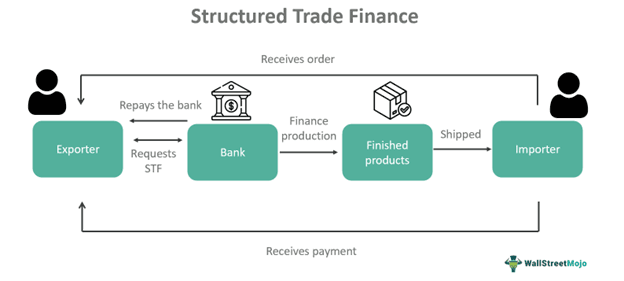
The core concept for opting for structured trade finance solutions is to eliminate the risks associated with cross-country trading and different jurisdictions. Trading houses, banks and financial institutions, including large corporations, commonly use it. Such financing structures help in diversifying funds and expanding the payment times.
Key Takeaways
- Structured trade finance is a complex business debt financing solution used for cross-country commodity trading by banks, trading houses and large corporations.
- The main types of structured trade finance solutions are receivable financing, warehouse financing, borrowing base facilities, pre-export finance and uncommitted trade facilities.
- It is majorly used in the commodity market sector by traders, producers and processors, including the end users and revolves around supply chain management.
- These debt financing instruments are alternatives to conventional lending schemes and procure the immediate and unusual needs of businesses.
How Does Structured Trade Finance Work?
Structured trade finance is a debt arrangement facility that is provided by banks, financial institutions, trading houses and other lenders in such a way that it satisfies the requirements of the lender, which in this case are mostly businesses from large corporations to small and medium enterprises. These faculties are tailor made to meet the needs of business owners tending to their immediate requirement of funds and cash flow management.
Structured trade finance products are complex and are solid agreements signed between the two parties, the lender and the borrower. The most important aspect of such financial instruments is that they reduce the risk involved in import and export transactions. Businesses strictly use these as an alternative to conventional loan arrangements because they do not fulfill the requirements that companies are looking to satisfy for their expansion, projects, management and business operations.
When a company facilitates structured trade finance, the bank as a lender provides them with multiple perks and benefits like fund diversification, self-liquidating deals, trade cycles, increasing and restructuring payment models, and collateral usage, which cannot be done with conventional forms of loan and debt.
Structured trade finance is heavily dependent on the supply chain management between the lender’s business and its clients and customers because, in most cases, the bank will get its money back after the payment from the importer has been received. It favors the borrower and provides a good security mechanism for their business operations.
Types
The main types of structured trade finance are –
- Pre-export finance – In this type of arrangement, funds are given to the exporter based on the confirmed orders they have from the importer or buyers. They use the funds received for working capital needs, which includes everything from raw materials purchase to any hidden or sudden costs and expenses, and it typically supports up to 80% of production.
- Warehouse trading – In this type of STF, the debt financing is taken by a manufacturer by putting the goods as collateral for the loan. These goods are then taken and kept at an approved warehouse by the lending party (bank or financial institution). Suppose the manufacturer fails to repay the loan or makes delayed payments. The bank can seize and sell the goods to cover the losses. Here, the approved warehouse is only approved by the bank and is managed by a third party.
- Uncommitted trade facility – An agreement is set between a borrower and a lender. In this agreement, the borrower agrees to offer a specific amount of money as a loan with no obligation to make it available. It is the same reason it is called an uncommitted trade facility. It is most convenient for small businesses that suffer from cash flow problems. This arrangement helps them to meet their immediate cash requirements and working capital for a short duration.
- Borrowing base facilities – Such STFs gauge the amount a borrower can obtain based on the value of their current assets’ pool held. The pool value varies based on the asset value, and so the loan value also varies based on the entire pool value.
- Receivables financing – In this type of structured trade finance method, the amount of money that a company can borrow is calculated from its outstanding bills and invoices. These invoices refer to the orders that are completed for which payment has not yet been received. So, in a nutshell, the company is showing its receivables to obtain debt, which it will use for business development, expansion, research and development and innovation.
Examples
Check out these following examples for a better idea:
Example #1
Suppose Rachel lives in New York and is a handbag exporter. Her handbags are very popular in the UK. She just received a big order from a UK buyer but she doesn’t have money to fulfill it. Upon searching she comes across structured trade finance. She goes to the local bank and explains her situation. The bank is ready to give her a loan based on the confirmed orders she has in hand right now.
Once she receives the funds, Rachel immediately starts the manufacturing process, from buying raw materials to setting up the production process, handling, storage and shipment. Everything gets done from the money she receives from the bank, so much so that 80% of the whole production is financed.
Once the order is fulfilled, she receives the payment from the UK buyer and then tends to the loan payments agreed as per the structured trade finance agreement. It is a simple example, particularly elaborating on the pre-export finance STF arrangement.
Example #2
In May 2023, Deutsche Bank was awarded for their excellent service in trade finance, lending and cash management throughout the Asia Pacific region. The bank was recognized for its outstanding work in corporate banking and finance solutions. The bank is also awarded with the title of the best transaction bank in China and India. All the accolades go to the bank given to their complex trade finance services, including supply chain solutions, project finance, structured export finance, natural resource finance and standard documentary credit.
Deutsche Bank is a German multinational investment bank that offers structured trade finance solutions along with other financial services. Its headquarters are in Frankfurt, Germany, and the bank has a dual listing on the Frankfurt Stock Exchange and the New York Stock Exchange. When it comes to STFs, the bank has a series of trade risk mitigation products coupled with tailor-made solutions for export trade finance.
Importance
The importance of structured trade finance is –
- It is attractive because, unlike loan agreements, the borrower’s capability is not given much consideration, and the focus is set on underlying business cash flows.
- Commodity-structured trade finance is majorly used for large quantities and trading of high value products.
- The complexity of structured trade finance makes it more attractive and relevant than traditional financing solutions.
- It is widely used for different forms of lending, such as STFs are used by businesses trying to maintain an independent structure.
- Structured trade finance agreements primarily focus on security documents and paperwork in terms of asset charges, debentures, property charges, guarantees, SBLCs and so on.
- It promotes bilateral trade relationships using non-standard security measures.
Frequently Asked Questions (FAQs)
Frequently Asked Questions
How is structured trade finance different from conventional lending?
Conventional lending is simple loans that are obvious to a loan term period, an interest rate, principal amount and monthly repayments. They do not have any form of extra benefit or perks to offer the borrower. In fact, they are quite similar to loans offered to individuals. But structured trade finance are customized debt instruments procured for the immediate and unusual needs of businesses and trade transactions.
Why should SMEs use structured trade finance?
The core reasons why structured trade finance can help small and medium enterprises are – – It offers better cash flow management compared to conventional loans and business financing solutions. – Given its complexity, it provides risk prevention in the market. – It is a better alternative for SMEs to thrive in the world economy. – STFs will allow small and medium enterprises to expand access and have good market development prospects and resources.
What is the difference between structured trade finance and trade finance?
Both structured trade finance and trade finance are financial products and instruments used by businesses to enable international trade and commercial transactions and activities. However, the distinguishing factor is that the former is a combination of multiple financial instruments to create a unified structure with complex agreements to satisfy specific trade requirements. In contrast, the latter is only limited to conventional methods such as bank guarantees and letters of credit.